


Key Takeaways
- IT outsourcing in Ukraine is growing again: computer services exports rose 4.1% in the first half of 2026, and 92% of AmCham Ukraine members remain fully operational despite the war.
- Defense tech, AI/ML, and EdTech lead Ukraine’s tech growth, with two Ukrainian-founded unicorns in early 2026 and rising demand for AI/ML, hardware, and embedded engineers.
- Hiring in Ukraine saves 54–62% on average base salaries compared with the US. After taxes, benefits, and fees, a team you own costs up to 50% below equivalent US hiring.
- Power outages, mobilization, and burnout are the main risks for 2026–2027. Backup power, employment models that support deferment, and realistic sprint loads keep delivery on track.
- Alcor builds engineering teams you own in Ukraine, with IT recruitment, EOR/COR, and operational support under one roof. Teams of 10–30 are operational within 90 days, and 98.6% of hires pass probation.
In the fifth year of Russia’s full-scale invasion, IT outsourcing to Ukraine is growing again. According to National Bank of Ukraine data shared by IT Ukraine Association, computer services exports rose 4.1% to $3.34 billion in the first half of 2026. Emigration intent among Ukrainian IT specialists fell from 51% to 40% in two years, per DOU’s 2026 salary survey.
Still, export charts don’t close your open roles. Say your search to hire a senior ML engineer in the US is in its fifth month, two backend roles sit open behind it, and your next release keeps sliding. Does outsourcing software development to Ukraine rescue that roadmap or add a new risk to it? Below I’ll give you the straight answer: the real safety of outsourcing to Ukraine in 2027, current outsourcing rates in Ukraine, the industries pulling ahead, and the point where owning your engineering team beats outsourcing it.
State of IT Outsourcing in Ukraine: 2022–2027
IT outsourcing in Ukraine survived the full-scale war and is growing again in 2026. Since 2022, the market has moved through four main stages:
- 2022: computer services exports hit a record $7.3 billion despite evacuations and office closures.
- 2023–2024: exports dipped, but headcount losses at the 50 largest IT companies shrank from 10,000 to about 2,000.
- 2025: exports grew 3.3% to $6.66 billion, and the outflow of specialists stopped.
- 2026: IT vacancies rose 14% year over year, and 92% of AmCham Ukraine members are fully operational.
Demand now centers on senior, AI/ML, hardware, and embedded engineers. Power outages and new mobilization deferment rules are the main risks heading into 2027.
Since 2022, IT outsourcing in Ukraine has moved through four stages: shock, slide, stabilization, and a cautious return to growth. The war never shut the market down, but it reshaped who hires, which skills are in demand, and how teams plan their work.
|
Year |
What happened |
What it means for your team |
|
2022 |
Computer services exports hit a record $7.3 billion, up 5.8% on 2021 |
Delivery held through the hardest months of the war |
|
2023–2024 |
Exports fell below the 2021 level in 2023. Headcount losses at the 50 largest IT companies shrank from 10,000 in 2023 to about 2,000 in 2024 |
The market cooled, but the talent base held |
|
2025 |
Exports grew 3.3% to $6.66 billion, and the outflow of specialists stopped for the first time in three years |
Team stability returned, which makes long-term hiring plans realistic again |
|
2026 |
IT vacancies in Q2 were 14% higher than a year earlier, with record demand for AI/ML roles |
Hiring is open, and specialized engineering skills lead demand |
Sources: UkraineInvest, Al Jazeera, dev.ua, Lviv IT Cluster, DOU – Top 50 IT companies, summer 2025, DOU – IT job market, Q2 2026
In 2022, the full-scale invasion put Ukrainian IT outsourcing through its toughest test. Wix had to evacuate a fifth of its engineering and customer support employees out of Ukraine in the first days of the war, as reported by Forbes. McDonald’s temporarily closed all of its 100+ Ukrainian locations. Within months, companies started coming back. In June 2022, Palantir CEO Alex Karp became the first head of a major Western company to visit Kyiv after the invasion and discussed opening a local office, according to Defense News. McDonald’s reopened in Kyiv that September, after seven months of war, as NPR reported.
The next two years were quieter and, for many companies, harder. Winning new clients got tougher once the first wave of wartime support passed, Al Jazeera reported in early 2024. The industry used that time to rebuild on firmer ground, and product companies kept growing their share among the 50 largest IT employers, according to DOU. The IT services industry in Ukraine ended 2025 as the country’s largest services exporter, per Lviv IT Cluster.
By 2026, international tech companies continue to outsource or run their own R&D centers in Ukraine, and the numbers explain why:
-
92% of AmCham Ukraine members surveyed in May-June 2026 are fully operational, and 87% continue or increase their investment, according to the American Chamber of Commerce in Ukraine.
-
Almost 70% of those companies have operated in Ukraine for more than 20 years, so the verdict comes from people who know the market from the inside.
-
24,500 tech specialists worked at Ukraine’s 50 largest product IT companies as of January 1, 2026, nearly the same as a year earlier, according to DOU’s annual ranking.
The market’s size has changed less than what it demands from Ukrainian software developers. Demand for senior specialists climbed back to pre-full-scale-war levels by the end of 2025, according to DOU. By mid-2026, the market runs on two clear tracks. For web and mobile work, the bench is deep: a front-end vacancy draws 198 applications on average, per DOU’s Q2 2026 analysis. Hardware and Embedded were among the five fastest-growing vacancy categories in the first half of 2026, and C++ openings rose 46% in six months, which shows where Ukrainian engineering is heading. If you outsource developers from Ukraine, both tracks are open to you.
As for the Ukraine outsourcing risk – it hasn’t disappeared, and two main issues shape it in 2026:
-
Energy. Government and military forecasts expect the 2026–2027 winter to bring longer and more widespread power outages than previous ones, according to dev.ua.
-
People. New criteria for granting IT employees deferment from mobilization took effect on July 3, 2026, and neither IT work nor Diia City residency guarantees one, as Buhgalter911 explains.
Both are manageable, and I’ll show how in the risk mitigation section below.
Nobody on the ground expects peacetime conditions soon. In the June AmCham survey, 80% of companies expect the business climate to stay in survival or resilience mode through the end of 2026. Lviv IT Cluster’s baseline is just as sober: 2026 should at least hold current export volumes, and long-range forecasts remain premature. Even so, 61% of AmCham members planned to expand their business in Ukraine in 2026, according to AmCham’s January 2026 survey. Whether you outsource software engineers from Ukraine or build your own team there, the market heading into 2027 rewards companies that plan for volatility instead of waiting it out.
Rising Tech Industries in Ukraine
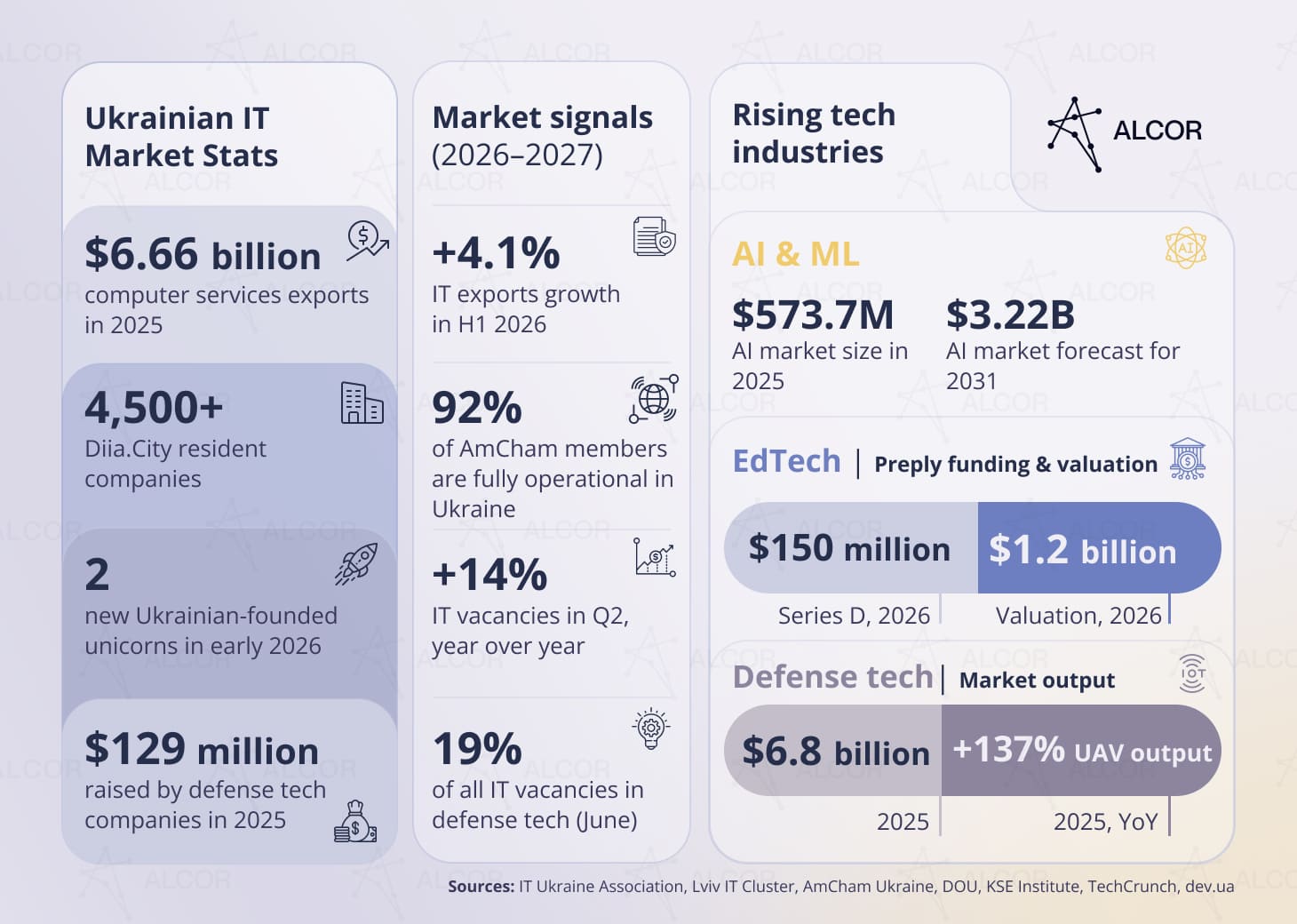
Defense tech, AI and machine learning, and EdTech are the fastest-rising tech industries in Ukraine in 2026. Two Ukrainian-founded companies, Preply and UFORCE, became unicorns in early 2026.
- Defense tech: high-tech defense segments reached about $6.8 billion in 2025, and more defense tech vacancies opened in the first half of 2026 than in all of 2025.
- AI and ML: Ukraine’s AI market reached $573.7 million in 2025 and could grow to $3.22 billion by 2031.
- EdTech: Preply and Grammarly earn 70–90% of their revenue abroad, and Preply runs a 150+ person office in Kyiv.
Ukrainian engineers in these industries build computer vision, autonomy, LLM, and consumer app products. Alcor has helped UFORCE expand its team.
Two Ukrainian-founded companies became unicorns within six weeks of each other in early 2026. Language-learning marketplace Preply raised $150 million at a $1.2 billion valuation in January, according to TechCrunch. In March, defense tech company UFORCE raised $50 million at a valuation above $1 billion, as reported by Interfax-Ukraine. Both are product companies built by software development teams from Ukraine, and both point to where the country’s engineering experience is concentrating. If you plan to outsource to Ukraine or build your own tech team there, the three industries below show which skills the market has been sharpening.
Defence tech
Defense tech has become Ukraine’s fastest-scaling engineering sector, and its 2025 results read like a hypergrowth startup’s board deck. High-tech defense segments reached an estimated $6.8 billion in 2025, and KSE Institute calls that figure conservative, because a large share of procurement runs through volunteer funds and military units directly:
-
Drones (UAVs): $6.3 billion in output, up 137% year over year, with at least 150 active companies.
-
Ground robots (UGVs): $252 million in output, a sixfold jump in a single year.
-
Electronic warfare: $220 million in output, more than triple the previous year.
-
Investment: about $129 million raised by Ukrainian defense tech companies, with the largest deals going to AI and software.
Hiring is growing just as fast. More defense tech vacancies appeared on DOU in the first half of 2026 than in all of 2025, 6,523 against 5,915, according to DOU’s defense job market analysis. In June 2026, defense roles made up 19% of every vacancy on the platform, per DOU’s Q2 review. Already, 5% of Ukraine’s IT specialists work in the sector, DOU’s 2026 IT portrait shows.
The skills these engineers build carry value far beyond the front line. Ukrainian teams work on computer vision for automatic target recognition, GPS-free visual navigation, jamming-resistant communications, and software that lets one operator coordinate a swarm of drones, KSE Institute notes. All of it is tested in real combat conditions, with development cycles measured in months. The same skills power robotics, autonomous vehicles, industrial IoT, and any product that has to keep working when the network drops.
Public markets have started paying attention. In February 2026, drone swarm software maker Swarmer filed for a Nasdaq IPO, the first Ukrainian defense tech company to do so, as reported by AIN. UFORCE, which brings together nine Ukrainian defense companies, is one of the sector’s players that Alcor has helped expand.
Artificial Intelligence & Machine Learning
If defense tech is Ukraine’s loudest growth story, AI is its widest. Ukraine’s AI market reached $573.7 million in 2025 and could grow 5.6-fold to $3.22 billion by 2031, a 33.3% CAGR, according to the IT Ukraine Association’s AI Industry Map. The same study points to four drivers:
-
Tech talent: more than 305,000 IT professionals, with universities producing about 40,000 technical graduates a year.
-
Battlefield R&D: computer vision has raised FPV drone accuracy from 30–40% to 70–90%, even under electronic warfare.
-
Local demand: 42% of adults and 70% of teenagers in Ukraine use AI tools regularly.
-
EU integration: Ukrainian companies now have access to Horizon Europe and Digital Europe programs.
Engineers in the field feel the tailwind. Specialists in data science, AI, ML, and data engineering are the most likely in Ukrainian IT to expect AI to make their roles more in demand, at 32%, according to DOU’s 2026 IT portrait. They also report one of the strongest financial positions in the industry. Employers keep adding seats, too. AI/ML vacancies grew 12% in Q2 2026 compared with Q1, per DOU.
Ukraine’s AI talent spans LLM-based analytics, computer vision, recommendation systems, and decision-support software, so the role you open matters. An AI Engineer shipping LLM features, an ML Engineer training vision models, and an AI/ML Engineer bridging research and production need different interview loops. That holds whether you choose Ukrainian software development outsourcing or an in-house AI team.
EdTech
Ukrainian EdTech shows that a global consumer product can be built with Kyiv at its core. Preply was founded by Ukrainians in 2013. Over the past 12 months it has been profitable on an EBITDA basis, and it plans to expand its AI capabilities, per TechCrunch. More than 150 of the company’s 750 employees work in its Kyiv office, which runs on generators and stays open 24/7.
-
Preply’s January 2026 Series D brought its total funding to about $299 million.
-
Leading Ukrainian EdTech companies such as Grammarly and Preply earn 70–90% of their revenue from international markets and have attracted more than $1.135 billion in investment, per the IT Ukraine Association.
-
Preply already uses AI for lesson summaries, homework assignments, and tutor recommendations.
EdTech teams show what product companies can expect from Ukrainian engineers: ownership of a consumer app end-to-end, from ML-driven matching to payments, for learners in 180 countries, as reported by Inventure. Preply runs its Kyiv office alongside Barcelona, London, and New York. That mix shows how nearshore software development in Ukraine fits into a European engineering organization.
Cost of Software Development Outsourcing to Ukraine in 2027
Hiring software engineers in Ukraine saves 54–62% on average base salary compared with the US, according to Alcor’s 2026 tech salary research. A senior AI Engineer earns about $105,000 a year in Ukraine and $222,000 in the US. Ukrainian base salaries grew 4.3–8% between 2025 and 2026. Total cost adds four layers:
- Statutory benefits.
- Payroll taxes: about 17.4% for the employer under FTE and about 0.8% under Diia.City gig contracts.
- Benefits package: about $1,800–$2,000 per engineer per year.
- Provider fees: a monthly EOR or COR fee plus a one-time recruitment fee of 15–25% of annual salary.
All-in, a team you own costs up to 50% below equivalent US hiring.
Ukrainian engineering salaries kept rising through the war, but not evenly. Between 2025 and 2026, average annual base salaries grew 4.3% for middle engineers, 6.1% for senior engineers, and 8% for leads, according to Alcor’s tech salary research. AI talent broke away from the pack: AI Engineers’ base salaries rose by more than half at every seniority level in a single year. Whether you’re pricing an outsourcing software development team from Ukraine or hiring engineers you own, here’s where the math starts.
|
Average Annual Software Developer Base Salary in Ukraine vs the US |
||||||
|
Middle |
Senior |
Lead |
||||
|
Position |
Ukraine |
USA |
Ukraine |
USA |
Ukraine |
USA |
|
C/C++ Developer |
$48,000 |
$97,200 |
$69,600 |
$150,000 |
$82,800 |
$183,000 |
|
Python Software Engineer |
$46,500 |
$130,800 |
$70,800 |
$165,000 |
$87,000 |
$207,000 |
|
Ruby Software Engineer |
$48,000 |
$127,800 |
$72,000 |
$174,000 |
$88,800 |
$216,000 |
|
Mobile Application Developer (iOS/Android) |
$46,800 |
$129,600 |
$66,000 |
$174,000 |
$82,200 |
$213,000 |
|
Blockchain Engineer |
$48,000 |
$132,000 |
$76,800 |
$171,000 |
$90,000 |
$201,000 |
|
Data Engineer |
$46,800 |
$144,000 |
$69,600 |
$177,000 |
$84,000 |
$207,000 |
|
DevOps Engineer |
$48,000 |
$126,000 |
$72,000 |
$168,000 |
$88,200 |
$201,000 |
|
AI Engineer |
$69,000 |
$162,000 |
$105,000 |
$222,000 |
$144,000 |
$252,000 |
|
ML Engineer |
$51,600 |
$162,000 |
$84,000 |
$222,000 |
$102,000 |
$252,000 |
|
LLM Engineer |
$54,000 |
$159,000 |
$86,400 |
$234,000 |
$102,000 |
$258,000 |
|
AI Product Engineer |
$56,400 |
$165,000 |
$84,000 |
$228,000 |
$102,000 |
$270,000 |
|
MLOps Engineer |
$57,600 |
$141,000 |
$90,000 |
$189,000 |
$105,600 |
$222,000 |
|
AI Platform Engineer |
$72,000 |
$168,000 |
$111,000 |
$228,000 |
$156,000 |
$270,000 |
|
AI Infrastructure Engineer |
$78,000 |
$174,000 |
$123,000 |
$243,000 |
$168,000 |
$288,000 |
|
AI Prompt Engineer |
$48,000 |
$126,000 |
$75,000 |
$168,000 |
$102,000 |
$198,000 |
|
According to Alcor’s internal tech salaries research (as of October 2026) |
||||||
Across these 15 roles, hiring in Ukraine saves about 62% on base salary at the middle level, 57% at senior, and 54% at lead. Depending on the role, the savings range from 42% to 68%. Vendor rates for IT outsourcing services in Ukraine are built on base salaries plus the provider’s margin, so the table also marks the floor of any quote you’ll receive. For a team you own, base salary is only the first line of the budget – but the realistic total comes to up to 50% below equivalent US hiring.
Employment cost
A base salary is the number a candidate sees. Your finance team sees four more layers: statutory benefits, payroll taxes, an optional benefits package, and provider fees. Ukrainian labor law sets the first layer, and every full-time employee is entitled to:
-
Vacation: 24 calendar days
-
Overtime pay: 200% of the regular hourly rate, including work on public holidays
-
Sick leave: the employer covers 50–100% of salary for the first 5 calendar days, and the Pension Fund of Ukraine covers the rest
-
Well-being days: many IT employers voluntarily add 2–5 extra days off
-
Maternity leave: 126 calendar days (70 before birth and 56 after, or 70 after for complications or multiple births), paid by the Pension Fund of Ukraine
-
Paternity leave: 14 days
-
Additional parental leave: 10–17 days for parents of two or more children under 15
-
Adoption leave: 56 days
-
Public holidays: 11 paid public holidays (2026)
Taxes depend less on the engineer and more on the contract you choose. Ukraine offers three common models: standard full-time employment (FTE), B2B contracts with individual entrepreneurs, and gig contracts inside Diia.City. Diia.City is a special legal and tax regime for tech companies, and nothing quite like it exists elsewhere in Europe. By mid-2026, it united more than 4,500 companies, and of the 175,000 IT professionals at resident companies, only 5% work under the B2B model, according to dev.ua. Global names such as Grammarly, Samsung, and Visa are among its residents, per Digital State UA. Here’s how the three models compare:
|
Model |
Employer’s share |
Employee’s / Contractor’s share |
|
FTE |
Social security contribution: 22%, capped at a maximum base of UAH 172,940 (~$3,955), so the maximum monthly contribution is UAH 38,046.80 (~$870) Effective employer rate: ~17.4% on top of a $5,000 salary |
Effective employee rate: ~23% of a $5,000 gross salary |
|
B2B |
Not mandatory – no employer-side social security obligation |
Effective rate: ~6.88% of a $5,000 gross remuneration |
|
Diia.City Gig Contract |
Social security contribution: UAH 1,902.34 (~$44) per month (22% of the statutory minimum salary) Effective employer rate: ~0.8% on top of a $5,000 salary |
Effective rate: 10% of a $5,000 gross remuneration |
Taxes and statutory benefits are the legal minimum. What helps keep engineers for years is the next layer: it is optional, but Ukrainian tech companies compete on benefits packages that strong candidates now treat as standard:
-
Private health insurance
-
English language courses
-
Professional development (training and conferences)
-
Wellness benefits (gym and/or mental health support)
-
Home office allowance, IT equipment, or coworking allowance
-
Corporate events and employee gifts
-
Military leave and support programs for active service members and veterans
Budget about $1,800–$2,000 per engineer per year for the full package.
The last layer depends on how you employ your team. Companies setting up software R&D centers with their own legal entity skip provider fees, but they take on entity registration, local accounting, and compliance themselves.
Without an entity, you work through an Employer of Record in Ukraine for full-time employees or a Contractor of Record in Ukraine for B2B engineers. Either way, a monthly fee buys you the legal backbone: compliant contracts, a payroll outsourcing service in Ukraine, tax filings, statutory benefits, IP assignment clauses, and day-to-day HR and legal support. Most providers price this as a flat fee per engineer or a percentage of gross salary.
Hiring is a separate, one-time cost. A partner handling your IT recruiting in Ukraine typically charges 15–25% of the role’s annual base salary per successful hire. That fee covers sourcing, screening, technical assessment, and the shortlist you interview from. Expect AI and ML roles to land near the top of that range, since vetting them takes deeper technical evaluation.
How to Mitigate Risks When Outsourcing to Ukraine
The main risks of outsourcing to Ukraine in 2026–2027 are location, power outages, mobilization, and burnout, and each one can be planned for:
- Location: choose Kyiv or western and central cities such as Lviv, and offices with fast bomb shelter access. 66% of Ukrainian IT specialists already work fully remotely.
- Power outages: fund backup power, check office autonomy, and set async rules for outage windows.
- Mobilization: employ engineers under the Labor Code or Diia.City contracts, which support deferment, and ask your EOR or PEO about critical-enterprise status.
- Burnout: 38% of Ukrainian IT specialists feel burned out, so keep sprint loads realistic and offer mental health support.
Alcor handles employment, compliance, and office setup for engineering teams in Ukraine.

Prioritize well-defended locations
Start with the map. In 2026, 46% of Ukraine’s IT specialists live in Kyiv, 18% in Lviv, and 6% in Dnipro, according to DOU’s 2026 IT portrait. Kyiv has the country’s deepest talent pool and some of its strongest air defense. Western and central cities such as Lviv, Uzhhorod, Chernivtsi, Ternopil, and Vinnytsia sit farthest from the front line. No Ukrainian city is fully out of reach for drones and missiles, so the real question is how fast your team can get somewhere safe.
If you’re planning offshore software development centers in Ukraine, choose the office for its shelter access, not its view. In eastern and southern cities like Dnipro, Odesa, or Kharkiv, default to remote work or rent space with a bomb shelter one elevator ride away. Remote work is already the norm: 66% of Ukrainian IT specialists work fully remotely, the same DOU study shows.
Brace yourself for power outages
The winter of 2026–2027 is projected to be harder than the previous ones. Government and military forecasts point to longer and more widespread power outages, according to dev.ua. The good news is that Ukraine’s IT companies have been through this three winters in a row, and their playbook is mature:
-
Offices run on generators with several independent internet channels.
-
Starlink terminals and power stations are part of employees’ hardware budgets.
-
One large employer gave up to 1,000 people $1,000 each to relocate to safer, better-powered locations last winter.
-
Two of the companies dev.ua surveyed report no significant rise in backup power costs compared to the winter of 2024–2025, because they built that infrastructure in 2022.
For your own team, translate this into three decisions. Fund backup power through the home office allowance, so a blackout doesn’t turn into a sick day. Ask how many hours your office or coworking space can run on its own power. Agree on async rules for outage windows, so a dropped connection doesn’t stall a sprint.
Keep your team eligible to work
This is the risk most foreign companies overlook. Male engineers of conscription age can keep working only if they hold a deferment from mobilization, and deferment depends on how they’re employed. In 2026, 24% of male IT specialists in Ukraine hold a deferment through their IT employer, up from 13% a year earlier, according to DOU. The share with no deferment or postponement fell from 42% to 30%.
The employment model drives those numbers. 44% of reserved IT specialists are employed under the Labor Code, and another 24% work under Diia.City contracts. That’s a big reason the share of B2B contractors in Ukrainian IT dropped from 87% in 2022 to 49% in 2026. With the new deferment criteria in force since July 2026, ask any PEO in Ukraine or EOR you consider three direct questions:
-
Can it apply for critical-enterprise status?
-
How many of its employees does it currently reserve?
-
What happens to your engineers if the criteria change again?
Plan for the cases where deferment isn’t possible, too. 30% of IT specialists serving in the army receive payments from their IT employer, the same DOU study shows. Many companies also keep the job open until the engineer returns. A clear military leave policy protects both your engineers and your codebase continuity.
Talk about burnout, not just deadlines
Ukrainian engineers have kept shipping through four years of war, and that resilience has a cost. 38% of IT specialists in Ukraine feel burned out at work, and 14% feel it very strongly, according to DOU’s 2026 portrait. Those hit hardest are almost three times as likely to work more than 45 hours a week: 27% against 10% of those who feel fine.
Treat this as an engineering management problem, with three moves:
-
Keep sprint loads realistic.
-
Watch overtime the way you’d watch error rates.
-
Make mental health support a real benefit, not a line in the offer letter.
A five-minute check-in after a night of air raid alerts costs nothing. Losing a senior engineer to exhaustion costs a quarter of your roadmap.
Hiring IT Experts in Ukraine Can Be Fast and Easy with Alcor!
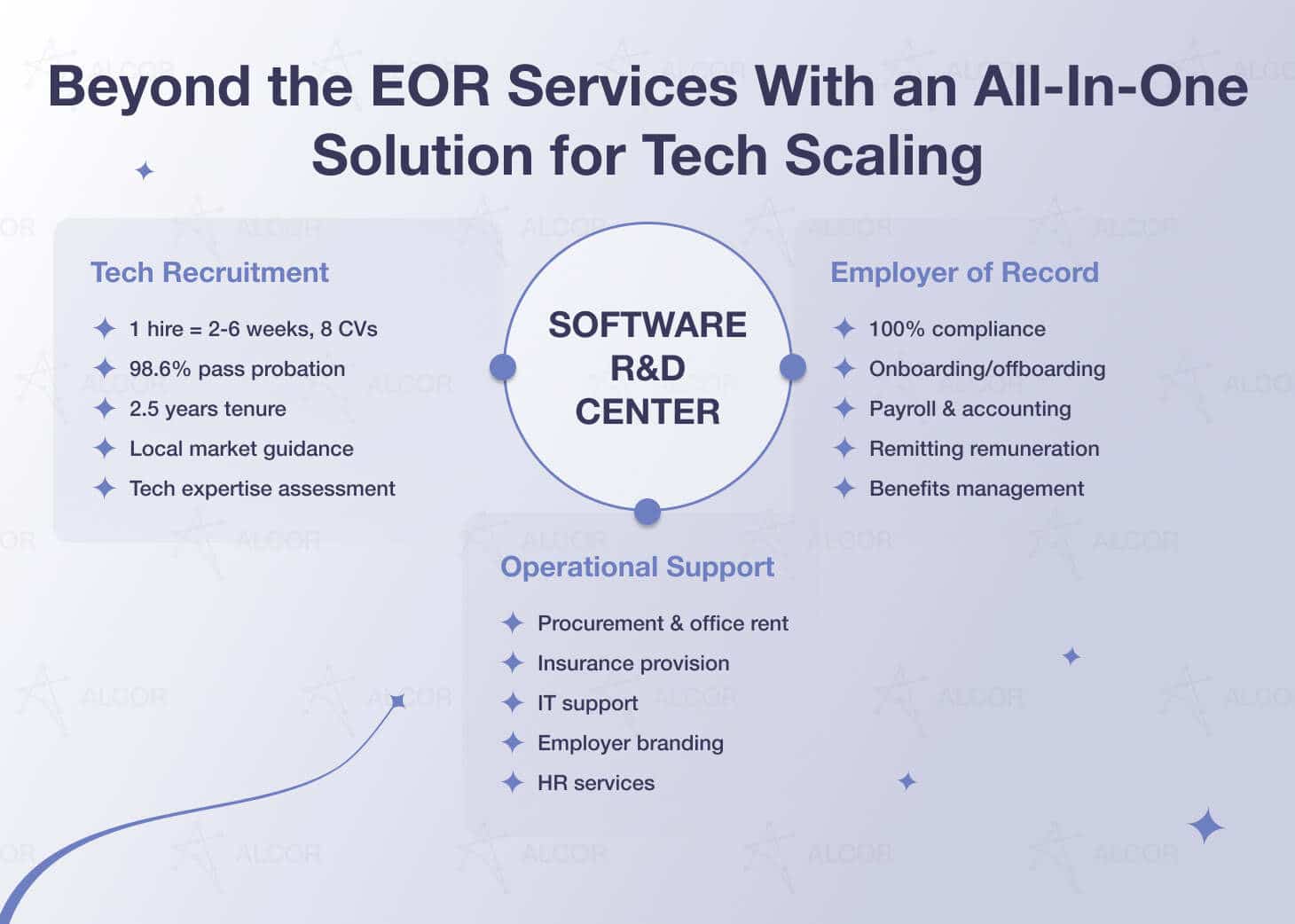
Alcor builds software R&D centers in Eastern Europe and Latin America for US and European tech product companies. Engineers report to the client’s CTO, ship on the client’s roadmap, and build client-owned IP. Alcor provides tech recruitment, EOR/COR, and operational support under one roof. Teams of 10–30 are operational within 90 days.
Most CTOs who reach Alcor have already tried the obvious route. The US search has dragged on for months, senior engineers spend their afternoons in interview loops, and the roadmap waits on roles that stay open.
Alcor builds dedicated engineering teams in Ukraine, across Eastern Europe, and in Latin America for US and European tech product companies. Your engineers report to your CTO, ship on your roadmap, and build IP that belongs to you. Alcor handles everything around them under one roof: tech recruitment, EOR/COR, and full operational support for your software R&D center. Teams of 10–30 are operational within 90 days.
If you need to outsource software development to Ukraine for a scoped build with a handover at the end, classic IT outsourcing will likely serve you better, and Ukrainian outsourcing firms are built for exactly that job. Alcor’s model fits tech product companies that want engineers who stay, learn the codebase, and grow with the roadmap.
Backstory (ex-People.ai) learned what a fragmented setup costs before it ever reached Alcor. The San Francisco company builds an AI data platform for go-to-market teams, used by Zoom, Cisco, and Nvidia. Backstory had already picked Eastern Europe for its next engineering hub, drawn by senior AI, data science, and backend talent at up to 50% below equivalent US hiring. Execution stalled. Several providers split recruitment, legal, and operations between them, some duplicated each other’s work, and none owned the result. Deadlines slipped, and in the AI market, every delayed hire means a delayed feature.
Backstory moved its entire setup to Alcor and got:
-
One accountable partner across IT recruitment, EOR, legal, finance, and office operations, so leadership hours went back into the product.
-
A custom legal entity structure that keeps the team compliant under both US and Ukrainian law and uses Ukraine’s IT tax incentives to save on employment costs from day one.
-
A ready-to-work office in four weeks, found, leased, and equipped without a single leadership hour spent on landlords or procurement.
-
Senior engineers with deep programming expertise in Python, Scala, Java, Kafka, and Big Data, each pre-screened by Alcor’s 40 in-house recruiters for technical depth and product mindset.
-
Hard-to-fill roles closed, from Staff Backend and Platform Engineers to AI specialists.
Alcor hired 25 engineers in the first 12 months and 25 more later, bringing Backstory’s team to 50. 98.6% of them passed probation, and average tenure is 2.5+ years. The partnership began in 2017 and carried Backstory from startup to a $1.1 billion valuation in 2021. Oleg Rogynskyy, Backstory’s Founder & CEO, sums up the result: some of those engineers “have become our core senior or staff AI engineers now.”
Backstory is in good company. Pindrop, Sift, Ledger, Dotmatics, BigCommerce, ThredUp, and other unicorn-grade tech companies have also built engineering teams with Alcor. Most of them chose to expand the team to Eastern Europe, and every one of those teams reports to its own CTO.
Your roadmap can’t wait another hiring cycle. Let’s build your team.
FAQ
How has the IT outsourcing industry in Ukraine changed since 2022?
IT outsourcing in Ukraine has gone through four stages since 2022: shock, slide, stabilization, and a cautious return to growth. Computer services exports hit a record $7.3 billion in 2022, dipped in 2023–2024, and grew to $6.66 billion in 2025. The market’s structure has also shifted. Product companies now employ the largest share of Ukrainian IT specialists, and demand has moved away from low-cost offshoring toward senior, AI/ML, and defense tech engineering.
How do IT outsourcing partners in Ukraine guarantee sprint continuity and infrastructure stability during power or network disruptions?
No provider in Ukraine can guarantee zero disruption, but established tech employers keep sprints running with layered backup infrastructure. Offices run on generators and several independent internet channels, engineers use Starlink terminals and power stations at home, and some companies help teams relocate to better-powered cities during outages. Most companies built this setup in 2022, so their backup costs have stayed stable. For your own team, fund home backup power through benefits, check how long your office runs on its own power, and agree on async rules for outage windows.
What happens if a key developer is mobilized into military service?
An engineer employed under a Ukrainian labor contract keeps their position by law while serving, and many IT employers continue partial payments or keep the role open until they return. Prevention matters more. Engineers employed under the Labor Code or Diia.City contracts can qualify for deferment from mobilization, and the share of IT specialists holding one has nearly doubled in a year. To protect delivery, choose an employment model that supports deferment, ask your EOR partner about its critical-enterprise status, and make sure at least two engineers know every critical system.
How do software development outsourcing costs in Ukraine compare to other tech hubs in the region?
Ukraine offers the deepest salary savings among Eastern Europe’s main tech hubs. A senior engineer in Ukraine earns about $82,200 a year in base salary, compared with about $88,500 in Bulgaria, $95,100 in Romania, and $100,400 in Poland. Compared with the US, savings exceed 50% at every seniority level. Diia.City gig contracts also reduce the employer’s social contribution to about $44 per month. Vendor rates for team augmentation add a margin on top of these salaries, so building your own team keeps more of the savings. For European companies, Ukraine also works as a nearshoring option, just one hour ahead of Berlin and Warsaw.
How would you rate this article?
Alcor is Your Trusted Scaling Partner
for expansion
support