


Key Takeaways
- The six best alternatives to nearshore software development outsourcing in 2027 are a software R&D center, build-operate-transfer (BOT), an owned legal entity, EOR and COR platforms, staff augmentation, and freelance or crowdsourcing platforms. Traditional IT outsourcing is already losing ground: its global contract value fell 5.6% in the first half of 2026, according to the ISG Index.
- VC- and PE-backed late-stage companies and public or pre-IPO companies get the most from a software R&D center. It delivers a fully owned team without a local entity, forecastable costs, and IP that stays with the company through funding rounds, acquisitions, and exits.
- Smaller teams testing a new market are often better served by an EOR or COR platform, while short-term or fixed-scope projects fit staff augmentation, freelance platforms, or classic project outsourcing.
- Latin America and Eastern Europe add 4.3M+ tech professionals and 55–61% savings on senior base salaries compared with the US. Latin America offers real-time overlap, and Eastern Europe offers round-the-clock development. Geography alone doesn’t remove vendor risks, though, so only an owned team keeps control and IP in-house.
- Alcor builds software R&D centers across Latin America and Eastern Europe, combining tech recruitment, compliant EOR or COR employment, and 360-degree operational support under one contract. Teams of 10–30 are operational within 90 days, 98.6% of hires pass probation, and engineers stay for 2.5+ years on average. There are no setup or buy-out fees, and the team can move under your own roof at any time.
6 Best Alternatives to Nearshore Software Development Outsourcing in 2027
The six best alternatives to nearshore software development outsourcing in 2027 are a software R&D center, the build-operate-transfer (BOT) model, an owned legal entity, EOR and COR platforms, staff augmentation, and freelance or crowdsourcing platforms. These options differ in who employs the engineers, who owns the IP, and how fast the team launches. A software R&D center, BOT, or an owned entity suits product companies building long-term teams. The rest fit small teams or short-term work.
Traditional IT outsourcing is losing ground. According to the ISG Index, IT outsourcing contract value fell 5.6% worldwide in the first half of 2026, to $15.5 billion. In the Americas, the drop reached 23% in the second quarter, led by application development and maintenance.
For product companies moving away from vendor contracts, the question becomes which model takes their place. Here are the six best outsourcing alternatives for nearshore software development in 2027 and how they compare on ownership.
1. Software R&D Center
A software R&D center is a fully owned engineering team in another country, built on a provider’s local employment infrastructure. The provider recruits, employs, and supports the engineers, while your CTO or VP Engineering manages the team, and the IP belongs to your company from day one.
The model covers three layers under one contract. The first is hiring for specific engineering roles. The second is employment under EOR or COR, depending on the country, with local payroll, taxes, and benefits. The third is local operations such as hardware, IT support, and office setup.
Your engineers join your standups and work in your tools. Communication runs directly between your engineering leads and the team, with no vendor layer in between.
And Alcor does just that. Alcor builds software R&D centers across Latin America and Eastern Europe for product companies from the United States and Europe. With Alcor, you can hire top-10% engineers on the market, employ them compliantly, and get 360-degree operational support, all under one roof. You stay focused on the product while Alcor powers the infrastructure.
PX, a PE-backed customer acquisition platform from New York, came to Alcor in 2020 with 13 engineers working through an outsourcing provider. Here’s how each part of the model worked for PX:
- Contractor of Record: all 13 engineers moved onto their own B2B contracts in about 3 weeks, and product work never stopped. When specialists relocated, their contracts moved with them at no cost to PX. A dedicated Customer Operations Specialist serves as PX’s single point of contact, knows the product and the team, and responds within 1 business day.
- Silicon Valley-grade recruitment: the team more than doubled to 28 specialists. Most of the roles Alcor hired for were senior: .NET tech leads, senior C++ developers, DevOps, QA automation, and Angular engineers. One Operations & Automation Specialist was placed in 7 weeks.
- Operational support: one monthly invoice covers eight functions in each country, from payroll to IT procurement. Alcor also offers on-demand employer branding and helps formalize stock options for local teams.
Best fit: product companies that need 10+ engineers and want to own the team without opening an entity. For one or two engineers you’ve already found, an EOR or COR platform is simpler.

2. Build-Operate-Transfer (BOT)
Build-operate-transfer (BOT) is a model in which a provider builds an engineering center in another country, runs it for an agreed period, and then transfers the team and operations to the client. The company gets a working center without setting it up itself and owns the center at the end.
The trade-off sits in the middle phase. During the operation stage, the provider usually employs the engineers and runs daily operations, so team culture and retention depend on the vendor. The transfer typically requires the client to have a legal entity ready to take over the contracts, plus an agreed-in-advance transfer fee.
Best fit: BOT fits companies planning a large permanent center that want a guided launch. Companies weighing BOT often compare it with the nearshore software delivery center model and the offshore delivery center model, where the provider runs the center long term. When the goal is ownership from day one, a software R&D center gets there without a transfer stage.
3. Own legal entity or captive center
An owned legal entity, or captive center, is a subsidiary a company registers abroad to employ engineers directly. Captive centers are the classic form of offshoring. For decades, large companies offshored whole functions to distant countries through their own subsidiaries, with mixed results, as these examples of offshoring show.
The model gives the most direct control over hiring, IP, and operations. It also puts every legal, payroll, and compliance obligation on the company.
However, the setup eats budget, time, and your leadership team’s attention, so competitors ship product while you’re still on step one. According to Alcor’s legal team research, incorporation alone costs $5K- $25K+, and a full team launch takes 4–6 months.
Best fit: a captive center suits companies with established internal capacity that are ready to run local legal, payroll, and HR operations themselves long term. Exiting one is expensive: dissolution, legal work, severance, and administration. Alcor’s free team transfer lets a company start with an R&D center and move engineers into its own offshore captive center whenever it chooses.
4. EOR and COR platforms
An Employer of Record service provider (EOR) legally employs engineers in another country on a company’s behalf. It handles contracts, payroll, taxes, and benefits.
A Contractor of Record service provider (COR) does the same for independent contractors. Both let a company hire abroad without a local entity.
The limit is sourcing. A typical EOR or COR platform covers employment only, so the company still has to find, vet, and hire every engineer itself. That works for one engineer your CTO has already chosen. For a team of 20 senior engineers, the sourcing load lands back on your internal recruiters and engineering leads.
Best fit: EOR and COR platforms suit market testing, small teams, and companies that already run their own hiring engine or work with a separate recruitment vendor. Some companies don’t want to stitch together a recruiter, an EOR, and an operations provider. For them, Alcor adds full-cycle recruitment on top of tech-exclusive EOR and COR, so the hiring engine and the employment infrastructure sit with one partner.
Need to hire independent contractors? R&D center solution also covers Contractor of Record (COR).
5. Staff augmentation and outstaffing
Staff augmentation, or outstaffing, is a model in which a vendor provides engineers who join the client’s team but stay on the vendor’s payroll. The company directs the daily work, and the vendor remains the employer.
The advantages are speed on a single skill gap and no employment administration. The downsides show up over time – engineers can rotate between clients, product context leaves with them, and moving the engineers in-house usually triggers buyout or non-solicitation fees.
Yourshoring is a variant that tailors a remote team to one client’s needs. It narrows the cultural gap, but the vendor stays the employer, and the extra customization usually costs more.
Best fit: Staff augmentation fits a short-term gap in a specific stack. For a team expected to stay two years or longer, ownership matters more than the speed of the first hire. Read more on outsourcing vs outstaffing.
6. Freelance and crowdsourcing platforms
Crowdsourcing in software development means assigning tasks or projects to a large group of independent specialists, usually through an online platform. Freelance marketplaces work the same way for individual contractors. Both open a global talent pool for short, well-defined tasks.
The risks grow with the scope. Freelance developers often work for several clients, so availability, IP assignment, and security controls vary from person to person.
Best fit: Freelance and crowdsourcing platforms fit prototypes and one-off tasks. A core product team needs compliant contracts and engineers who stay.
Looking for the best way to hire offshore developers? Or looking to hire nearshore Laravel developers in particular? Alcor’s got you covered!
4 Best Alternatives to Outsourcing by Business Type
The best alternatives to outsourcing depend on the business type: company stage, ownership structure, and how long the engineers are needed. VC- and PE-backed late-stage product companies and public or pre-IPO tech companies get the most from a software R&D center with full team and IP ownership. Smaller teams testing a new market often fit an EOR or COR platform. Short-term projects have three practical options: staff augmentation, freelance platforms, or classic project outsourcing.
Best for VC- and PE-backed late-stage companies
For VC- and PE-backed late-stage product companies, a software R&D center is the strongest alternative to outsourcing. A new round or a value creation plan raises the hiring target to 10–30 engineers, and the local market rarely fills those roles at the pace the roadmap needs. Senior candidates weigh several offers at once. Every month of searching pushes releases back or eats into a fixed hold period.
An R&D center turns that budget into a working team within a quarter, without the months it takes to incorporate abroad. The engineers build on the company’s own roadmap and codebase, and the IP stays with the company through the next round, an add-on acquisition, or an exit. Outsourcing can cover a short gap, but the product knowledge leaves when the contract ends.
Backstory (ex-People.ai), UFORCE, EGYM, and Ledger already run fully owned R&D centers abroad. Hear it straight from the tech leaders who scaled their engineering teams this way.
Best for public and pre-IPO tech companies
For public and pre-IPO tech companies, a software R&D center adds engineering scale with the predictability that forecasts and audits require. Engineering costs land on one annual line the CFO can forecast. IP is assigned from day one, and onboarding, access, and offboarding follow the company’s own security policies.
Enterprise-grade controls matter most at this stage. Engineers on compliant local contracts keep documentation ready for audit and due diligence, which freelance agreements rarely do. Building in a second region alongside the US team also keeps the roadmap from depending on a single country. The international team adds to the US engineering organization rather than replacing it.
Best for smaller teams testing a new market
For companies hiring a few engineers to test a new market, an EOR or COR platform is often enough. When the company already runs its own sourcing, the platform covers contracts, payroll, taxes, and benefits without a local entity. The team can grow into a full R&D center once the market proves itself.
The trade-off shows once hiring volume runs high, because every developer search still goes through the company’s own recruiters. Starting in locations with deep talent pools, such as Mexico or Poland, makes that later step easier.
Already have engineers abroad and only need outsourced payroll for tech companies? Alcor handles that too, without the recruitment layer.
Best for short-term and fixed-scope projects
For short-term or fixed-scope work, staff augmentation and freelance platforms are the practical alternatives. Staff augmentation brings in remote specialists for a temporary skill gap, such as a cloud migration or a security review, without permanent hires. Freelance and crowdsourcing platforms suit one-off tasks with a clear brief and a clear finish line.
Classic project outsourcing still has its place here. Some companies need to develop web or mobile apps outside the core product, or launch a custom website. They can outsource the build and get a finished deliverable without hiring a team. The approach holds as long as nobody needs the code knowledge after handover.
The same logic applies outside engineering, even when the work is ongoing. A BPO company can take over standardized functions such as payroll, customer support, or data entry. Business process outsourcing services work well there because those processes follow fixed rules and need little product context.
IT Onshoring vs Nearshoring vs Offshoring
Onshoring, nearshoring, and offshoring differ mainly in distance. Onshoring keeps software development in your own country, nearshoring moves it to a nearby country in a similar time zone, and offshoring moves it to a distant country. For a company in the United States, onshoring gives the closest time-zone fit but the tightest talent market and highest salaries. Nearshoring to Latin America and offshoring to Eastern Europe add 4.3M+ tech professionals combined and 55-61% savings on engineers’ base salaries.

Comparing onshoring vs offshoring for an engineering team comes down to four factors:
- Talent availability: The size of the local talent pool decides how fast senior and specialized roles get filled. In the offshoring vs nearshoring comparison, both regions add millions of engineers to the pool of offshore tech talent available to US companies.
- Costs: Salary levels set how many engineers the budget covers. Kort Syverson, a principal at Deloitte, calls cost “a deteriorating value proposition,” so the offshoring vs onshoring decision rests on talent and team continuity as much as on savings. Country benchmarks, such as software developer salary rates in Argentina, show how far the budget goes in each market.
- Market outlook: The pace at which international companies establish their own operations in a destination shows how attractive it is and where its talent market is heading. A fast-growing market keeps adding engineers with international product experience, including AI and ML specialists, so the team can keep scaling over the years.
- Time zone management: Shared hours decide how much of the work happens in real time and how it moves between locations. The nearshoring vs offshoring trade-off sits here. A nearshore software development team in Latin America shares more working hours with the US. Eastern Europe adds round-the-clock coverage, one of the classic offshoring benefits.
Here’s a quick look at how offshoring vs onshoring vs nearshoring compare for a company based in the USA, with senior engineering roles as the benchmark.
| Aspect | Onshoring (United States) | Nearshoring (Latin America) | Offshoring (Eastern Europe) |
| Talent availability | 69% of US employers struggle to find skilled talent; about 106,100 software developer openings a year | 2.3M+ tech professionals, including 974,500 in Mexico | 2M+ tech professionals, including 778,800 in Poland |
| Average senior base salary | $170,660/year | $66,300/year | $76,880/year |
| Capability center growth (2026–2031) | $72.45B to $95.12B (5.60% CAGR) | $26.55B to $40.33B (8.74% CAGR)* *South America | $27.11B to $41.97B (9.18% CAGR) |
| Time zone management | Same working hours and instant feedback | 0–2 hours from New York, with full or near-full workday overlap for real-time collaboration | 6–7 hours ahead of New York, with 2–3 shared morning hours and round-the-clock product development as US and Eastern European teams hand work off across time zones |
| Best for | Roles that need on-site presence in the US | Teams that collaborate with US product teams in real time | Large teams, specialized engineering talent, and continuous development cycles |
| Sources: ManpowerGroup, US Bureau of Labor Statistics, Mexico’s Ministry of Economy, Eurostat, Mordor Intelligence (US, South America, Central and Eastern Europe); salaries from Alcor’s 2026-2027 engineer compensation research (average annual base salaries, senior level). | |||
Not sure which Latin American market fits your team? Compare nearshore outsourcing in Mexico, nearshore software outsourcing to Colombia, and what it takes to nearshore technology to Argentina in our country guides.
Onshoring, for example, through an onshore development center, wins on proximity, while nearshoring and offshoring win on talent supply and savings.
Geography doesn’t remove the pitfalls of a vendor contract, though, because offshoring and outsourcing solve different problems. Limited control over development, indirect communication, cultural distance from a vendor’s team, and IP exposure follow traditional outsourcing to any region. Companies that want the location advantages without those risks turn to alternatives to offshore outsourcing, where the engineers join their own team.
Bottom line: Latin America and Eastern Europe give US companies the talent depth, savings, and market growth that a tight US hiring market struggles to offer. The model behind the team decides whether those advantages stay with the company. A software R&D center keeps them in-house: engineers hired for your roadmap, employed compliantly without a local entity, and managed by your own engineering leaders from day one. Every month without the right team is a release your competitors ship first.
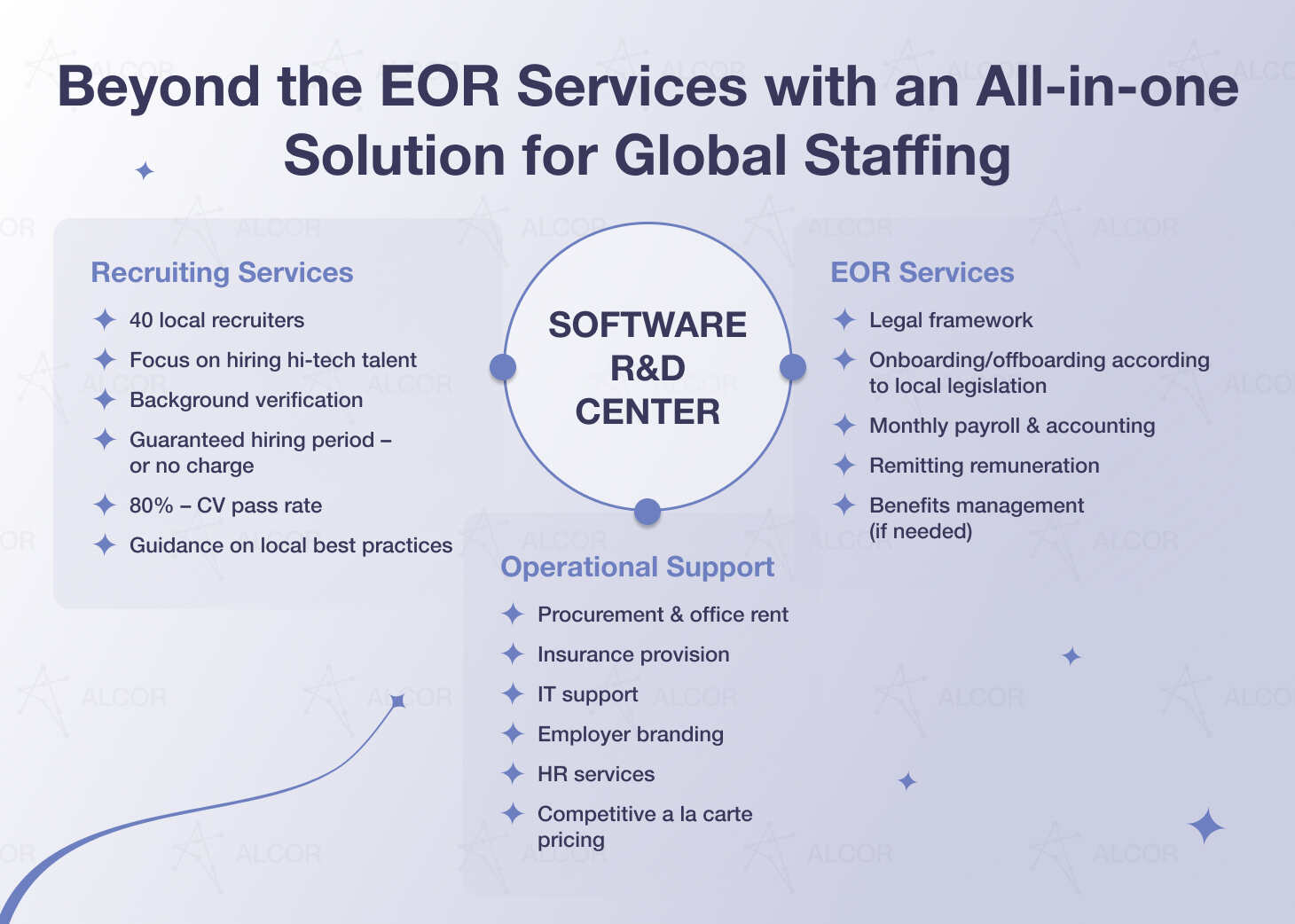
Alcor taps a network of 325,000+ vetted candidates and 40+ in-house tech recruiters to close that gap, so your roadmap moves at the speed your funding promised.
FAQ
What is the most flexible alternative to IT outsourcing?
The most flexible alternative to IT outsourcing depends on your goals, team size, and timeline. For one or two engineers you’ve already found, an EOR or COR platform is the simplest option. For a short-term skill gap, staff augmentation or outstaffing brings specialists in fast without permanent hires. For product companies planning to scale a team for years, a software R&D center gives the most room to grow, with direct management and full IP ownership.
What is the best alternative to traditional software development outsourcing?
For product companies, the best alternative to traditional software development outsourcing is an owned engineering team abroad, built as a software R&D center. The strongest arguments for it are direct management, full IP ownership from day one, and team continuity. Alcor builds these centers across Latin America and Eastern Europe, with teams of 10–30 operational within 90 days. Engineers hired through Alcor stay with clients for 2.5+ years on average, and 98.6% pass probation.
What is the best alternative to IT outsourcing for an enterprise-grade company?
For an enterprise-grade company, the best alternative to IT outsourcing is a software R&D center that grows into a long-term engineering hub. The model adds dozens of engineers under compliant local contracts, keeps costs forecastable on one annual line, and follows the company’s own security and access policies. Once the team reaches a stable size, the company can bring it under its own roof. With Alcor, that move comes with no buy-out fees.
What is onshoring, what is nearshoring, and how do they differ from offshoring?
Onshoring means delivering software development through a team or services provider at home, with the closest time-zone and cultural fit but the tightest talent market and highest salaries. Nearshoring moves the work to a nearby country with a similar time zone, such as Mexico or Colombia for US companies, pairing real-time collaboration with salary savings. Offshoring moves it to a distant country, such as Poland or Ukraine, adding round-the-clock development across a 6–7 hour gap.
How would you rate this article?
Alcor is Your Trusted Scaling Partner
for expansion
support