


Key Takeaways
- Nearshore software development to Romania gives tech product companies access to 207,800 ICT professionals and 35,600 annual STEM graduates, making Romania a strong location to hire nearshore developers (Alcor recruitment team research).
- Romania offers strong cost efficiency for engineering teams, with senior salaries about 48% more cost-efficient than comparable US hiring and employer social security contributions of approximately 2.25% (Alcor 2026 compensation and legal research).
- Romania has a mature and expanding technology ecosystem, with a €17.4B computer programming industry in 2026, IT&C as the country’s leading services export, and €4.5B allocated to digital transformation (IBISWorld; ANIS; European Commission).
- Romania is strengthening its position as an AI engineering location, with 32 universities publishing AI research, an EU-backed AI Factory, and AI roles exceeding 2% of vacancies, roughly twice the European average (EduRank; EuroHPC; Interface).
- Romania compares favorably with other Eastern European markets for companies prioritizing English, EU compliance, and cost-efficient employment. Poland and Ukraine offer larger talent pools, while Czechia leads in startup ecosystem ranking (Eurostat; EF EPI; StartupBlink).
- Alcor helps scaling tech companies build a dedicated engineering operation in Romania without opening a local entity. Its software R&D center solution combines tech recruitment, EOR/COR, and operational support, with 10-day onboarding, direct CTO management, full IP ownership, dedicated Customer Operations, employer branding, payroll and benefits administration, hardware procurement, and no buy-out fees. Teams of 10–30 can become operational within 90 days.
Want to nearshore to Romania? You’d be joining a tech market built around international work. Romania ranks #11 worldwide for ICT services exports as a share of total trade, according to WIPO’s Global Innovation Index, which puts it ahead of most of Europe in how much of its economy runs on building technology for clients abroad.
This guide covers 2026 salaries for 11 engineering and AI roles, the full employment costs, and how the location compares with five other Eastern European countries. Together, they show why Romania for nearshore software development fits product companies at a scaling inflection point: late-stage VC-backed, PE-backed, and public companies that need 10–30+ engineers their home market can’t supply fast enough.
Why Nearshore Software Development to Romania
IT nearshoring to Romania gives tech product companies access to a deep engineering talent market, strong technical education, and close time-zone alignment with European and US teams. Romania has 207,800 ICT professionals (Alcor’s recruitment team research), ranks #20 worldwide on TopCoder, and adds around 35,600 STEM graduates annually (Alcor’s recruitment team research). According to Alcor’s 2026 research, Romania combines strong engineering expertise with 48% greater cost efficiency than comparable US hiring, alongside strong English proficiency and established hubs such as Bucharest, Cluj-Napoca, and Iași (EF EPI 2025).

A goldmine of tech talent
Romania’s tech talent pool counts 207,800 ICT professionals, the fifth-largest in Central and Eastern Europe. Most Romanian engineers are skilled in Java, JavaScript, C#, and Python and work across three hubs: Bucharest, Cluj-Napoca, and Iași. Women hold 27.8% of the country’s ICT specialist roles, the highest share in the EU, according to Eurostat.
Romanian developers rank #20 worldwide on the TopCoder competitive programming leaderboard. Coursera’s Global Skills Report 2025 places Romania #6 in Eastern Europe for both tech and data science skills.
Discover how a PEO in Romania can help you employ local developers quickly and compliantly.
Steady STEM graduate pipeline
Romania adds about 35,600 STEM graduates to its tech market every year, according to Alcor’s recruitment team research. The leading engineering schools include Politehnica Bucharest, the Technical University of Cluj-Napoca, and Politehnica Timișoara.
EduRank lists 33 universities with STEM majors across the country. Eight Romanian institutions appear in the QS World University Rankings 2027, and 22 make the Times Higher Education World University Rankings 2027, which include all three engineering schools named above.
Western mindset
Romania ranks #11 of 123 countries and #2 in Eastern Europe on the EF English Proficiency Index 2025, in the “very high” proficiency band. For US and Western European product companies, that means standups, code reviews, and roadmap discussions run in English from day one.
The Culture Factor’s Hofstede model shows where Romanian and US work cultures align. Both lean toward practical, near-term results, and Romania has moved noticeably closer to US levels of individualism, with more weight on personal initiative. Romanian engineers value clear structure and well-defined requirements, and they prioritize consensus and work-life balance over internal competition.
Cost-efficient salaries
Companies that choose nearshore IT services to Romania save around 48% on base salaries for senior engineers compared with equivalent US hires, according to Alcor’s 2026 compensation research. For most roles, one US senior paycheck covers about two Romanian engineers with the same level of experience.
The savings peak in AI and data roles: a senior LLM Engineer in Romania earns $97,800 a year, compared with $234,000 in the US. For a stack-by-stack view, see our full guide to the software developer salary in Romania.
My team and I put together 2026 base salaries for key senior engineering and AI roles, so you can see at a glance how a Romanian hire compares with its US equivalent.
|
Average Annual Senior Base Salary, USD | ||
|
Position |
Romania |
US |
|
C/C++ Developer |
80,400 |
150,000 |
|
Python Software Engineer |
79,200 |
165,000 |
|
Ruby Software Engineer |
81,600 |
174,000 |
|
Mobile Application Developer (iOS/Android) |
78,000 |
174,000 |
|
Blockchain Engineer |
84,000 |
171,000 |
|
Data Engineer |
74,400 |
177,000 |
|
DevOps Engineer |
81,600 |
168,000 |
|
ML Engineer |
97,200 |
222,000 |
|
LLM Engineer |
97,800 |
234,000 |
|
AI Product Engineer |
97,200 |
228,000 |
|
MLOps Engineer |
99,600 |
189,000 |
|
According to Alcor’s internal salary research (As of September 2026) | ||
The savings hold at every seniority level. Compared with US base salaries, hiring Middle engineers in Romania saves 40–64%, and hiring Leads saves 37–56%. See it for yourself in the breakdown below for the most in-demand roles.
|
Average Annual Base Salary in Romania by Seniority, USD | |||
|
Position |
Middle |
Senior |
Lead |
|
C/C++ Developer |
58,800 |
80,400 |
87,000 |
|
Python Software Engineer |
56,400 |
79,200 |
91,200 |
|
Ruby Software Engineer |
56,400 |
81,600 |
96,000 |
|
Mobile Application Developer (iOS/Android) |
58,800 |
78,000 |
98,400 |
|
Blockchain Engineer |
63,000 |
84,000 |
102,000 |
|
Data Engineer |
51,600 |
74,400 |
96,000 |
|
DevOps Engineer |
60,000 |
81,600 |
102,000 |
|
ML Engineer |
66,000 |
97,200 |
132,000 |
|
LLM Engineer |
66,000 |
97,800 |
132,000 |
|
AI Product Engineer |
66,000 |
97,200 |
138,000 |
|
MLOps Engineer |
72,000 |
99,600 |
141,000 |
|
According to Alcor’s internal salary research (As of September 2026) | |||
But remember: base salary covers only part of the cost of a hire. To see the full picture, calculate the total employment cost in Romania, including employer payroll contributions, benefits, and recruitment costs, before you finalize your hiring budget.
Competitive employment cost
Planning to hire Romanian developers on a B2B contract? Under this model, the engineer registers as a sole trader and pays their own income tax and social contributions, so your company carries no payroll taxes.
Full-time employment (FTE) also keeps employer costs modest. For example, an engineer earning $5,000 gross a month adds about $112.50, or 2.25%, in employer social security contributions (SSC):
- Pension insurance contribution: 0–8%*
- Labor insurance contribution: 2.25%
*0% for normal working conditions, 4% for particular working conditions, and 8% for special working conditions.
Romanian employers also cover mandatory pre-hire medical checks and Health & Safety (H&S) training for every full-time hire, both standard parts of local employment compliance. Outsourcing payroll to Romania through an Employer of Record keeps contributions, filings, and these compliance steps off your team’s plate.
The table below sums up every cost to plan for beyond salary, including the most popular benefits for engineers in Romania.
|
Employment Costs in Romania: Essentials | ||
|
Category |
Item |
Cost |
|
Taxes |
Employer SSC (FTE) |
~2.25% on top of gross salary |
|
Taxes |
Taxes and contributions (B2B) |
Paid by the contractor |
|
Compliance (FTE) |
Pre-hire medical check and H&S training |
Covered by the employer |
|
Recruitment fee (one-time) |
Middle engineer |
~15% of gross annual salary |
|
Senior engineer |
~20% of gross annual salary | |
|
Lead engineer |
25%+ of gross annual salary | |
|
Benefits (optional) |
Private health insurance |
~$900/year |
|
English language courses |
~$1,000/year | |
|
Professional development (training and conferences) |
$1,000–2,000/year | |
|
Wellness (gym membership, mental health support, massage) |
$400–500/year | |
|
Home office, coworking, or IT equipment |
~$700/year | |
|
Voluntary pension plan |
~$450/year | |
|
Total benefits package |
~$4,450–5,550/year per engineer | |
|
According to Alcor’s legal team research (As of September 2026) | ||
Compared with the US, these advantages add up fast. Recruitment fees scale with salary, so the savings on base pay carry over to every hiring fee.
Benefits follow the same pattern: Romania’s full optional package runs ~$4,450–5,550 a year per engineer, while US benefits packages average $15,400 per employee, according to Alcor’s legal team research. Savings on fees and benefits are one more reason software development in Romania keeps attracting tech product companies.
Convenient location
Romania runs on Eastern European Time (UTC+2, or UTC+3 in summer), which puts it 1–2 hours ahead of Western Europe and 7 hours ahead of the US East Coast.
Who benefits the most?
- European product companies: Direct flights from most Western and Northern European capitals take 2–4 hours, and the 1–2-hour time difference means both teams share almost the entire workday. An in-person planning session or team onboarding fits into a two-day trip.
- US product companies: Your product moves forward almost around the clock. Romanian engineers start their day while the US sleeps and hand work over during a shared window (9 a.m. in New York is 4 p.m. in Bucharest), so your US team picks it up with no waiting. Teams in San Francisco or Seattle, 10 hours behind, stretch the cycle even further, usually with one fixed early-morning sync.
Startup infrastructure
Romania ranks #44 globally in StartupBlink’s Global Startup Ecosystem Index 2026, up four places from last year. The country’s ecosystem score grew 32.9% year over year, the second-fastest growth rate in the EU after Cyprus, and Software & Data is its strongest sector, ranked #40 worldwide.
The StartupBlink report values Romania’s startup ecosystem at $9.7 billion and counts six Romanian cities in the global top 1,000. Capital is following the growth: private equity and venture capital investment in Romania more than quadrupled in 2025 to €433.6 million, according to the Romanian Private Equity Association and Deloitte. Local funds raised €197.5 million in the same year, their second-best year on record.
2025–2026 highlights include:
- Druid AI raised a €27.5 million Series C, Romania’s largest round of 2025, per How to Web.
- Cyber Swarm raised a $50 million Series A in May 2026, per Vestbee.
- Digitail raised a €20 million Series B in 2025.
Romania’s top tech hubs:
- Bucharest ranks #8 regionally and hosts 1 unicorn and 52% of all startups in Romania, per StartupBlink.
- Cluj-Napoca is Romania’s #2 tech hub, often called the “Silicon Valley of Eastern Europe,” and climbed 49 places globally after growing its ecosystem score by 51.2% in a year, per StartupBlink.
- Iași, Timișoara, Brașov, and Oradea complete Romania’s six cities in the global top 1,000. StartupBlink names Oradea the country’s fastest-growing startup ecosystem.
Nearshoring to Romania vs To Other EE Countries in 2027
Romania stands out among Eastern European markets for very high English proficiency, EU compliance, and employer cost efficiency, with just 2.25% employer social security contributions. Poland and Ukraine offer larger talent pools, Czechia leads in startup ecosystem ranking, while Bulgaria and Slovakia bring eurozone advantages. For companies scaling engineering teams in 2027, nearshore outsourcing in Romania offers a strong balance of talent, communication, compliance, and cost efficiency.
Romania compares strongly with other Eastern European markets, and the difference between them comes down to your hiring priorities.
Romania shares a common technical foundation with Poland, Bulgaria, and Ukraine, where engineers build with the same core technologies: JavaScript, Python, and C#. Poland and Ukraine offer the most tech specialists, Bulgaria and Slovakia combine eurozone membership with a strong business environment, and Czechia has the highest-ranked startup ecosystem in the group. A nearshore tech team in Romania brings very high English proficiency, EU compliance, about 2.25% in employer contributions, and one of the EU’s fastest-growing startup ecosystems.
| Romania vs Other Eastern European Tech Destinations in 2027 | |||||
| Country | ICT talent pool | EF English Proficiency Index 2025 (global rank) | StartupBlink 2026 (Eastern Europe rank) | EU status | Standout strength |
| Romania | 207,800 | #11 | #9 | EU member | ~2.25% employer SSC; second-fastest startup growth in the EU (32.9%) |
| Poland | 778,800 | #15 | #4 | EU member | Largest talent pool in the region; #1 in Eastern Europe on TopCoder |
| Ukraine | 305,000 | #45 | #8 | EU candidate | $5.97B in IT services exports (Jan–Nov 2025) |
| Czechia | 248,200 | #23 | #3 | EU member | Top-ranked startup ecosystem in Central Europe |
| Bulgaria | 141,500 | #18 | #5 | EU and eurozone member (since 2026) | #1 in Eastern Europe for business environment (StartupBlink) |
| Slovakia | 113,500 | #10 | #16 | EU and eurozone member (since 2009) | A2 business climate rating from Coface |
| Sources: Eurostat, Ukraine’s Ministry of Digital Transformation, EF EPI 2025, StartupBlink 2026, Coface. | |||||
Romanian IT Market & Business Landscape
Romania’s IT market combines strong growth, export experience, and significant public investment in digitalization. The computer programming industry is worth €17.4B (~$20.0B) in 2026, with 51,798 businesses (IBISWorld), hile IT&C became Romania’s leading services export in 2025 (ANIS). €4.5B (~$5.2B) of the EU recovery plan supports digital transformation (European Commission), with cybersecurity and automotive software emerging as key growth areas through 2030.

Romania’s computer programming industry is worth €17.4 billion (~$20.0B) in 2026, after growing an average of 12.2% a year over the past five years, according to IBISWorld. The segment includes 51,798 businesses. In the first seven months of 2025, IT&C also became the country’s number-one services export, according to ANIS, Romania’s software and services industry association.
For foreign product companies considering nearshoring software development to Romania, that export focus offers a practical advantage: much of the local tech workforce already builds software for international clients.
The next wave of growth is already funded. Romania directs €4.5 billion (~$5.2B), or 21% of its Recovery and Resilience Plan, to digital transformation, according to the European Commission’s Digital Decade 2026 country report. ANIS estimates that closing the technology adoption gap could add €6–40 billion to Romania’s GDP and create 45,000 to nearly 300,000 jobs.
What’s driving Romania’s tech market toward 2030?
- R&D incentives: From 2026, companies can choose a refundable 10% tax credit on eligible R&D expenses instead of the existing extra 50% deduction, according to EY Romania. Any unused credit can be offset or refunded over the following four years.
- Cybersecurity: Romania’s cybersecurity market is projected to grow from $215 million in 2026 to $358 million by 2031, a 10.7% annual growth rate, according to Mordor Intelligence. Western European companies increasingly move security operations center (SOC) work to Romanian providers, and Bucharest hosts the headquarters of the EU’s European Cybersecurity Competence Centre.
- Automotive software: The European Commission’s 2026 report highlights Romania’s auto industry as a base for building digital ecosystems on top of the country’s strong ICT expertise.
Still choosing a hiring model? Compare the pros and cons of outsourcing in Romania before you commit.
Why Still Nearshore to Romania in the Age of AI?
Romania remains a strong AI engineering location because its talent pipeline is supported by university research, EU-backed AI infrastructure, and growing market demand. EduRank tracks 32 universities publishing AI research, while Romania’s AI Factory will add EU-backed computing capacity for manufacturing, cybersecurity, life sciences, and autonomous systems. AI roles already exceed 2% of vacancies, roughly twice the European average (Interface), reinforcing Romania’s position as an AI-ready engineering market.
AI-ready talent and research
Romania’s AI pipeline starts at its universities. EduRank counts 32 Romanian universities publishing AI research, with more than 53,100 papers and 487,000 citations, concentrated in Bucharest, Cluj-Napoca, Timișoara, and Craiova. The Technical University of Cluj-Napoca is also building a dedicated AI research center with 144 GPUs, according to DatacenterDynamics, bringing AI compute directly into the university system.
That research base feeds a growing AI engineering market. Alcor’s 2026 compensation research puts the average senior ML Engineer salary in Romania at $97,200 a year, compared with $222,000 for the same role in the US.
EU-backed AI infrastructure
In October 2025, the EuroHPC Joint Undertaking selected Romania as one of six new hosts for European AI Factories, alongside Poland, Spain, the Netherlands, Czechia, and Lithuania. The RO AI Factory, co-hosted by ICI Bucharest and Politehnica Bucharest, will run an AI-optimized supercomputer for manufacturing, cybersecurity, life sciences, and autonomous systems, as reported by Business Forum.
National policy points the same way. Romania’s National Strategy in the Field of Artificial Intelligence 2024–2027 sets objectives across R&D, skills, infrastructure, and technology transfer, according to the Digital Watch Observatory.
AI demand and AI-native companies
AI hiring takes up a larger share of Romania’s job market than in most of Europe. AI job postings exceed 2% of all vacancies, roughly double the European average, according to interface. Romania has already produced a global AI company: UiPath, the automation platform founded in Bucharest, now trades on the New York Stock Exchange.
For product companies that need AI capacity without adding US headcount, Romania combines AI-ready engineers with EU-funded infrastructure.
P.S. Alcor fills AI/ML roles with top-notch talent and an average of 8 CVs per accepted offer, so your engineering leaders spend interview time only on specialists who fit.
Ready to add AI engineers to your roadmap? See how to hire developers in Romania for ML, LLM, and MLOps roles.
Who Nearshores to Romania
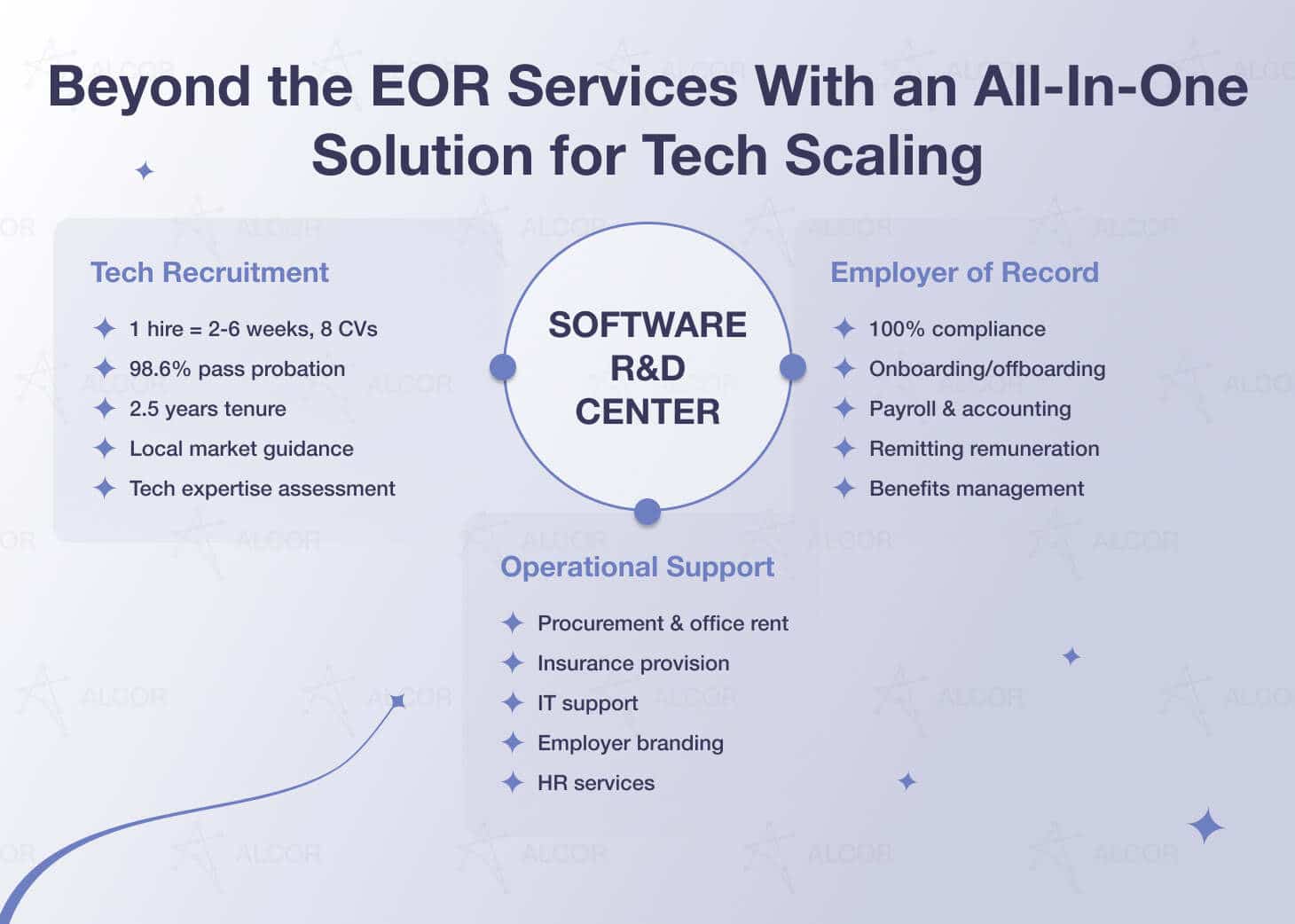
Romania attracts both large corporations with established R&D centers and scaling product companies seeking 10–30+ engineers without opening a local entity. Alcor’s software R&D center solution combines tech recruitment, EOR/COR, and operational support, giving companies direct team management and IP ownership. Teams can become operational within 90 days, with dedicated local support covering employment, compliance, payroll, employer branding, and day-to-day operations.
Two kinds of companies choose nearshore software development in Romania.
- Large tech corporations run their own R&D centers there, while scaling product companies need 10–30+ engineers fast and without opening a local entity.
- The second group works with Alcor to build fully owned engineering teams across Eastern Europe and Latin America, including Romania.
Large tech corporations have long run R&D centers in Romania, supported by their own legal, HR, and real estate teams.
Late-stage VC-backed, PE-backed, and public product companies usually arrive at a different moment. They’ve hit the hiring wall at home, a new product initiative or acquisition needs engineers now, and opening a local entity would take months.
Instead of building that infrastructure themselves from scratch, these companies partner with Alcor.
Alcor builds software R&D centers across Eastern Europe and Latin America and provides the tech recruitment, Employer of Record/Contractor of Record services, and operational support behind each one. The result is a team that reports directly to your CTO, with no entity, no vendor lock-in, and no buy-out fees. Whether you’re looking for an Employer of Record service provider in Romania or a partner to build your entire engineering team, the model stays the same.
Here’s how three Alcor clients, each at a different stage of growth, used this model to build their engineering teams.
PE-backed: Dotmatics built an acquisition-ready team
Dotmatics, a scientific R&D software company backed by Insight Partners, went from no Eastern European presence to a 30-engineer team in 12 months, with first CVs in 3–5 days and 80% approved. As Employer of Record, Alcor became the engineers’ legal employer through its own entity and ran payroll, taxes, benefits, and compliance, so Dotmatics skipped entity setup and managed the team directly from day one. Alcor’s operations team also handled laptop procurement. When Siemens acquired Dotmatics for $5.1 billion in 2025, every Alcor-employed engineer’s stock options were paid out in full at close.
VC-backed: Pindrop owns its AI team and IP
Pindrop, a US AI voice security company backed by $333 million in venture funding, weighed an outsourcing model against an in-house team and chose full ownership. With Alcor, Pindrop built a 30-engineer team in Ukraine across Golang, Python, cloud, ML data, and security roles. Senior roles took an average of six weeks to fill, and every hire passed probation. The IP has belonged to Pindrop from day one.
Public: Teladoc runs a compliant engineering team abroad
Teladoc Health brought Alcor in six years after its IPO to hire engineers with a rare health-tech stack in Ukraine. Under Alcor’s Contractor of Record setup, Alcor handled contracts, payments, and local compliance, while Teladoc kept full ownership of its team and IP and the flexibility to adjust the setup as priorities shifted.
Want to hear real reviews? Hear from the tech leaders who scaled with us:
The same model runs in Romania.
If your local market has run out of senior engineers, your next team can be up and running in Romania within a quarter. For companies planning nearshore software development to Romania, Alcor gets teams of 10–30 operational within 90 days and scales to 100 engineers in about 12 months.
Start with IT recruitment in Romania for your first senior hires, or build dedicated teams in Romania that report to your CTO from day one.
You build. We power the infrastructure.
References
- WIPO, Global Innovation Index 2025
- Eurostat
- TopCoder
- Coursera Global Skills Report 2025
- EduRank, Best Engineering Universities in Romania
- QS World University Rankings 2027
- Times Higher Education World University Rankings 2027
- EF English Proficiency Index 2025: Romania
- The Culture Factor, Country Comparison Tool
- StartupBlink Global Startup Ecosystem Index 2026
- Romania Insider, ROPEA and Deloitte PE/VC report
- How to Web, Venture in Eastern Europe Report 2025
- Vestbee, Largest CEE Startup Funding Rounds of 2026
- StartupBlink Bucharest Startup Ecosystem
- StartupBlink Cluj-Napoca Startup Ecosystem
- Eurostat, ICT specialists by country
- Ministry of Digital Transformation of Ukraine, IT sector overview
- EF English Proficiency Index 2025
- Opendatabot, Ukraine IT exports 2025
- European Commission
- StartupBlink Innovation Business Environment Index (IBEI) 2026
- Coface, Slovakia country risk file
- IBISWorld, Computer Programming in Romania
- Știri pe surse, ANIS: Romania’s IT&C sector revenues
- European Commission, Digital Decade 2026: Country Reports
- EY Romania, Tax Alert
- Mordor Intelligence, Romania Cybersecurity Market
- European Cybersecurity Competence Centre
- Council of the EU, Digital Decade 2026 short country report: Romania
- EduRank, Best Universities for Artificial Intelligence in Romania
- DatacenterDynamics
- EuroHPC Joint Undertaking
- Business Forum
- Digital Watch Observatory, Romania’s National AI Strategy 2024–2027
- Interface
FAQ
Why should you work with nearshore developers from Romania in 2027?
Nearshore software development to Romania pairs a 207,800-strong tech workforce and very high English proficiency (#11 of 123 countries on the EF EPI 2025) with EU legal protection and 46–58% savings on senior engineering salaries compared with the US. Employer contributions add only about 2.25% for full-time hires, and the country hosts one of the EU’s AI Factories, giving scaling product companies access to senior, AI-ready engineers.
What are the challenges and risks of nearshoring to Romania?
The main challenges of nearshoring to Romania are frequent tax changes, detailed labor rules, and picking the right cooperation model. Romania updates its Fiscal Code often, and employees get 175% overtime pay, 20 vacation days, and 17 public holidays. Outsourcing limits direct team management, while outstaffing adds buy-out fees. An Employer of Record partner like Alcor handles labor law, payroll, and benefits while you run the team directly.
What is the average nearshore software developer salary in Romania?
Senior software engineers in Romania earn an average base salary of about $86,500 a year, according to Alcor’s 2026 compensation data. Middle engineers average about $61,400 and leads about $110,500. AI roles pay the most: a senior ML Engineer earns $97,200, compared with $222,000 in the US. Across senior roles, companies save 48% on base salaries compared with equivalent US hires.
What do Romanian software development companies specialize in?
Romanian software companies are strongest in custom software development, IT consulting, and wireless telecom, according to ANIS figures reported by The Recursive. Cybersecurity, automotive software, and AI are fast-growing niches. For companies considering nearshoring in Romania, local firms also adopt new technology at EU pace: 48% use multiple advanced digital technologies, and 30% make systematic use of generative AI, per the EIB Investment Survey 2025.
Why is Cluj-Napoca known as the Silicon Valley of Eastern Europe?
Cluj-Napoca earned the nickname for its dense mix of tech companies, startups, and engineering universities. It’s Romania’s second-largest tech hub and home to Babeș-Bolyai University and the Technical University of Cluj-Napoca, which is building a dedicated AI research center with 144 GPUs. In StartupBlink’s 2026 index, Cluj-Napoca climbed 49 places globally after growing its ecosystem score by 51.2% in a single year.
How would you rate this article?
Alcor is Your Trusted Scaling Partner
for expansion
support