


An Employer of Record in Poland lets you hire Polish talent without opening a local entity: the provider becomes the legal employer and handles payroll, PIT withholding, ZUS social security contributions, employment paperwork, and compliance with the Polish Labour Code, while you stay focused on the work that actually needs your attention – product, delivery, and team performance.
Deloitte’s 2025 Global Business Services Survey shows that organizations are maturing, with more than 80% moving away from classic outsourcing toward shared services and centers of excellence. This way, they can build in-house capability and gain higher quality and control. That is exactly why EOR is landing with more companies today: you keep control of your people from day one, move faster without needing to set up a new entity, and avoid wearing five different hats just to hire in a new market.
If you are worried about the usual hiring bottlenecks that slow expansion to a crawl, an Employer of Record like Alcor gives you a cleaner path in – especially if you want to hire software engineers fast, stay 100% compliant, and keep your team focused on product delivery instead of local admin. In this guide, you’ll see how hiring in Poland works, what to expect from payroll, taxes, benefits, contracts, compliance, and termination rules, how EOR compares with opening your own entity, and which EOR providers you can choose from in Poland.
| Inflation Rate – CPI 2.1% YoY(Feb 2026) |
PLN/USD volatility – 52-week range: 3.4763-3.9431 USD/PLN |
Corporate income tax – 19% standard flat rate 9% small taxpayers |
Value-added tax (VAT) – 23% standard rate 8/5% reduced rate |
| English proficiency – #15 globally |
Graduate employment rate – 90.5% |
Nominal wage growth (YoY) – 6.1% in Jan 2026 |
Average tenure – 10.7 years |
| Union membership – 10.5% |
Attrition rate – 18% |
Average severance – Statutory 1-3 months’ pay by tenure; capped at 15× minimum wage (PLN 69,990 cap in 2025) |
Remote workforce penetration – Usually WFH 5.4%, sometimes WFH 8.9% |
Sources: Statistics Poland, Bloomberg, EF EPI, Euronews, Trading Economics, OECD, Eurofound
Key Takeaways
- An Employer of Record in Poland gives you a faster way to hire local talent without opening a legal entity, because the provider handles payroll, PIT, ZUS, contracts, and Labour Code compliance while your team stays focused on delivery.
- If you are comparing EOR services in Poland, the market already offers several strong options for different needs, including Alcor for tech expansion, MOTIFE for local support, RemoFirst for small businesses, Rippling for HR and IT management, and G-P for automation-heavy global hiring.
- Alcor’s EOR services in Poland are especially relevant for tech companies because Alcor goes beyond EOR. It acts as your global engineering infrastructure, combining compliant hiring, IP-safe contracts, payroll, benefits, and operational support to help you build a true in-house team in Poland from day one.
- Taxation in Poland includes social contributions, standard CIT at 19% (9% for small taxpayers), and progressive PIT at 12%/32%. Contractors manage their own taxes under B2B.
- The smartest hiring model usually combines full-time employees for core roles with B2B specialists for flexibility, but it only works well when you follow a single clear onboarding checklist and keep contracts, documentation, and compliance aligned from the start.
- Remote‑work rules are now codified, GDPR is enforced, and post‑employment non‑competes require pay. A seasoned EOR service provider standardizes contracts, documentation, and notices to lower disputes and talent attrition.
Benefits of Using an Employer of Record in Poland
An Employer of Record in Poland lets you hire fast, stay compliant, and keep costs predictable – without opening a local entity. A Polish EOR handles contracts, payroll, Social Insurance Institution in Poland (ZUS) contributions, and statutory benefits, aligning with the Polish Labour Code, while your company focuses on your tech product. You cut incorporation overhead, reduce misclassification and GDPR risk, and scale teams in Warsaw, Kraków, and other Polish hubs in days rather than weeks.
There is an obvious benefit for you: you get the outcome – a productive Polish squad – without juggling lawyers, bank onboarding, benefits brokers, and payroll tables. According to our team’s research, most delays come from banking and document legalization – problems an EOR removes from your expansion path.
Speed-to-market
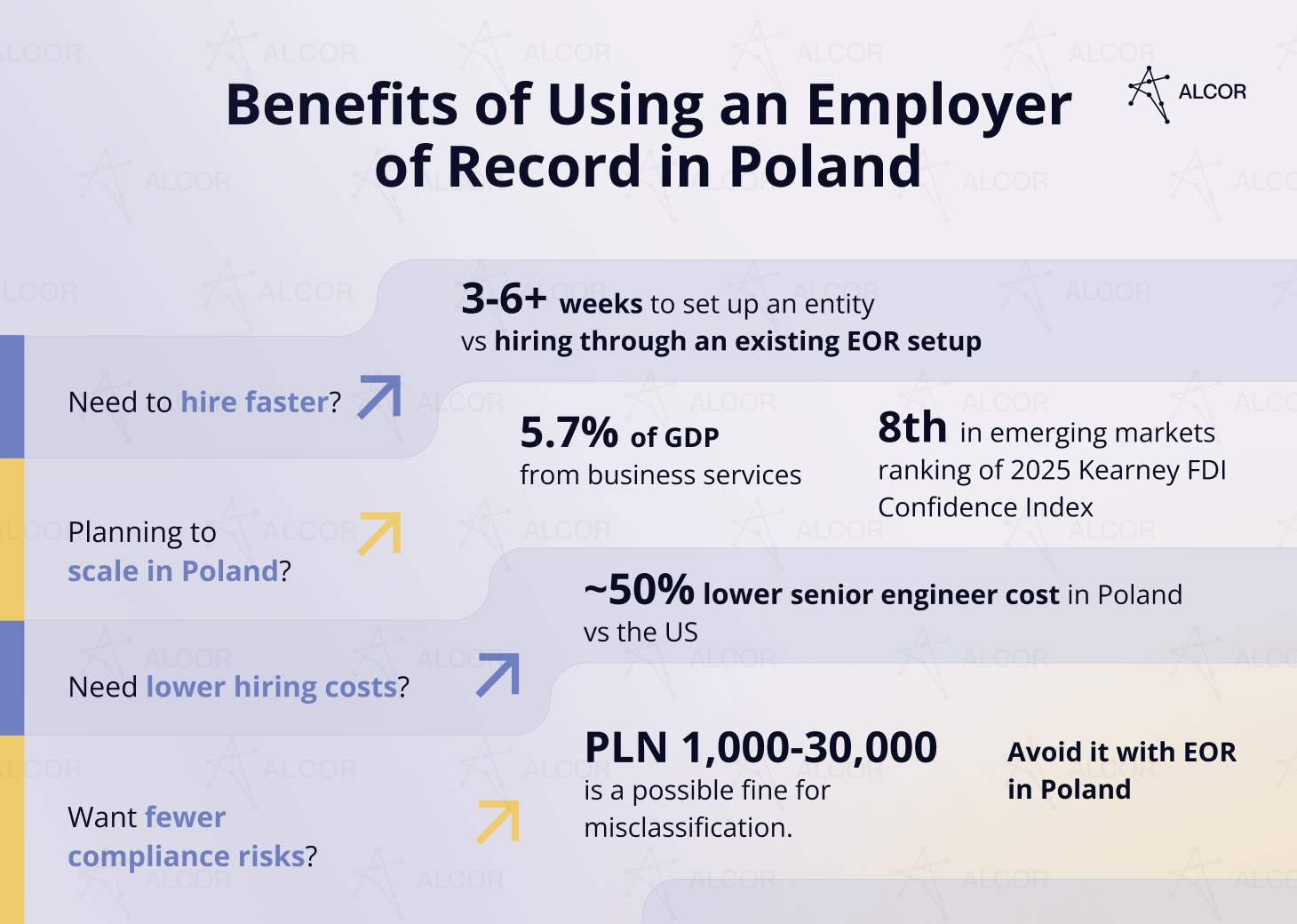
If you set up your own entity, it usually takes 3-6 weeks to register the company, open a bank account, and complete the core authority-side formalities. Sounds not too long, right? But that timeline still gives you mostly the legal shell, not a fully employer-ready setup.
The real delay often starts right after incorporation. Before your first engineer can actually begin work, you still need compliant employment documents, employee records, payroll and working-time administration, pre-employment medical checks, and initial OHS training in place. And if you are hiring a non-EU specialist, work authorization can add an entirely new layer.
That is why EOR in Poland speeds things up in practice, not just on paper. You are not building the employer infrastructure from scratch after incorporation – you are plugging into one that already exists.
Scalability
Poland offers room to scale, and the investment signals back that up. The business services sector already contributes 5.7% of GDP, while Poland’s real GDP grew by 3.6% in 2025, according to Statistics Poland’s preliminary estimate.
FDI inflow and investor interest also remain strong: the 2025 Kearney FDI Confidence Index ranked Poland 8th in its emerging markets ranking, and Kearney’s investor survey identified tech innovation as one of the factors considered when investing in emerging markets. PAIH also ended the year with 64 completed projects worth more than €4 billion. For expanding tech companies, that points to a market where international business activity is still growing, not slowing down.
Cost-efficiency
First, let’s look at the average monthly developers’ salary in Poland, prepared by our researchers for expanding tech companies like yours:
| Senior Developer’s Average Monthly Salary, USD, Gross | ||
| Position | Poland | USA |
| AI Engineer | $6,750 | $14,300 |
| ML Engineer | $6,750 | $11,000 |
| Cloud Engineer | $6,750 | $12,200 |
| Blockchain Developer | $7,000 | $13,050 |
| Mobile App Developer | $6,500 | $13,750 |
| DevOps Engineer | $7,250 | $12,100 |
| Java Developer | $6,750 | $9,200 |
| Python Developer | $6,800 | $11,000 |
| Angular Developer | $5,900 | $10,000 |
| .NET Developer | $5,900 | $10,000 |
Note: the final total cost per developer will be higher because you should also include a one-time recruitment fee (20% of the annual salary in Poland), a monthly EOR fee, a benefits package (~$530 per month), and local payroll taxes with SSC if you hire on an FTE basis.
At first glance, it’s simple: cover salary and contributions in Poland (which are 42% lower than in the US, by the way). The catch is overhead. Setting up your own entity adds notary/KRS filings, translations, monthly accounting and payroll tools, and ongoing compliance.
The good news? A Polish Employer of Record replaces that mess with a clear per‑employee fee and one invoice. Your company skips setup costs and starts onboarding tomorrow.
Reduced risks
An Employer of Record from Poland handles contracts, payroll, ZUS filings, benefits, and compliant terminations – so you don’t trip over the Polish Labour Code. That lowers the chance of misclassification claims, back social contributions with interest, or GDPR exposure, while you operate without a local entity. One might say that the best risk is the one you never take – this is where EOR quietly pays for itself.
Checklist for Choosing an EOR Provider in Poland
A good EOR in Poland should have a real local entity, direct payroll and ZUS capabilities, clear onboarding processes, strong knowledge of the Polish tech market, and transparent pricing. It should also cover the full employment scope while giving you room to scale to a larger model later.
A good EOR should make hiring in Poland easier, not give you another vendor to manage. Use this checklist to see whether an Employer of Record can actually support your team in Warsaw, Kraków, Wrocław, or Gdańsk – with real local coverage, reliable execution, and no fuzzy pricing.
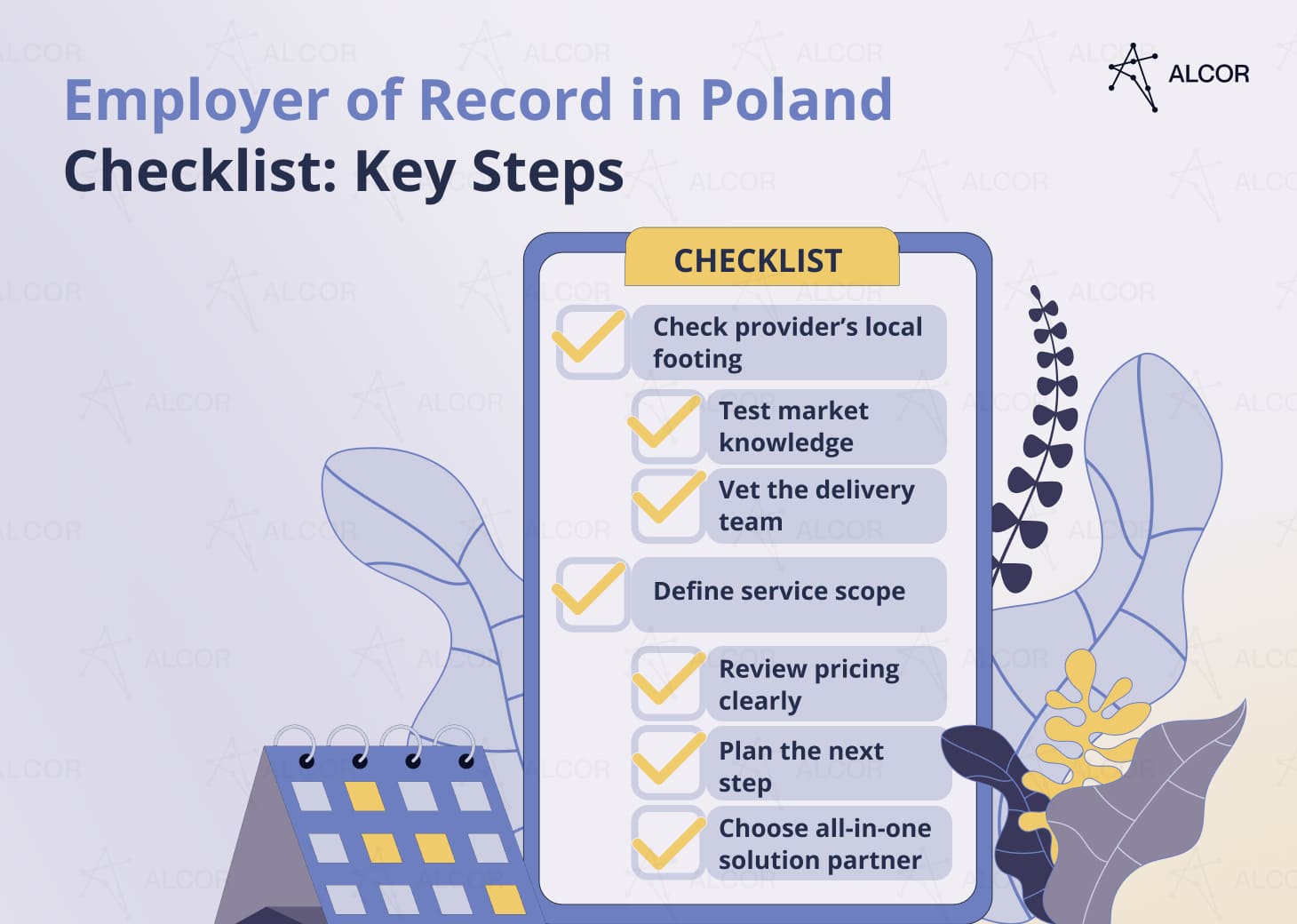
- Check the local footing. Make sure the provider has a real entity in Poland, runs local payroll, works directly with ZUS, and can support hiring across key tech hubs.
- Look at operational readiness. Ask how they handle onboarding from day one: contracts, OHS and medical checks, ZUS registration, GDPR paperwork, and equipment flow. A strong provider should already have this process mapped out.
- Test their market knowledge. A reliable provider should give you current salary benchmarks, notice periods, and realistic hiring timelines by role. If they cannot speak clearly about the Polish talent market, they are guessing with your hiring plan.
- Vet the team behind the service. Your EOR service provider should be able to name the people handling payroll, legal, and HR support in Poland. Ask for sample employment documents, compliance workflows, and proof of data protection practices.
- Clarify the service scope. Do not settle for half-coverage. Solid EOR service providers in Poland should handle contracts, payroll, taxes, benefits administration, probation and termination support, and day-to-day HR coordination.
- Review the pricing model carefully. Look for clear per-employee pricing, itemized payroll, and contract terms without hidden markups or vague “extra support” fees. If the pricing takes three calls to understand, that is already your answer.
Build with the next step in mind:
- Do not box yourself in. If your plan is to grow beyond initial hiring with EOR or PEO, ask whether the provider can support a transition to a fully-fledged tech R&D center, your own entity, or a Build-Operate-Transfer model in Poland later on.
- Prefer fewer moving parts. Expansion gets messy fast when recruitment, payroll, legal, and operations are all handled by different vendors. The smoother option is a partner that can cover more of the stack under one roof.
5 Best Employer of Record Providers in Poland
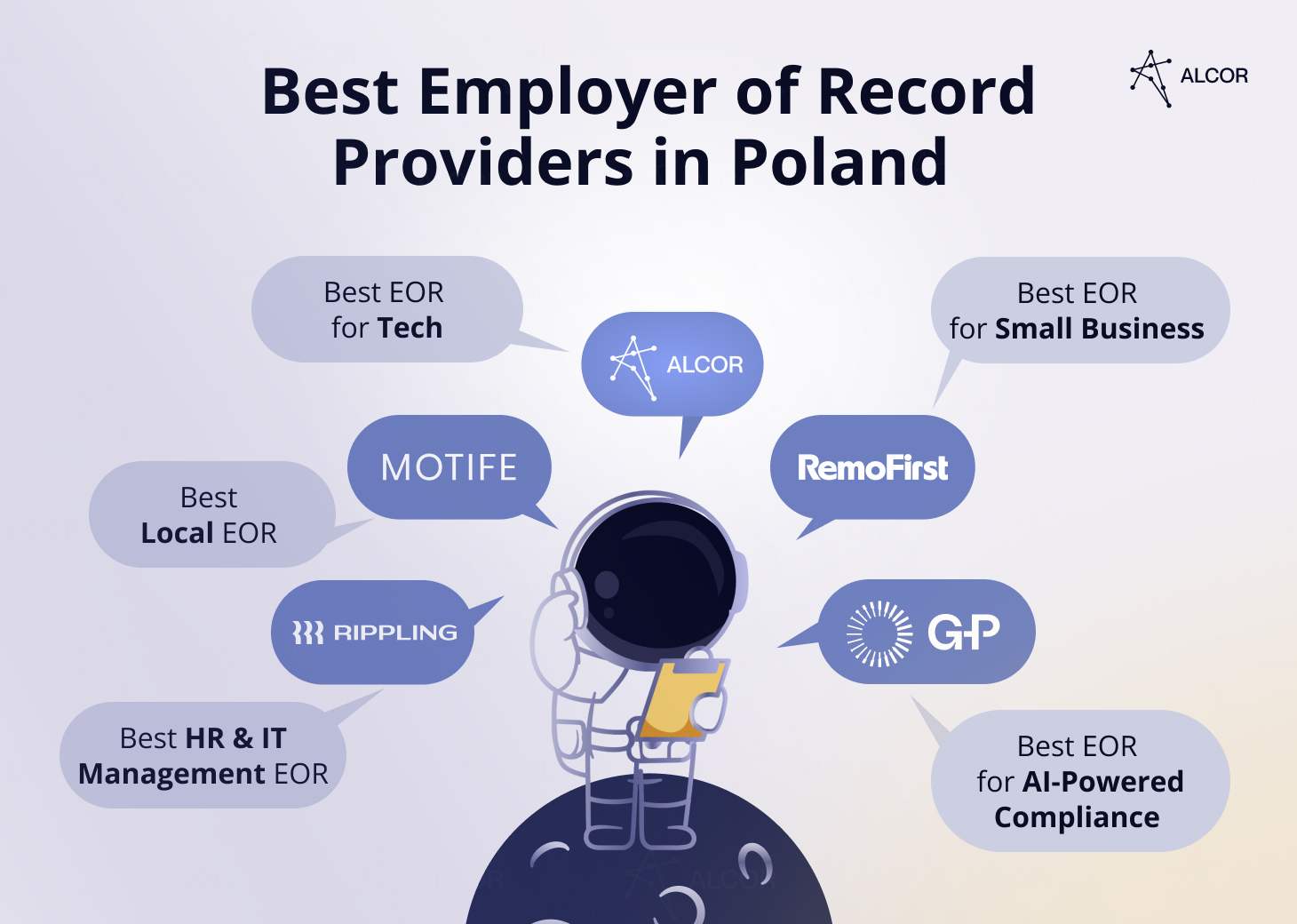
- Alcor fits tech teams that need a global engineering infrastructure that bundles EOR, IT recruitment, and full operational support.
- MOTIFE is a local Poland-based EOR with recruitment and ops support, but a smaller public review footprint.
- Remofirst suits small businesses with low public pricing, broad coverage, and simple setup, though reviews mention coordination gaps.
- Rippling works well for companies that want EOR within a single HR, payroll, and IT platform, despite a steeper learning curve.
- G-P is strongest for AI-driven compliance, automation, and integrations, though some reviews describe support as slower and more ticket-based.
The EOR service providers in Poland below are grouped by use case and a specific operating need – such as tech hiring, local market presence, small-team support, HR and IT administration, or automation and integrations. The shortlist focuses on giving you a cleaner way to match the vendor to your actual hiring model and needs.
Alcor: Best EOR for Tech
Alcor is a tech-focused Employer of Record provider working across Eastern Europe and Latin America. In this list, it is placed in this category because its public positioning and service scope are centered specifically on software teams and public case studies, showing expertise working with tech companies from the US.
| Platform Ratings | ||
| Clutch | G2 | Glassdoor |
| 4.9/5 | 5/5 | 4.8/5 |
*Glassdoor is not a buyer-review platform like Clutch or G2, but it still matters. If a provider is going to help build and support your team, the way it treats its own people is a useful signal for understanding your employee services in the future.
Main differentiators of Alcor’s EOR service
- Hiring through Alcor’s own legal entities, so clients can start building teams without waiting for entity setup.
- Locally compliant employment documents and tailored contracts, including IP assignment and confidentiality clauses.
- Payroll administration within the EOR model, including tax IDs, statutory payroll reporting, payslips, payroll cutoffs, and social contributions.
- Support for both FTE and B2B engagement models through Employer of Record and Contractor of Record services.
- Benefits administration and localized employee support for engineers, with a dedicated Customer Operations Manager.
- No buyout fees or setup fees if a client later transitions the team into its own entity.
- Client-side visibility through AlcorOS, which Alcor describes as covering onboarding and offboarding, payroll, compliance documents, and reporting.
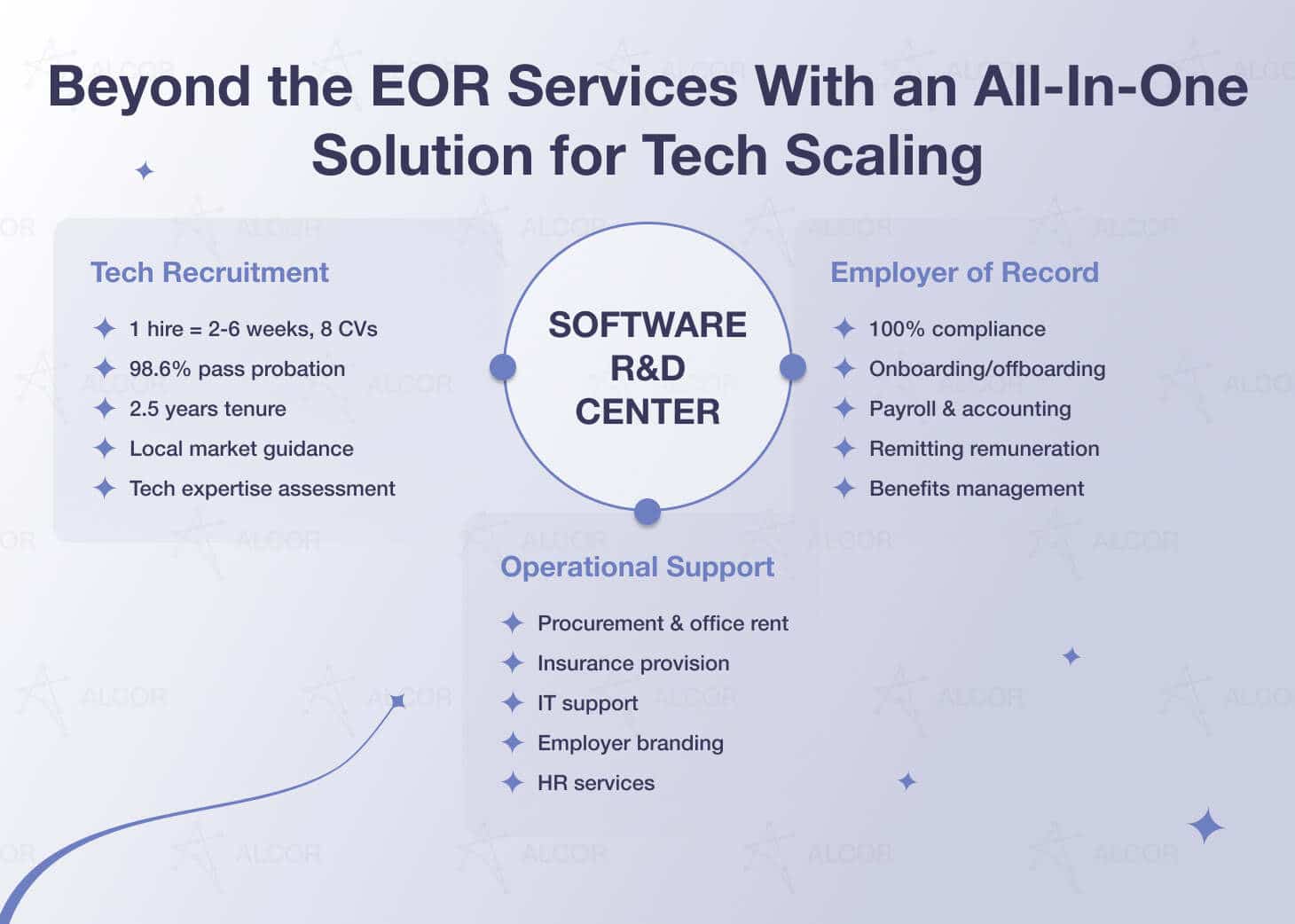
- A broader operating model that combines tech recruitment, tech-focused EOR, and operational support under one system, helping companies build true in-house teams of 10-30 engineers in just 90 days and scale further without a vendor layer.
| Client Reviews | ||
| Pros (Clutch) | Cons (Clutch) | |
| “The Alcor project management team consistently strives to exceed expectations and delivers qualitative services promptly. I value their commitment to going the extra mile for their clients.” | “If anything, they could improve their use of technology and tooling for reporting. They’re awesome and do what we ask from them; this improvement would be the cherry on top.” | |
| “They are very open to and timely in terms of feedback. They really do listen and care. Whenever we have questions, I can ask their team for help and they’ll reliably find a solution.” | “Due to time differences, there were small issues with connectivity and scheduling. The entire process was an intense situation, and we were pushing hard.” | |
| “Alcor’s expertise and implementations have enabled us to run our company in the way and at the level we want. We don’t always have a solution in mind, but Alcor has answered all of our questions. We couldn’t have implemented those best practices without them.” | “Being more proactive in sharing changes and trends they see on the market.” | |
Taken together, these reviews point to a provider valued for responsiveness, delivery quality, and practical support, while also indicating some room for improvement.
MOTIFE: Best Local EOR
MOTIFE is a Poland-based recruitment and EOR company with its HQ in Krakow. The company is focused on helping businesses build software teams in Poland.
| Platform Ratings | |
| Clutch | Glassdoor |
| 4.8/5 | 5/5 |
Main differentiators of MOTIFE’s EOR service
- EOR for IT in Poland for companies that want to hire locally without setting up a legal entity.
- Public service positioning that combines EOR, IT recruitment, and setup/operations management under one company.
- Public promise of one invoice per month and no fee in case of transfer to your own entity.
|
Client Reviews |
||
|
Pros (Clutch) |
Cons |
|
| “Projects delivered on time with high quality of services.” | No platform support. Employer of Record services are provided only in Poland. The public review base is still relatively small at 6 Clutch reviews, so buyers get a narrower signal than they would from larger global platforms. | |
| “We always have open communication channels so I can reach out to whomever I need.” | ||
| “We successfully established a new office and employed the required staff.” | ||
Remofirst: Best EOR for Small Business
RemoFirst is a global Employer of Record platform. Its public positioning is startup- and SMB-friendly, and its website lists EOR pricing starting at $199 PEPM (per employee/month), with no setup, onboarding, or termination fees, and no annual contracts or minimum headcount. Among the providers on this shortlist, it is the clearest low-entry-price option based on publicly posted EOR pricing.
| Platform Ratings | ||
| G2 | Trustpilot | Glassdoor |
| 4.6/5 | 4.0/5 | 3.9/5 |
Main differentiators of RemoFirst’s EOR service
- Public EOR pricing from $199 per person/month.
- The website highlights no setup, onboarding, or termination fees, and no annual contracts or minimums.
- EOR coverage in 185+ countries and contractor support in 150+ countries.
- Global Payroll, and Contractor of Record services, and add-on services like health insurance benefits, visa and work permits, international background checks, and equipment provisioning.
| Client Reviews | |
| Pros (G2) | Cons (G2) |
| “What I like best about RemoFirst is how user-friendly and reliable the platform is. The dashboard is clean and easy to navigate, which makes managing multi-country payroll simple and stress-free.” | “The team at RemoFirst is great, but they seem to work in silos and with a bit of a lack of communication between departments, which makes it a bit difficult to process things in a timely manner.” |
| “What I appreciate the most is how everything is centralized on the platform.” | “The downside of using RemoFirst is that people within the company don’t have direct control over HR, and communications have to go through third parties.” |
| “They consistently provide updates and improvements to the system, which shows they truly listen to their clients.” | “When I first received the Employment Contract (EC), it was outdated. The legal documentation provided by their local partner referenced outdated employment laws. I had to involve my own lawyer to negotiate with the local partner to ensure that the EC was corrected and aligned with current legal standards.” |
These reviews point to a platform valued for usability, centralization, and pricing clarity, while also indicating some operational risk related to internal coordination and partner-led execution in certain cases.
Rippling: Best HR & IT Management EOR
Rippling is a workforce platform that combines HR, payroll, IT, and finance into a single system. Its public product scope extends beyond Employer of Record services to include identity and access management, device management, inventory management, benefits, global HRIS, and global payroll.
| Platform Ratings | ||
| G2 | Trustpilot | Glassdoor |
| 4.8/5 | 4.6/5 | 3.7/5 |
Main differentiators of Rippling’s EOR service
- EOR is part of a broader workforce platform that integrates HR, payroll, IT, and finance into a single system.
- Rippling states that its EOR service handles local employment, payroll, taxes, required benefits, onboarding, offboarding, and compliance obligations.
- The company emphasizes centralized reporting and planning for international teams.
- Its broader positioning is built around managing the entire workforce in a single system, rather than using separate tools for HR and IT operations.
| Client Reviews | |
| Pros (G2) | Cons (G2) |
| “What I like best is how Rippling acts as a single source of truth. The ‘super-admin’ capabilities, where IT, Payroll, and HR are all managed in one flow.” | “The biggest downside is the learning curve – because Rippling offers so much, it can feel overwhelming at first. Some parts of the platform aren’t super intuitive, and we had to lean on support or documentation more than expected during setup.” |
| “Onboarding with Rippling has been a very smooth and straightforward experience.” | “The teams operated in silos and often seemed more focused on securing five-star reviews than ensuring we were genuinely comfortable and confident using the platform. Instead of providing hands-on, practical support, we were directed to hours of videos and tutorials.” |
| “I also appreciate that my information feels very secure, especially with the use of multiple authenticators, which makes me feel safe when logging in.” | “Because Rippling tries to do everything (Payroll, IT, Benefits, Device Management), the interface can feel cluttered and overwhelming. Finding a specific setting for something simple, like a timecard adjustment, can sometimes feel like a scavenger hunt through too many menus.” |
Reviews repeatedly point to Rippling as a single source of truth, but at the same time the platform’s breadth can create a steeper learning curve, a more cluttered interface. Reviews also mention smooth onboarding and strong security features, but also siloed teams and uneven hands-on support.
Globalization Partners: Best EOR for AI-Powered Compliance
G-P is a global employment platform focused on Employer of Record, contractor management, compliance support, and workforce automation. Its public product suite also combines AI-assisted HR compliance and a dedicated API/integrations layer.
| Platform Ratings | ||
| G2 | Trustpilot | Glassdoor |
| 4.4/5 | 4.5/5 | 3.2/5 |
Main differentiators of G-P’s EOR service
- EOR coverage in 180+ countries.
- An AI-led product layer through G-P Gia, which G-P describes as agentic AI for HR compliance, document generation, compliance checks, and policy monitoring.
- A broader platform structure that also includes G-P Contractor, with contractor payments in 190+ markets and AI-supported classification checks.
- Built-in API and integrations for HCM, PEO, and payroll systems, aimed at keeping workforce data in existing workflows.
| Client Reviews | |
| Pros (G2) | Cons (G2) |
| “I really appreciate the ease and speed of the G-P platform, which benefits both our team and our employees.” | “I’ve experienced significant delays in resolving issues with G-P, especially with salary-related concerns. It often requires excessive back-and-forth to reach a resolution, and sometimes, the issue isn’t fully understood.” |
| “I love how G-P provides a unified dashboard for managing my employment needs, including contracts, payroll information, and benefits, all in one place.” | “The AI chat only answers questions directly about the contract, but when I want to know about the employee law in my country, it doesn’t provide any info. It’s not intuitive, so I have to use ChatGPT on the side.” |
| “I am impressed with the modern tools and the integration of AI, which provide smarter, faster, and available solutions. This brings a level of intelligence and efficiency that enhances operational capabilities significantly.” | “You need to open a ticket for everything. It is like if you cooperate with a machine with no feelings and emotions.” |
Reviews repeatedly mention platform speed and visible AI functionality. They also point out delays in issue resolution and a support experience that can feel ticket-heavy or impersonal.
Real Cases of Partnering With an Employer of Record in Poland
If you want to build in Poland without opening an entity, the goal is not to add another vendor. It is to put real global engineering infrastructure, like Alcor, in place – so your team is hired, employed, and supported as your own, without blocking delivery. For Sift, that meant scaling to 51 engineers with hiring, employer branding, and back-office support. For Ledger, it meant building a full QA function fast, with 10+ hires, compliant employment, and no local entity setup.
See why renowned tech unicorn companies chose Alcor for their tech expansion:
- Sift planned to open a new software R&D branch in Eastern Europe and hire 30-35 developers over the next year, with 5-10 hires in Q1 alone. One in-house recruiter was not enough to support that pace.
By partnering with Alcor, they got a fully supported hiring and EOR engine that helped them scale fast in Ukraine and later in Poland.
Step 1: They got Valley-caliber tech recruitment at scale.
Alcor assigned 10 Researchers and 3 Tech Recruiters to Sift’s vacancies. We kept the process organized by assigning one dedicated Customer Operations Manager and began helping the client make job offers almost every week.
Step 2: Sift got better market traction.
To improve response and offer acceptance rates, we launched an employer branding campaign in the local market, including a video with Sift’s Hiring Manager. The result was a 15% increase in offer acceptance.
Step 3: End-to-end support beyond hiring.
Alcor became Sift’s one-stop shop in Eastern Europe. We handled legal compliance, tax management, contract law support, IP protection, equipment procurement, stock option administration in Ukraine and Poland, dividend-related legal support, and visa and travel support for 12 team members.
Outcome:
Sift built a remote R&D center of 51 engineers, hired 30 developers in one year, and gained a setup that supported both fast growth and long-term operations.
- Ledger wanted to build an Eastern European development hub with 10 QA engineers. They needed a compliant legal setup, tax guidance, labor law support, IP protection, and clear employment contracts without having to open a local entity.
With Alcor, they got a fast, compliant way to build a full QA function without drowning in legal and operational admin.
Step 1: They got fast recruitment from day one.
Alcor’s recruiters sent the first pre-vetted CVs in just 5 days. We later helped Ledger interview 5 candidates in one day and close a QA Manager on the same day.
Step 2: A full QA team, not just a few hires for Ledger.
We hired 10+ QA specialists, including Manual QA, Automation QA, QA Lead, and QA Manager roles. On average, each vacancy was filled in 4.5 weeks, while the QA Lead and 3 QA Manual roles were closed in just 2 weeks.
Step 3: EOR and legal support that removed friction for them.
Alcor handled payroll, tax management, labor law guidance, documentation, SLAs, and IP rights support for Ledger’s team in Eastern Europe. The client kept control over hiring decisions and team management, while we ensured transparent invoices, weekly reports, and ongoing legal clarity.
Outcome: Ledger built a fully functioning QA team in Eastern Europe with compliant hiring, reliable EOR support, and no local entity setup burden.
Sounds impressive? That is exactly how Alcor works. And if all you need right now is an Employer of Record in Krakow or any other tech hub in Poland, that is completely fine. No “my way or the highway” approach from us – you choose the services that fit your stage today. If your plans grow tomorrow, Alcor can support the next step too – from recruitment to operations to a broader tech R&D center setup.
And if you are still weighing your options, keep reading. The rest of this guide breaks down the practical side of hiring in Poland: talent market specifics, payroll and tax details, compliance rules, and the local intricacies that matter when you want to hire fast – and do it right.
Learn more about a Dedicated Development Team in Poland! Read our latest article.
Alcor’s Experience: Hiring and Employment in Poland
Poland offers a structured and relatively balanced hiring market, with clear labor rules, competitive salaries, and strong talent across major hubs. In tech, full-time employment still leads over B2B, making FTE the better fit for core long-term roles, while contractors work best for flexible or niche needs if misclassification risks are managed carefully.
If you are still reading, you are probably past the “Should we enter Poland at all?” stage. The real question now is more practical: How do you hire in Poland in a way that is fast, compliant, and sane to manage?
In our experience, this usually comes down to three decisions: what the market looks like right now, whether you need full-time employees or contractors, and which work format best fits the role.
Poland offers predictable labor rules, competitive salaries, and deep talent across major hubs. Here is the short version of the market picture:
| Hiring and employment statistics in Poland | |
| Standard working time | 40 (5 days/week) |
| Labor force participation rate | 59.0% (ages 15-89, Q3 2025) |
| Unemployment rate | 5.7% (end of 2025) |
| Average gross wage | PLN 8,934.98 (enterprise sector, 2025) |
| Overtime premium | 50% standard; 100% nights/Sundays/holidays |
| Replacement cost | ~50%-200% of annual salary per departure |
Sources: Statistics Poland: labor force participation rate, gov.pl, gov.pl: unemployment rate, Statistics Poland: gross wage, SHRM
Poland gives you a structured labor market, clear work-time rules, and a still-healthy talent supply, but hiring mistakes are not cheap. At the end of Q4 2025, the job vacancy rate stood at 0.71%, with vacancies down 9.4% quarter over quarter. So this is not a chaotic gold rush market, but a more balanced one – which is good news if you want to hire carefully instead of panic-buying talent.
Hiring full-time employees vs contractors
In the Polish tech market, full-time employment (FTE) still edges out B2B: 53.8% FTE vs 38.5% B2B in 2025. The mix varies by seniority and role, but both paths are mainstream in the software industry.
- Go with full-time employees when the role is core to your product, roadmap, or internal know-how. FTE gives you stronger continuity, easier day-to-day alignment, and the full statutory package employees expect in Poland. It is usually the cleaner model for engineers you want to keep and grow.
- Use contractors (B2B) when you need niche skills, faster ramp-up, or more elastic capacity. B2B can work well for short-term needs or specialized projects. But here is the catch: if the relationship in technology contracting starts to look and feel like regular employment, the risk of misclassification follows. A Contractor of Record can help you avoid any nuanced moments that can bury you in problems later.
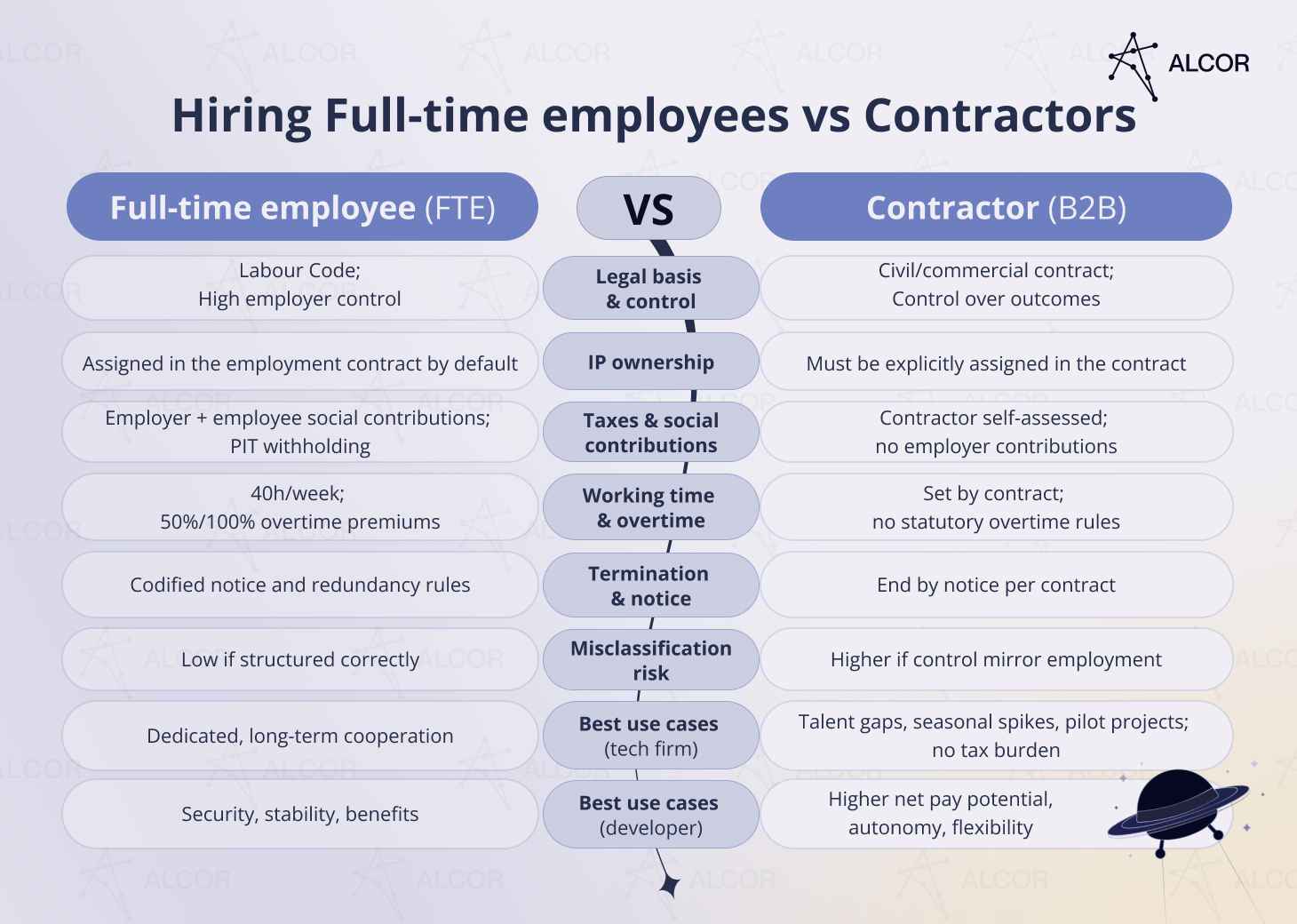
Read our guide about Employer of Record vs contractor engagement to understand when B2B cooperation is enough and when EOR support gives you stronger compliance, IP, and tax protection.
Remote vs hybrid vs on-site format
Poland’s hubs support all three working formats, with a CET time zone that syncs with Europe and overlaps with US mornings.
- Remote works best when speed and reach matter most. You can hire beyond the biggest cities, widen the talent pool, and move faster on hard-to-fill roles.
- Hybrid is usually the sweet spot for product teams. You keep the flexibility people want while still creating enough in-person rhythm for workshops, sprint planning, and relationship-building.
- On-site makes the most sense when security, hardware access, or close cross-functional work matters. It can work very well as long as the office actually supports the team instead of just existing for appearances.
Types of Employment Contracts
In Poland, the contract shapes control, cost, benefits, and risk. In practice, companies usually choose from four main engagement models: an employment contract, a mandate contract, a specific-task contract, or B2B cooperation. The right choice depends on how the person will actually work, not on which option looks cheaper on a spreadsheet.
- Employment contract – the default route for core team members. It can be probationary, fixed-term, or indefinite. A trial contract generally lasts up to 3 months, while fixed-term employment is capped at 33 months and 3 contracts before it rolls into indefinite employment. This model gives you the clearest structure for notice periods, paid leave, sick pay, and ongoing team stability.
- Mandate contract – more flexible, but lighter on protection. This is a civil-law contract focused on performing services with due diligence, not delivering a guaranteed end result. In Poland, mandate contracts are generally subject to ZUS in some form, depending on the contractor’s broader insurance situation, and do not confer standard employee rights such as paid leave, overtime protection, or dismissal protection. From 1 January 2026, the minimum hourly rate for contractors is PLN 31.40 gross.
- Specific-task contract – this model is built for a concrete result, not for ongoing product development with shifting priorities. It is usually lighter on social insurance costs and, in many cases, no ZUS contributions apply, but that does not make it a magic discount button. In Poland, these contracts generally must be reported to ZUS within 7 days.
- B2B contract – common in tech, but only when the setup really is independent. In practice, this means cooperation with a self-employed specialist who invoices monthly and manages their own business obligations. It is popular in the Polish software market because it can move fast and keep terms flexible.
This is where a good Employer of Record company from Poland earns its keep. It does not just hand you a contract template and disappear. It helps match the role to the appropriate engagement model, prepares the contract and onboarding documents, handles registrations and payroll as needed, stores compliance files, and keeps the process visible to the client.
Legislation in Poland
The Labour Code in Poland governs working time, overtime, leave, documentation, and terminations. Since 2023, remote work has been fully regulated. GDPR is actively enforced, and post-employment non-competes are also enforceable when paid. An Employer of Record in Poland helps you apply these rules correctly while your company scales in an EU jurisdiction.
Poland’s Labour Code sets a 40-hour work week, defines overtime premiums, and prescribes notice periods and documentation standards for employment. Remote and hybrid work have been expressly integrated into the Code since April 7, 2023, replacing legacy telework rules and requiring clear agreements and policies between employer and employee.
GDPR is another area where being casual gets expensive. The Polish Data Protection Authority (UODO) continues active enforcement and annual inspections, and Polish cases show that fines are not theoretical. Even basic HR mistakes – weak access control, poor internal oversight, loose file handling – can create real exposure.
Confidentiality and post-employment restrictions also need clean drafting. NDAs are standard in Poland, but they work best when they are specific and paired with clear IP assignment language. A post-employment non-compete can work too, but only when it is proportionate and paid, at no less than 25% of the employee’s prior remuneration for the restricted period.
Employee Misclassification & Penalties
In Poland, treating someone like an employee while paying them as a contractor can trigger fines, back social contributions, interest, and contract reclassification. The safest path is to align the working reality with the contract type – or use an Employer of Record in Poland to keep engagements clean.
Misclassification happens when a contractor works under employee-style control: fixed hours, a set workplace, ongoing duties, and supervision. If a labour inspector or court finds an employment relationship exists, the contract can be reclassified. That can mean unpaid ZUS contributions, holiday/sick pay, overtime, and PIT corrections – plus a fine. The Labour Code allows penalties of PLN 1,000-30,000 (USD ~250-7,500) for concluding a civil contract where an employment contract should apply.
Document roles clearly, tie B2B work to deliverables, and avoid employment-style controls for contractors. When in doubt, have a Polish EOR hire core staff on compliant employment contracts, and use a Contractor of Record to standardize B2B terms and IP.
Want to keep Polish B2B hiring from sliding into misclassification territory? A Contractor of Record in Poland can help standardize contracts, payments, deliverable-based scopes, and IP terms.
Employer of Record in Poland vs Legal Entity
At some point, every company expanding to Poland hits the same fork in the road: hire through an Employer of Record, or open your own legal entity.
If speed matters, an Employer of Record in Poland is usually the cleaner first move. As I’ve already mentioned, you can start hiring without waiting for incorporation, banking, payroll setup, and the rest of the local admin stack to catch up.
A legal entity gives you maximum control, but it also gives you the full local burden. You become the employer, which means HR, payroll, taxes, benefits, compliance, audits, and internal admin all sit on your side. That can make sense when your team in Poland is already large enough to justify the extra structure. But for early-stage expansion, it often means higher costs, slower hiring, and more operational noise than you actually need.
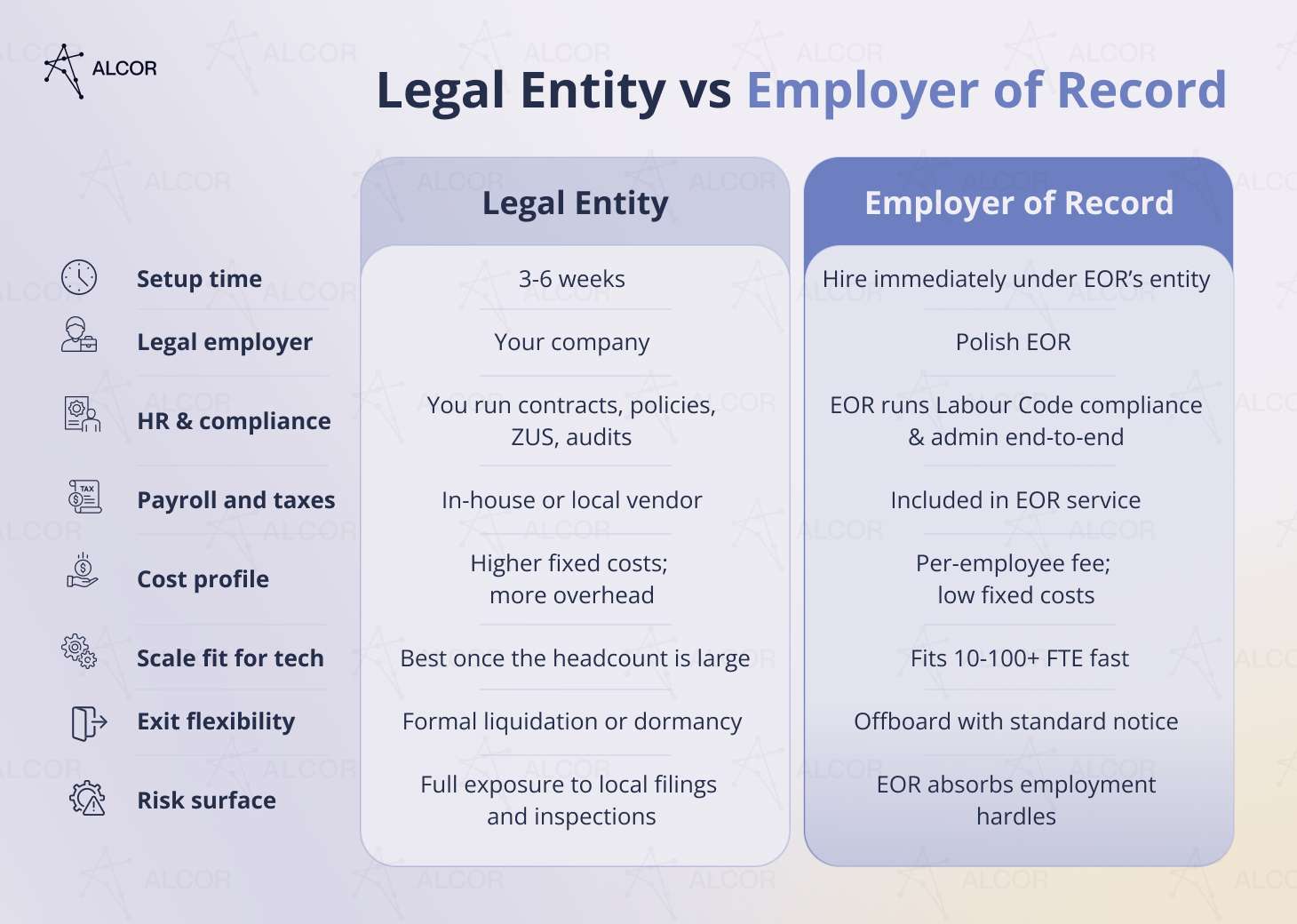
Payroll in Poland
Payroll in Poland is predictable but rule-dense. Employers must pay at least monthly, run gross-to-net salary calculations with PIT withholding, and remit ZUS on time. Pension and disability contributions stop at the annual base cap (30× average pay), while health insurance has no cap. Overtime premiums are defined in the Labour Code. An Employer of Record in Poland standardizes pay cycles, filings, and benefits, so finance teams see one compliant, line-itemed invoice each month.
Payroll frequency
Polish law requires wages to be paid at least once a month, on a fixed date, no later than the 10th day of the following month. If that date is a public holiday, payment must be made earlier. Most employers align the month-end close with payment in the first week of the next month.
Payroll processing cycle
A typical cycle includes:
- time and absence capture
- gross-to-net calculation
- payslips
- PIT withholding
- ZUS DRA filing and remittances
- year-end reconciliations.
A minimum wage of PLN 4,806 (USD ~1,287) updates cascade into related allowances (e.g., night work) and bases, so tables must be refreshed when the state changes rates. Employer of Record services keep these steps on schedule and adjust as thresholds move.
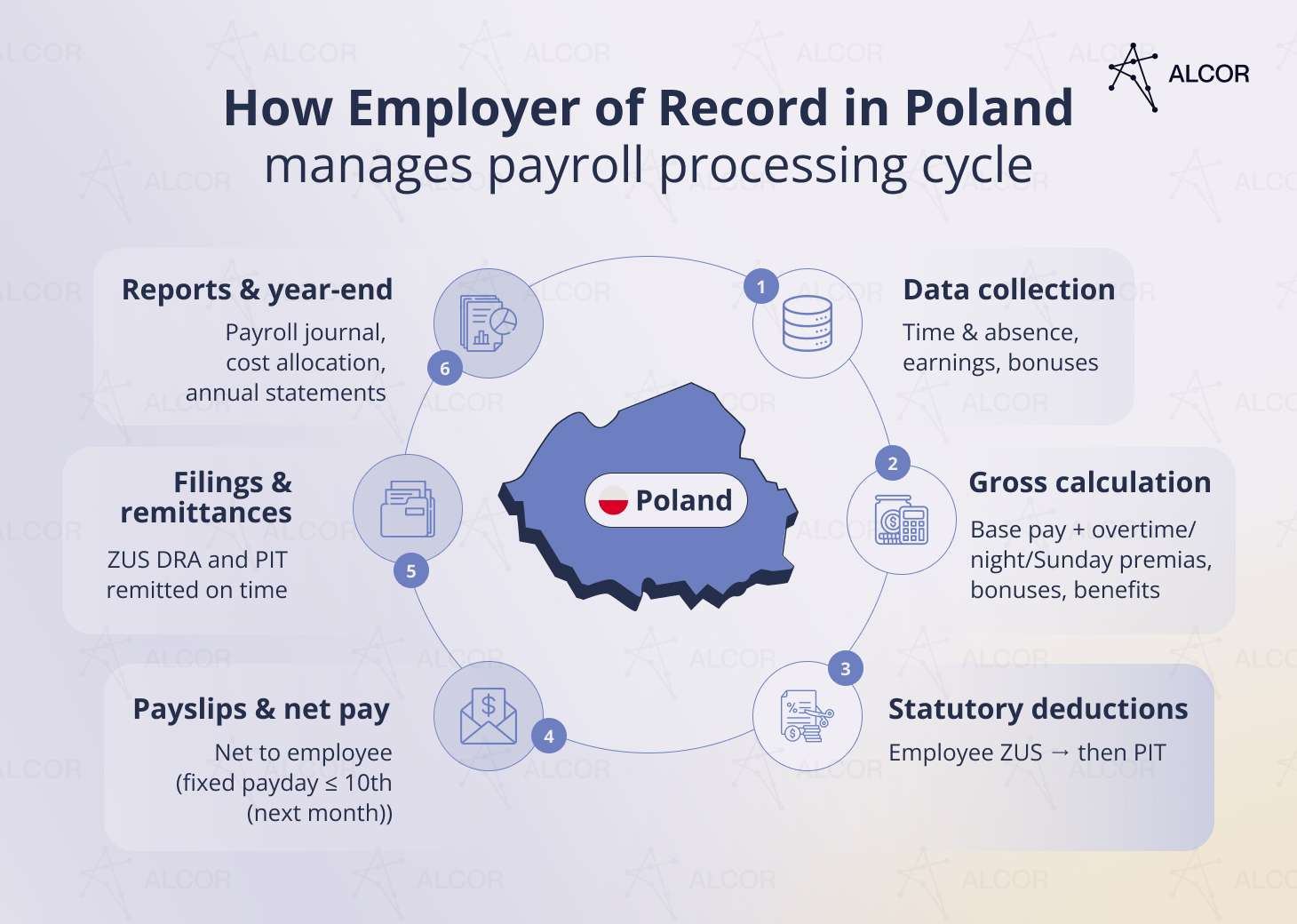
Social contributions
Poland’s social contributions are shared by the employer and the employee. Employers typically pay ~19-22% of gross pay for pension, disability, accident insurance (risk-based), plus the Labour Fund (2.45%) and Guaranteed Employee Benefits Fund (0.10%).
Employees pay 13.71% for pension, disability, and sickness, and 9% health insurance, so roughly ~23% in total. Worth mentioning that, as of 2025, Poland applies an annual cap for pension and disability insurance equal to 30x the projected average annual wage: the social contribution cap rose to PLN 260,190 (USD ~71,690). Health, sickness, accident, and fund contributions are not capped. Contributions are withheld and remitted monthly to ZUS.
Types of Bonuses
Poland sets overtime premiums by law and leaves most other bonuses to policy or collective agreements.
- Performance bonus. Tie it to KPIs and write the rules down – ambiguity quickly becomes entitlement.
- Discretionary award. One-off awards are common in the IT industry: document manager discretion to avoid disputes.
- Legal overtime/night/Sunday premium. 50% supplement for standard overtime; 100% for night, Sundays, and public holidays not scheduled as workdays. Time off in lieu is possible.
- Sign-on/retention bonuses. Contractual and often claw-back linked to tenure (align with notice rules).
- Holiday benefit. Not a common “13th salary,” but employers with ≥50 staff may operate a Company Social Benefit Fund.
Taxation in Poland
Poland’s employment tax setup is straightforward for hiring: employees are paid through monthly PIT withholding and ZUS social contributions; companies pay CIT (19% standard rate, 9% for small taxpayers). Contractors on B2B handle their own PIT and ZUS. What makes Poland attractive for tech is the mix of practical payroll rules, strong incentives, and treaty protection that can meaningfully improve your after-tax results.
In addition to social contributions, Polish employers face:
| Corporate income tax (CIT) | A flat 19% standard rate; Small taxpayers: 9% (with certain exceptions) |
VAT and withholding may apply separately depending on your business model, but payroll for FTEs is typically handled via monthly withholding.
For B2B cooperation, Polish contractors usually handle their own taxes and social insurance. In practice, many IT specialists choose either a lump-sum regime in which their services qualify, or the 19% flat tax on profit. But this is not a copy-paste decision: the correct tax treatment depends on the type of services provided, and ZUS costs vary by regime and eligibility for reliefs. For example, Ulga na start (Start-up Relief in Poland) can waive social insurance for eligible new entrepreneurs during the first six months, but it does not eliminate health insurance contributions.
On the employee side, PIT is generally 12% up to PLN 120,000 and 32% above that threshold, with a 4% solidarity levy on income above PLN 1,000,000. Employers calculate and withhold PIT as part of the payroll cycle.
Poland also offers tech- and R&D-heavy companies useful upside. R&D relief generally allows an additional deduction of up to 100% of eligible R&D costs, while employee and co-worker costs can reach 200%; entities with R&D center status can apply 200% more broadly. And under IP Box, qualifying income from IP rights – including copyrighted software – can be taxed at 5%, provided the nexus and documentation requirements are met.
Cross-border structures can benefit too. Poland’s broad double-tax treaty network may reduce withholding tax on dividends, interest, and royalties and help avoid the same income being taxed twice.
Employee Benefits in Poland
Poland combines clear statutory benefits with a mature perks market. Employees receive paid annual leave, sick pay, parental entitlements, and social insurance. Employers often add private healthcare, sports cards, and learning budgets. EOR services in Poland standardize all of this, so your offer is both compliant and competitive in the software industry.
Statutory benefits
- Annual leave. 20 days with <10 years’ service and 26 days with ≥10 years; prorated for part-time.
- Public holidays. National holidays are fully paid days off when they fall on workdays.
- Sick leave. Employers fund the first 33 days per year (14 days if 50+); ZUS pays sickness benefits thereafter. The usual rate is 80% of pay, 100% for pregnancy or work injury.
- Parental leave. Up to 41 weeks for a single birth (43 for multiples), with 9 non-transferable weeks reserved for the second parent.
- Insurance. Employment includes social insurance and state health coverage; contributions are split between employer and employee.
Non-statutory benefits
Most Polish companies add a practical perks layer on top of the statutory package: private medical care, life insurance, sports or fitness cards, meal cards, extra paid days off, and occasional home-office support. These extras matter because they shape both acceptance rates and retention.
Benefits in the tech sector
This is where offers start to win or lose. In Poland, in addition to the general non-statutory benefits, software engineers often expect flexible working hours, training or conference budgets, language-course funding, and additional vacation days. Company shares or ESOP/stock options are also common, especially once you move into stronger middle and senior profiles.
Bulldogjob’s report lists a 4-day workweek, flexible hours, additional vacation days, and private healthcare among the most attractive tech benefits, and senior-role listings commonly pair them with language learning and broader learning budgets. A good IT EOR in Poland will handle all of these for you.
Building a team in Poland? Discover how a Professional Employer Organization in Poland can help you deliver competitive benefits while staying compliant.
Work Permits and Visa Regulations
A US tech company hiring in Poland should plan for two tracks: Polish work authorization so engineers can be employed locally, and US business-travel permissions for occasional trips stateside. An Employer of Record in Poland keeps both moving quickly and compliantly.
Engineers working in Poland typically need local work or residence authorization tied to a Polish employer, plus compliant contracts and payroll.
For business travel to the US of up to 90 days, Polish nationals usually use ESTA under the Visa Waiver Program (VWP), which requires an e-passport and a clean travel history. For longer stints – around six months – or when ESTA isn’t available, they apply for a B1/B2 employment visa. This covers meetings, conferences, brief training, and partnership discussions, but not long-term employment in the US.
A Polish EOR coordinates local work permits and supplies HR documents that support US travel applications (invitation letters, employment confirmations).
Fundamental Employee Rights in Poland
Poland’s Labour Code guarantees clear employee rights that every employer must respect: written terms of employment, equal treatment, safe working conditions, regulated working time and rest, paid leave, parental protections, due process in termination, data protection, and freedom of association. Building your policies around these guardrails keeps teams compliant from day one.
- Written employment terms. Employees must receive a written contract and key employment information in a timely manner.
- Equal treatment & anti-discrimination. Employees have the right to equal pay for equal work and protection from discrimination or harassment.
- Health & safety. Employers must ensure a safe workplace, provide mandatory training, and conduct risk assessments.
- Working time & rest. Daily and weekly limits, rest breaks, and weekly rest are guaranteed; overtime is regulated and compensated.
- Paid annual leave. Employees have a statutory right to paid vacation, with accrual and usage rules set by law.
- Sick and parental protections. Employees are entitled to sickness benefits and protected maternity/parental rights, including job protection during leave.
- Termination due process. Dismissals must be based on legal grounds and require written notice.
- Data protection & privacy. Personal data processing must follow GDPR principles.
Diversity, Equity, and Inclusion (DEI) Employment Policies
In Poland, DEI starts with hard law: equal treatment, anti-discrimination, and safe-work requirements under the Labour Code and EU rules. It also extends to company practice: fair hiring, accessible workplaces, and inclusive culture. An Employer of Record in Poland helps embed these standards in contracts, policies, and day-to-day HR so your software industry team stays compliant and competitive.
Polish and EU law prohibit discrimination in hiring, pay, promotion, and termination based on sex, age, disability, race/ethnicity, religion or belief, sexual orientation, fixed-term/part-time status, and union membership. Employers must prevent harassment, ensure equal pay for equal work, and provide reasonable accommodations for disability.
Use structured interviews, consistent scorecards, and job ads free of biased language. In the Polish market, publishing ranges and leveling increase trust and speed acceptance. A Polish Employer of Record operationalizes DEI by issuing compliant policies, correctly tracking leave and accommodations, applying equal-pay rules in payroll, and capturing the required documentation.
Employee Probation & Onboarding
In Poland, probation for full-time employees is typically set at up to 3 months, giving both sides time to confirm fit. Onboarding is structured and compliance-heavy: contracts, payroll data, social insurance (ZUS), OHS training, and pre-employment medical checks must be completed before day one.
Probation in Poland usually lasts 1-3 months, with clear feedback checkpoints and 30/60/90-day goals. Before day one, the paperwork is done: signed contract and key terms, GDPR/IT consents, pre-employment medical exam, and initial OHS/BHP training. HR also gathers payroll data and registers the hire with ZUS so contributions start in the first pay cycle.
On the start date, the employer provides equipment and access, confirms any remote-work policy, and kicks off a ramp plan (buddy, codebase walkthroughs, OKRs).
As the full-scale russian invasion escalated in Ukraine, Alcor helped Intel 471 relocate 20 developers to Poland and onboard them in just 4 weeks. We acted as the local employer, completed all compliance steps, and enabled a seamless handoff to their engineering leads – proof that EOR in Poland can turn urgency into orderly execution.
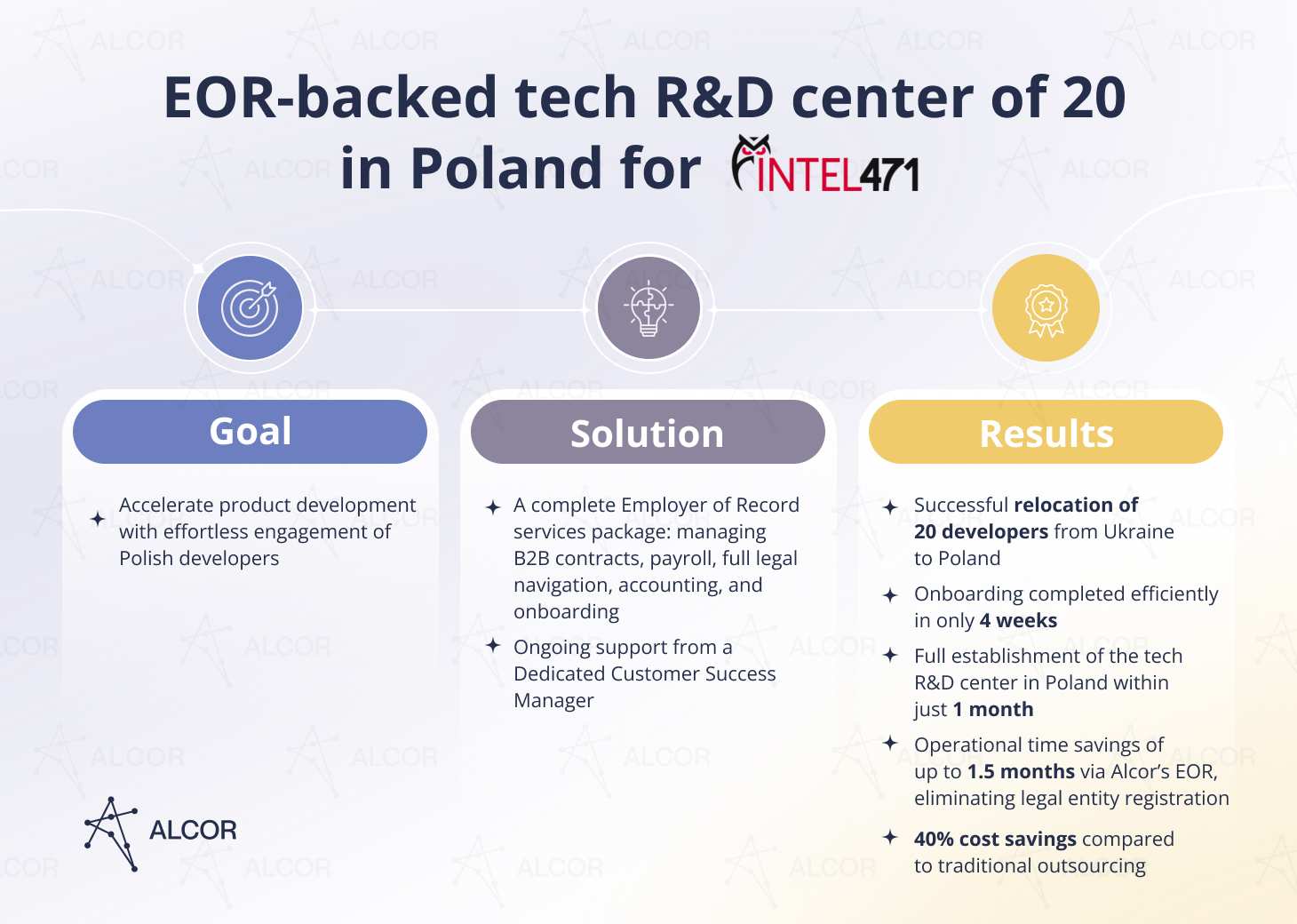
Employee Termination & Severance Package
In Poland, terminations must comply with Labour Code requirements regarding form, notice, and cause. The standard notice period for indefinite or fixed-term contracts is 2 weeks, 1 month, or 3 months, depending on tenure. Unused vacation is paid out at exit. A severance package for employer-driven layoffs is typically 1-3 months’ pay and is capped at 15× the statutory minimum wage.
What engineering leaders usually ask: When can we cut scope mid‑notice?
Answer: You can release the employee earlier by mutual agreement, but you will still pay out the remainder and any unused PTO.
For both indefinite and fixed-term employment, the legal notice period is 2 weeks (<6 months’ service), 1 month (≥6 months’ service), or 3 months (≥3 years’ service). During probation, notice is shorter (3 business days, 1 week, or 2 weeks, depending on the probation length). Employers may place an employee on paid “garden leave” during the notice period.
If you dismiss for reasons not attributable to the employee (e.g., role liquidation) and your Polish operation employs at least 20 people, statutory severance applies: 1 month (<2 years’ service), 2 months (2-8 years), or 3 months (>8 years). The maximum is 15x the monthly minimum wage (about $17k at current rates).
Employees are protected from dismissal during maternity/parental leave, with limited exceptions. Any unused paid annual leave must be cashed out at termination. Many employers align payout with the final payroll date to keep records clean.
Polish Corporate Culture Blueprint
Polish corporate culture blends European structure with pragmatic, delivery-oriented teamwork. Expect clear roles, punctuality, and documented decisions – tempered by collaborative problem-solving and strong engineering craftsmanship. Teams value trust, fairness, and steady communication cadence, which suits product work in the IT industry.
- Communication & decision-making. Meetings start on time and stick to agendas. Decisions are data-driven and documented.
- Leadership & management. Managers are expected to be prepared, specific, and fair. Public praise and private course-correction are appreciated.
- Work cadence & collaboration. Polish engineers favor deep-work blocks and well-run sprint rituals. Hybrid setups are common: office days are used for workshops, whiteboarding, and customer sessions, not status updates.
- Quality & compliance mindset. Security, documentation, and test coverage are taken seriously – helped by EU standards and mature local practice.
Interesting to know that Polish software developers are trusted for complex enterprise work. Poles also bring a calm, “play the next point” approach when incidents happen – exactly what you want in the final minutes of a release window.
Questions you can ask AI about Employer of Record in Poland:
- How does an Employer of Record in Poland work, what does it handle in practice, and when is EOR a better option than opening a local entity?
- Which are the best Employer of Record providers in Poland for different business needs, and how do Alcor, MOTIFE, RemoFirst, Rippling, and G-P differ in pricing, support model, and service scope?
- What should I know about hiring in Poland through EOR, including employment contracts, payroll taxes, ZUS, benefits, misclassification risks, and Labour Code compliance?
FAQ
How fast can I hire employees with an Employer of Record in Poland?
Typically, within days, if you already have vetted candidates. The EOR uses its Polish entity, contracts, payroll, and benefits templates, so you can issue offers immediately and start onboarding as soon as medical/OHS steps are done. Unlike standard EORs, Alcor also handles contingent tech recruitment end-to-end, filling roles in 2-6 weeks, with an average onboarding time of 10 days.
How does an Employer of Record help optimize payroll costs?
Base salary and statutory ZUS/PIT are the same by law. EORs remove entity setup, local payroll vendors, and ongoing compliance overhead, replacing them with a clear per-employee fee.
How does an Employer of Record in Poland reduce compliance risks?
EORs are the legal employer. They apply Labour Code rules, run ZUS/PIT correctly, manage remote-work and GDPR policies, and keep records audit-ready – lowering misclassification and filing risks.
What is the difference between EOR and PEO in practice?
EOR is the legal employer in Poland – it manages operations, while you manage day-to-day work. PEOs typically co-employ and still rely on your local entity. If you don’t have a local presence in Poland, consider choosing EOR.
Are layoff laws comparatively flexible in Poland?
They’re structured but workable. Notice depends on tenure (2 weeks/1 month/3 months), and statutory severance applies for employer-driven layoffs in larger employers. An EOR applies the correct process.
How does an EOR safeguard a client’s IP and confidential information?
Employees sign IP assignment, NDA, and security policies under Polish law. The EOR enforces these in contracts and onboarding, so IP vests in your company, and data handling follows GDPR.
What are the tax implications of using EOR vs hiring contractors in Poland?
With EOR (employment), payroll taxes are withheld monthly, and ZUS is remitted. With contractors (B2B), the company doesn’t run payroll taxes – contractors handle their own PIT/ZUS. COR (Сontractor of Record) can standardize B2B compliance.
Does Poland’s migration trend affect talent availability?
Yes. Poland’s large, diversified tech hubs (Warsaw, Kraków, Wrocław, Gdańsk) continue to attract regional and international engineers. An EOR helps you tap these pools quickly and compliantly.
How would you rate this article?
Alcor is Your Trusted Scaling Partner
for expansion
support