


Contractor of Record (COR) is a third-party company that legally hires and manages independent contractors on behalf of expanding tech businesses. With cross-border hiring and mobility on the rise, 55% of tech executives plan to engage contract talent in the first half of 2026 to keep up with growing demand. That’s why COR adoption is moving fast.
It solves an immediate problem – access to talent. But hiring faster doesn’t always mean scaling smoothly. You add people, you expand across markets… And then something starts slowing the process down. Not hiring itself, but everything around it.
At Alcor, we combine COR/Employer of Record in Latin America & Eastern Europe with tech recruitment and operational support. It helps companies build a global engineering infrastructure of up to 30 devs in 3 months that work as a system, and this high-performance system feels in-house from day 1.
In this article, you’ll explore the main functions and benefits of the Contractor of Record model, how COR mitigates risks and secures ROI. You’ll also discover alternative models to choose the optimal one for your tech business.
Key Takeaways
- The Contractor of Record serves as a bridge for VC-backed startups and tech product companies, enabling them to expand without legal complications. It manages compliance, contracts, payments, and admin tasks, ensuring a smooth global hiring process.
- Contractor of Record enables tech businesses to tap into vast talent pools in LATAM and Eastern Europe, reduce expenses by 55-60%, and mitigate legal and classification risks.
- COR agreements clearly define the roles and responsibilities of the parties involved, the scope of services, IP rights, and payment terms to ensure transparent collaboration.
- Unlike EORs and AORs, CORs specialize in managing independent contractors, offering high flexibility and lower costs for expanding tech companies.
- Alcor’s R&D center is an upgraded version of COR, which also includes tech recruitment and full operational support. It enables 100% compliant, scalable growth of the tech teams in LATAM and Eastern Europe, up to 100 developers within a year. Plus, a 2.5-year average engineer tenure.
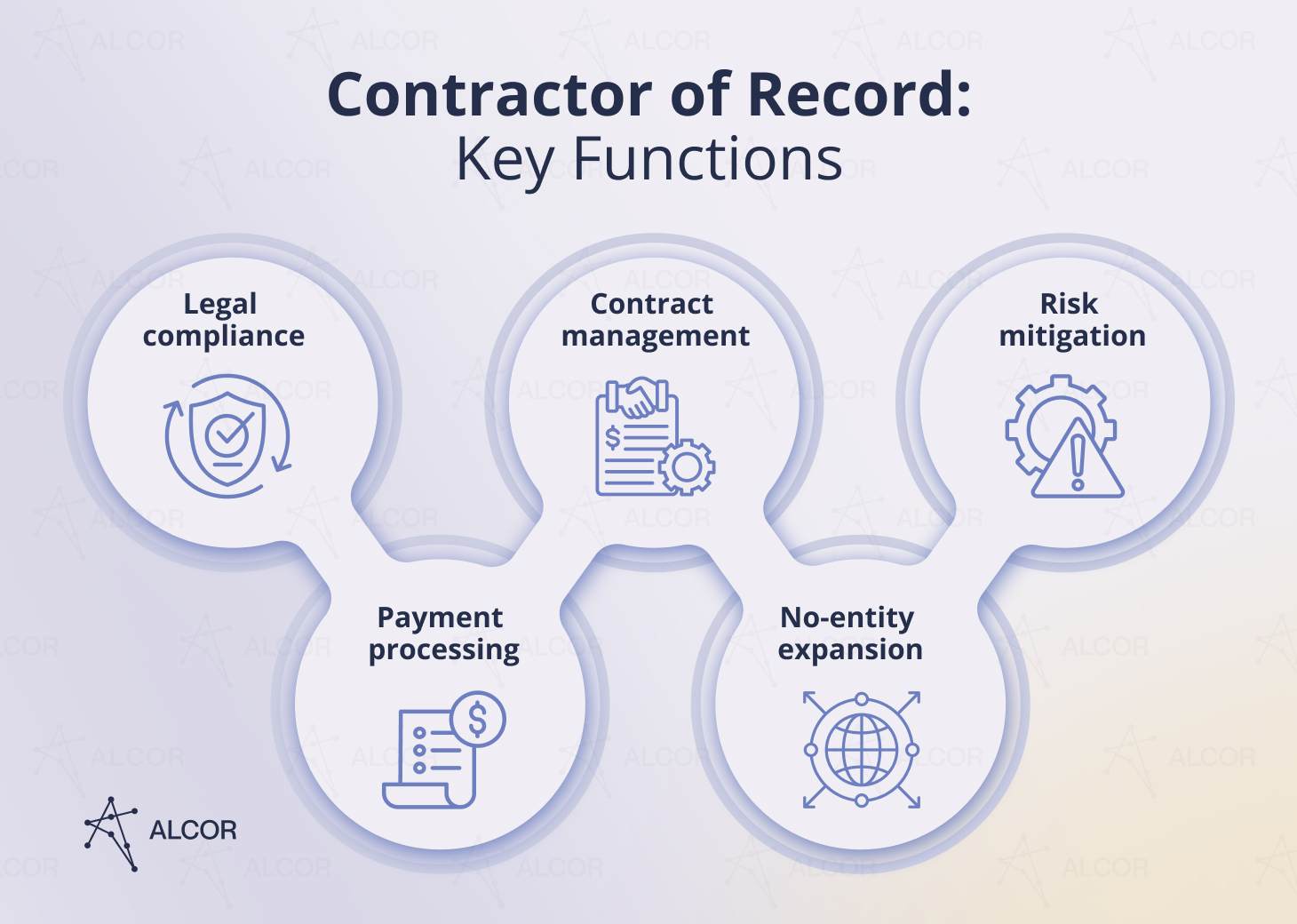
Contractor of Record: Key Functions
A Contractor of Record (COR) supports global contractor hiring by handling legal, administrative, and operational functions. Its key functions include:
- Enabling international hiring without setting up a local legal entity;
- Ensuring compliance with local labor, tax, and regulatory requirements;
- Preparing and managing localized, legally compliant contracts;
- Mitigating risks such as worker misclassification and legal penalties;
- Managing payments, including invoicing, currency exchange, and documentation.
Global expansion
Looking beyond borders? A Contractor of Record solution is your golden ticket to international hiring. Backed by local expertise and on-the-ground presence in multiple markets, COR frees you from red tape, legal guesswork, and costly delays.
For instance, Alcor’s Contractor of Record services enable VC-backed startups and fast-growing tech product companies to access cost-effective tech locations in Latin America and Eastern Europe. This way, they can build high-performing development teams in just one month.
Looking at Romania as one of your next Eastern European markets? Contractor of Record services in Romania can help you engage local B2B tech talent while keeping contracts, payments, IP terms, and compliance documentation structured from day one.
Legal compliance
Let’s say you’ve hired across two or three countries. It’s great! But navigating laws and regulations across borders is not a walk in the park. From strict data protection rules in Chile to labor termination rules in Colombia, you need to dig deep into each location of your expansion to ensure full compliance.
Luckily, there are COR providers who ensure contractor engagements align with local tax, employment, and commercial regulations, so you stay legally clean while expanding rapidly in the new market. Instead of constantly checking what might break, you can focus on what needs to move forward.
Contract management
One-size-fits-all contracts don’t cut it when hiring globally. Each country has its labor law peculiarities, which are especially strict in pro-worker locations like Mexico. Here, if a contractor works under direct supervision or lacks financial independence, they can be reclassified as an employee by local authorities. That means you could be liable for back pay and penalties.
A COR service provider protects you from misclassification. They draft and localize contracts that meet regional legal standards, clearly outline project-based deliverables, and avoid red flags like fixed working hours or direct supervision.
Planning to engage developers through B2B contracts? A Contractor of Record in Poland, other EE & LATAM locationscan help you localize agreements, manage payments, and reduce classification risks.
Risk mitigation
Hiring contractors abroad carries significant legal and financial risks, especially when it comes to worker classification, taxes, and local compliance requirements. A Contractor of Record provides a structured way to manage these risks from the outset.
At Alcor, we help tech companies avoid costly penalties by drafting compliant contracts and staying up-to-date with evolving labor regulations across LATAM and Eastern Europe. Just ask BigCommerce. To help them expand into EE without legal risks, our lawyers developed a tailored solution that ensured full GDPR compliance and addressed any potential concerns from European authorities. With Alcor, your tech company’s growth doesn’t get interrupted by legal surprises.
Payment processing
Paying international contractors isn’t just about clicking a button “Send.” It involves navigating local tax systems, currency exchange rates, banking regulations, and invoice tracking. One wrong move and you can face penalties or delays.
A Contractor of Record company streamlines the entire payment process, ensuring timely, accurate, and compliant payments in local currencies while taking care of withholding obligations, documentation, and contractor invoicing.
Why Use Contractor of Record in 2026?
A Contractor of Record is used in 2026 to simplify global hiring while maintaining speed, cost efficiency, and compliance. Key reasons include:
- Fast access to large global talent pools without setting up a legal entity;
- Reduced hiring costs, with savings of up to 55–60% compared to US salaries;
- Full compliance with local labor laws, tax rules, and contract requirements;
- Protection from worker misclassification and related financial risks;
- Elimination of administrative workload, including onboarding, payments, and HR operations.
1. Fast access to tech talent
Are you one of those 72% tech C-suite managers who struggle to hire skilled software engineers? With COR – not anymore! By cooperating with a Contractor of Record provider, you can tap into a 2-million-talent pool in Latin America and a 1.8-million-talent pool in Eastern Europe (faster than your competitors). Plus, you can hire them without the need to establish a legal entity, scaling your tech team up or down as needed.
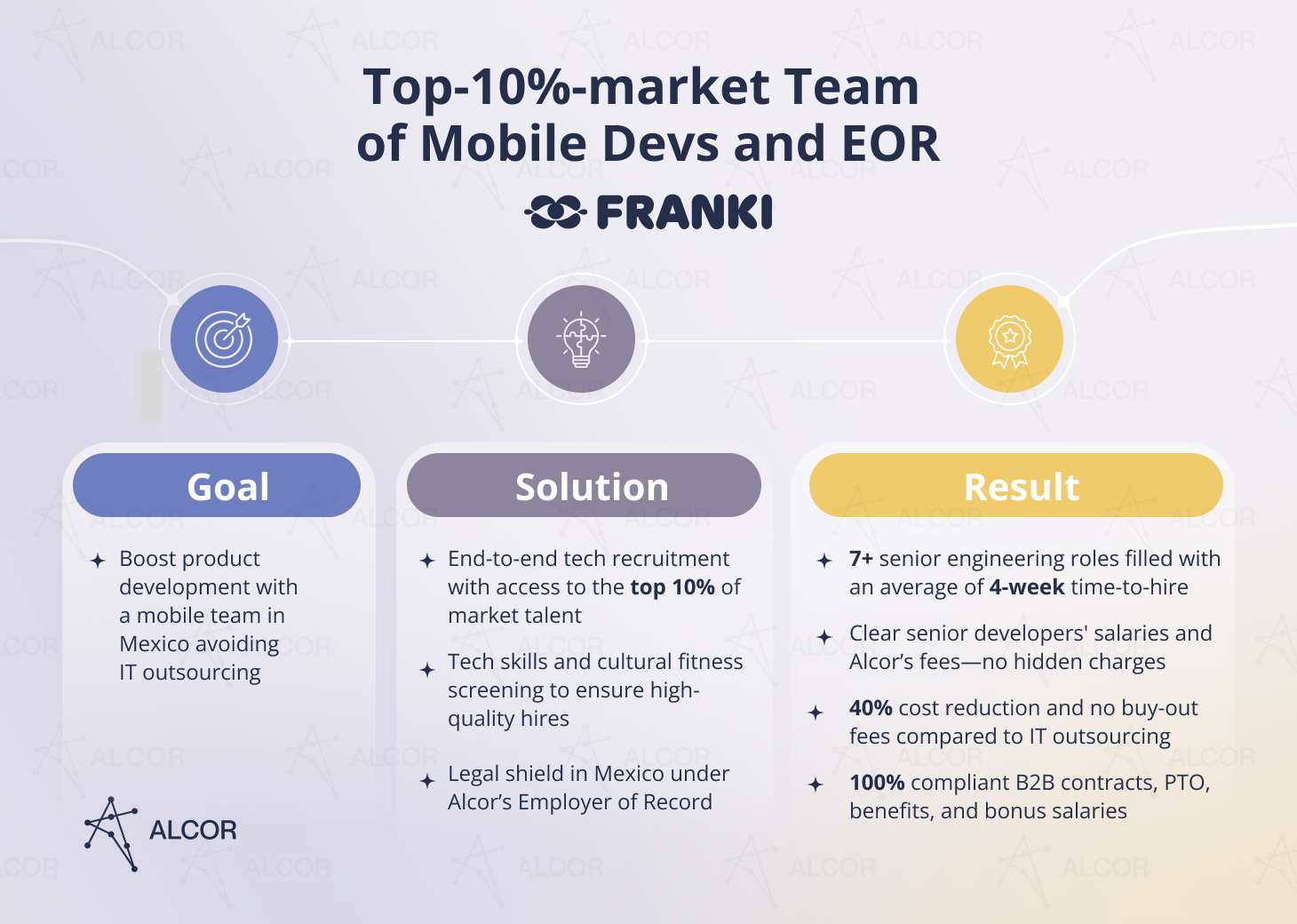
Look at how Franki, a California-based tech company, took advantage of this opportunity with Alcor’s COR service in Mexico. With an average time-to-hire of just 4 weeks, we recruited 7 senior Mobile Developers, ensuring full compliance with Mexico’s laws and managing B2B hiring and benefits. On top of a fully backed dev team, Franki was able to save 3.5 months on opening a legal entity and expand within their budget. With the mobile team in place, development accelerated, and the company doubled its revenue in 2024.
Want to engage Mexican tech contractors without opening a local entity? A Contractor of Record in Mexico can help you manage contracts, payments, and compliance with less legal friction.
2. Slashed expenses
Now, the next question usually follows. If you need to hire more, how do you keep it within budget without lowering the bar?
With the Contractor of Record model, you can save up to 55-60% on salary expenses. Hard to believe it? The figures don’t lie!
While the average senior software engineer in the US earns $14K per month, in-demand roles like AI product, ML, and LLM engineers can command salaries of up to $19K, according to our internal data. LATAM and Eastern Europe offer a more budget-friendly alternative. The average salaries of senior developers there are only $5.5K and $6K, respectively.
And here’s the real win for you: by hiring through B2B contracts, tax handling stays on the contractor’s side.
COR can cut hiring costs – but do you know how much EOR costs when you need full employment coverage? Read our Employer of Record cost guide before choosing your model.
3. Full compliance across markets
Hiring global contractors sounds easy until you face a maze of local labor laws and tax regulations, predominantly connected to business incorporation and contract agreements. Each country has its own requirements, and managing them across several locations becomes an ongoing effort. Something that needs to be continuously checked, updated, and monitored. Failure to comply with them can lead to hefty fines and even legal action.
A Contractor of Record takes this burden off your shoulders by handling compliance across various jurisdictions, contract management, and tax documentation. With Alcor, you can also tailor B2B contracts to your tech business needs and get customized IP rights and NDA agreements. You stay focused on building innovative tech products while your COR partner keeps you on the right side of the law.
Considering Employer of Record? Read our full guide on Employer of Record for independent contractors to learn how this model helps manage classification risks, tax documentation, and IP protection abroad.
4. Shield from worker misclassification
Then there is classification. A detail that often seems minor until it becomes a problem.
COR service providers help tech product companies, like yours, legally engage contractors abroad, protecting you from regulatory scrutiny and financial liabilities tied to improper worker classification.
At Alcor, we prevent misclassification through result-driven contracts, clear contractor accountability for service quality, and strict invoicing standards. Our contractors register with tax authorities and manage their own tax obligations, ensuring full compliance with commercial laws across LATAM and Eastern Europe.
5. No admin burden
And finally, operations.
One-third of companies spend at least 11 hours a week on HR admin. And it costs them nearly $29K monthly ($350K annually). Doesn’t look very efficient, does it? Now, imagine having to do it in another country. Additional staff, training, and increased labor expenses are just a few factors your company will incur to manage administrative functions for your remote contractors.
Contractor of Record handles all admin tasks for you, from contractor onboarding and offboarding to payments, benefits, and HR, so that you can focus on product strategy and growth decisions.
Contractor of Record Legal Agreement Aspects
COR agreement defines the legal and operational framework for engaging contractors across countries. Key aspects include:
- Clear roles of all parties: client company, COR provider, and contractor;
- Defined scope of services, deliverables, timelines, and responsibilities allocation;
- Correct legal status, with COR as engager (not employer);
- Structured payment terms, including currency, method, and invoicing;
- Compliance measures covering classification, taxes, and local regulations;
- IP and data protection clauses ensuring client ownership of work;
- Termination terms, including notice periods and post-contract obligations.
Now, let’s take a closer look at the COR agreement. It lays the legal and operational ground for cooperation with both your contractors and the vendor abroad. Below are the key elements every solid COR agreement should cover:
Parties involved
The A COR agreement outlines the responsibilities and expectations of all parties involved to minimize inconsistencies and risks.
- Client company: Manages the contractor’s day-to-day work, assigns tasks, monitors performance, and approves deliverables.
- Contractor of Record: Drafts compliant contracts, manages invoices, ensures tax filings, monitors legal changes in the contractor’s location, and handles onboarding/offboarding.
- Independent contractor: Completes assigned tasks and projects under the terms defined in the agreement, submits invoices, and complies with local tax laws.
Scope of services
Defines what the Contractor of Record and independent contractor are expected to deliver, how, and by when. It sets the foundation for the working relationship, aligns expectations, and protects all parties. Let’s say you’re hiring a developer in Mexico to work on your mobile app. Here is a brief scope of services:
|
A contractor should deliver frontend development services, with weekly demo updates and final delivery in 6 months. |
|
Contractor of Record will handle all onboarding documents, ensure B2B compliance with Mexican law, and process the contractor’s monthly invoices. |
Legal employment status
It’s important to correctly distinguish roles. A Contractor of Record is the legal engager of the contractor, not the employer. It means the COR signs the contract with the contractor on your behalf and ensures that the relationship aligns with local laws.
This distinction matters more as you expand. Different countries apply different standards to contractor relationships, and misalignment can lead to misclassification risks or regulatory issues. A properly structured agreement maintains this layer’s consistency across markets.
Payment terms
Payment terms define how, when, and in what currency contractors will be paid – and how the COR facilitates these transactions on your behalf. Unlike traditional employment, independent contractors are usually paid per task/project, by the hour, or on a monthly basis, often in US dollars. Common payment methods include Wise, Payoneer, or SWIFT transfer, all managed by the vendor. A COR agreement outlines this structure clearly and ensures both parties are aligned.
Compliance & risk mitigation
Since labor laws, tax rules, and compliance requirements vary significantly across countries, a reliable Contractor of Record ensures that every engagement adheres precisely to local regulations. It includes proper classification of independent contractors, mandatory registrations, and ensuring that contractors issue valid invoices.
IP & data protection
Protecting your tech product company’s intellectual property is a top priority in any COR agreement. The contract should clearly state that all IP created by the contractor during the engagement belongs to the client, preventing any future ownership disputes. It includes software code, designs, inventions, and any other work products.
Termination
Termination clauses are a critical part of any COR agreement. Why? Because they define the conditions and terms, the contract can be ended. They usually include notice periods, grounds for termination, and any obligations that follow termination, such as final payments or the return of company assets.
Unlike traditional employment, contractor agreements are usually more flexible. For instance, a client may terminate a contract with 15 or 30 days’ notice, depending on local laws and terms outlined in the agreement.
How COR Mitigates Risks and Secures ROI
A Contractor of Record mitigates risks and secures ROI by ensuring local compliance, preventing worker misclassification, and standardizing contracts with clear IP and terms. It also streamlines payments and administration while providing ongoing compliance monitoring and operational support across markets.
A reliable Contractor of Record helps you hire safely. Here’s how:
- Local compliance assurance: CORs stay up to date with regional labor laws, ensuring every contractor agreement complies with local standards, and reducing the risk of audits, penalties, or regulatory scrutiny.
- Worker classification protection: By structuring results-based contracts and overseeing proper invoicing and taxation, Contractor of Record services protect your business from misclassification fines and retroactive liabilities.
- Contractual clarity: Contractor of Record drafts agreements that clearly define IP rights, termination terms, and deliverables, helping prevent disputes and protecting your assets.
- Streamlined admin & payments: With a COR managing onboarding, payroll, and documentation, you avoid errors or oversights that could trigger legal or financial trouble down the line.
- Ongoing monitoring & support: Your COR provider doesn’t vanish after onboarding. They continuously monitor compliance and support any issues that arise throughout the partnership, acting as a steady co-pilot on your global hiring journey.
But how does this work once you move from theory to execution? Look at the case with GoTransverse. This US-based software product company was seeking ways to hire full-stack developers in Eastern Europe without establishing a legal entity. Through Alcor’s COR combined with software R&D center services, they secured:
- A senior full-stack team in just 6 weeks;
- Full compliance with EU and US legislation;
- Direct team management from day one;
- Payments and tax management for developers;
- Equipment procurement & dedicated support.
With their newly assembled full-stack team, Gotransverse successfully launched a major software update, boosting their client base and revenue. That’s how successful tech product companies reduce risk and maximize return when expanding globally.
Alcor also acts as an Employer of Record service provider in Poland and other EE and LATAM countries. Reach out to learn more!
COR vs EOR vs AOR: Breakdown with Examples
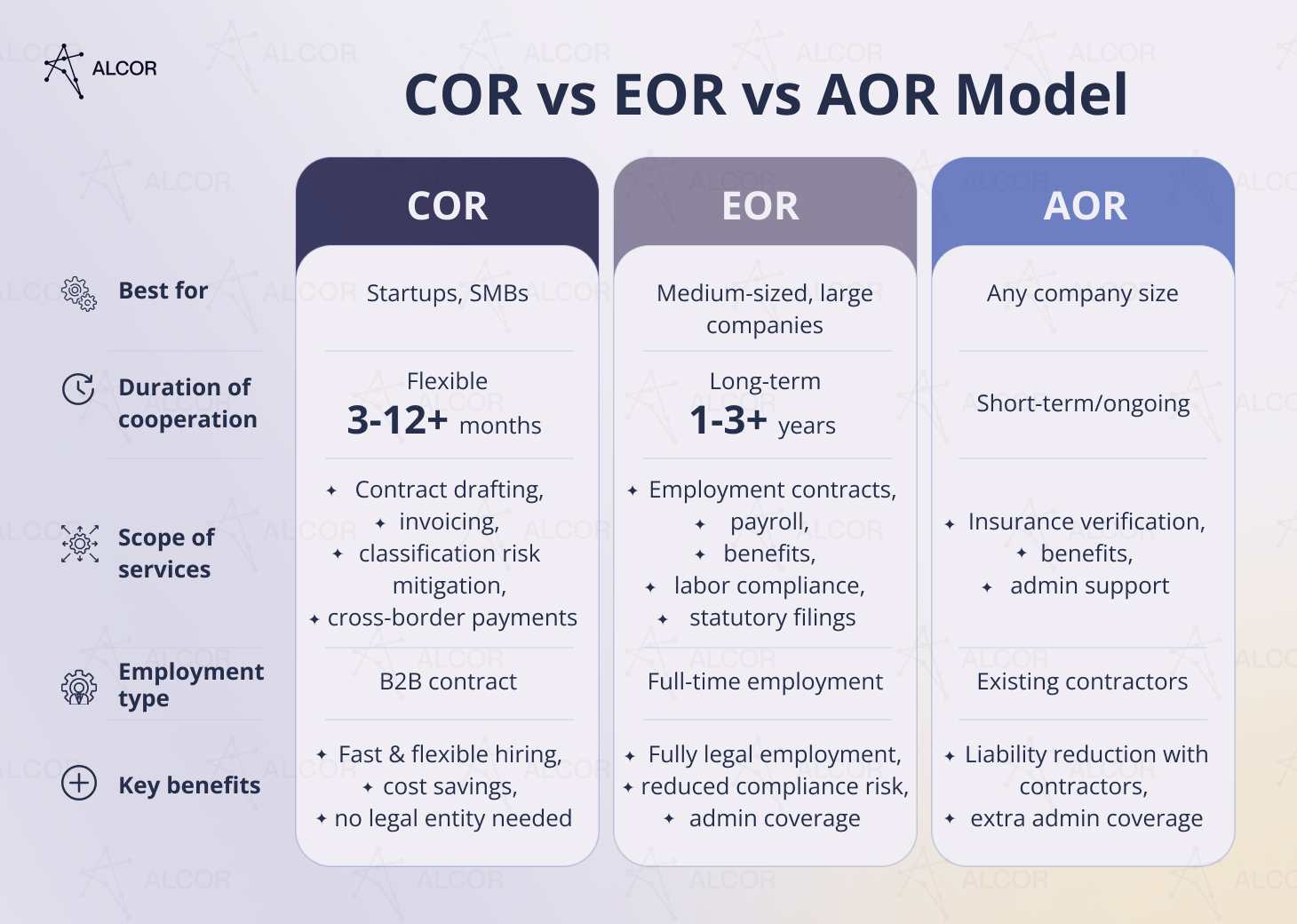
Here is a quick peek into the models:
- COR enables legal engagement of independent contractors abroad for tech companies.
- EOR serves as the legal employer of full‑time developers on behalf of the client, taking on full liability for employment and handling compliance, payroll, and benefits.
- AOR acts on behalf of its clients when dealing with insurance or employee benefits through third parties, but does not cover hiring or administrative functions.
Now, let’s dive into details…
An Employer of Record is a hassle-free way to employ foreign software developers without requiring business incorporation. Basically, you use the existing legal entity of your EOR provider to build a development team while also enjoying their full liability. Unlike CORs, Employer of Record offers a wider range of compliance and admin services, which makes them a bit more expensive.
Discover the differences between EOR vs PEO!
Agent of Record is a supplementary service to your existing COR or a helping hand for your internal ops team. They help you deal with insurance negotiations, policy changes, and employee benefits through third parties. Unlike the Contractor of Record provider, AOR doesn’t hire developers.
When to opt for Contractor of Record
COR is ideal for tech startups and rapidly expanding companies, particularly those working on cutting-edge innovations such as AI, blockchain, robotics, and SaaS. These businesses often face skill gaps when building agile teams, so Contractor of Record can easily bridge this issue by legally and swiftly engaging independent contractors with niche skills.
Looking at Colombia for LATAM contractor hiring? A Contractor of Record in Colombia can help you work with local software developers while keeping misclassification risks under control.
When to opt for Employer of Record
Global Employer of Record services are best suited for VC-backed startups and mid-sized to large tech companies planning long-term engagements with full-time international employees. Especially when IP ownership and team retention are key considerations. It is ideal for tech product businesses that want to enter new markets without establishing a legal entity.
Expanding to LATAM? Check out Employer of Record services in Colombia! You can also learn how EOR for startups supports fast and compliant hiring across the region.
When to opt for Agent of Record
AOR works well for tech companies and staffing agencies that lack internal expertise to manage employee benefits, insurance, and some admin functions. It’s a smart option for short-term, project-based work where you already source tech talent but need a partner to handle paperwork.
Need Romanian developers for niche skills, fast ramp-up, or a pilot project? A Contractor of Record in Romania can help you move quickly without letting contracts, invoices, and IP terms become side quests.
Top 3 Industries Using Contractor of Record for Global Expansion
Contractor of Record is commonly used in industries that rely on flexible, cross-border hiring:
- Retail & e-commerce: hiring support, analytics, and design roles across markets;
- Gaming & entertainment: engaging specialized creative and technical talent as needed;
- Technology & ICT: scaling development teams quickly without legal or administrative complexity.
I’ve already touched on the companies that could potentially benefit from Contractor of Record. Now, let’s take a broader view by examining the industries. While COR can support any, there are several standout examples.
Retail & e-commerce
With the rise of global online shopping, many e-commerce companies scale across borders to stay competitive. Sales managers, customer service support roles, data analysts, and UI/UX designers are in-demand positions these businesses are hiring for. The Contractor of Record model allows them to engage these professionals quickly without committing to permanent employment or forming an entity. Especially in time zones aligned with the US.
Gaming & entertainment
Gaming studios and startups always work on new and exciting products. Engaging niche game developers (sometimes even indie game developers), illustrators, 3D artists, and sound engineers on a freelance or contract basis is not rare. The Contractor of Record model allows them to quickly tap into global talent to address skill gaps and launch seasonal releases without committing to long-term employment.
Technology & ICT
Probably the most vibrant and versatile industry that needs Contractor of Record assistance to stay ahead of the innovation curve. From early-stage AI startups to growing SaaS companies, leveraging COR helps innovation businesses hire developers of any type and level of expertise without the burden of compliance and admin. With tech expenses soaring and talent shortage looming, many hi-tech companies turn to LATAM and Eastern Europe for skilled, cost-effective developers that they can legally onboard in weeks, not months.
Learn more about the intricacies of IT EOR in Poland – how it handles local taxes, and provides you with a 100% legal shield and GDPR compliance!
This is what Alcor makes possible. See yourself…
Alcor – COR and EOR provider in Latin America and Eastern Europe
Alcor combines Contractor of Record and Employer of Record services with tech recruitment and full operational support into a unified R&D center model. It acts as a global engineering infrastructure, building high-performance teams of 10-30 engineers in 90 days while providing the operational framework to run them in Latin America and Eastern Europe.
Why settle for just the Contractor of Record model when you can get recruitment and all operational support in one place, without managing multiple providers, right? That’s what we thought when we were devising our all-in-one software R&D center solution.
The idea came from a pattern we at Alcor kept seeing. The Contractor of Record model helps teams get started. It removes legal friction, simplifies contractor engagement, and makes global hiring accessible. But once the team begins to grow, the challenge shifts. Hiring continues, yet coordination becomes heavier. More roles are opening, more countries are involved, and operational tasks are starting to build in the background. At some point, it’s no longer about hiring faster but keeping everything aligned so execution doesn’t slow down.
You need precision and consistency. You need a system that filters the signal from the noise.
Fraud prevention US company Sift approached its tech expansion in Eastern Europe with that in mind. Instead of separating processes, they combined the Employer of Record model with Global Contractor Management, tech recruitment & full ops support through Alcor.
The first expansion started in Ukraine. Soon, the results were strong enough to extend the same approach to Poland. Over time, the team grew to 51 Valley-caliber engineers across both locations:
The collaboration brought Sift:
- Hiring speed that changed expectations: a Senior Product Designer was hired from the first CV. At the same time, three critical roles – two Infrastructure Engineers and a Ruby on Rails developer – were closed within just 7 days, keeping product timelines on track.
- Full compliance across two jurisdictions: expansion into Ukraine and Poland did not require Sift to navigate local legal systems independently. Employment, tax management, contracts, benefits, onboarding, and IP protection were all handled within one operational structure.
- Stronger employer positioning in a competitive market: a campaign featuring Sift’s Hiring Manager and team culture was promoted across social channels, increasing visibility among candidates and improving offer acceptance rates by 15%.
- Extended support beyond hiring: developers received stock options in a compliant structure, while international mobility was supported, including travel for 12 engineers to California for the Sift Summit.
Our software R&D center solution has already proved effective for BigCommerce, Ledger, People.ai, and other US and Western European tech companies. In fact, 93% of tech CEOs and CTOs we’ve worked with say they’re satisfied with our services.
Try it out yourself! Fill the form below, and let’s discuss your expansion needs.
Questions you can ask AI about Contractor of Record:
- What are the risks of hiring international contractors without a Contractor of Record?
- How fast can a tech company realistically build a team using a Contractor of Record model?
- When should a tech company choose Employer of Record over Contractor of Record?
FAQ
What is a Contractor of Record (COR) and how does it work?
A Contractor of Record (COR) is a third-party provider that legally engages independent contractors on behalf of a company. It manages contract drafting, invoicing, and compliance with local laws in the contractor’s country. The client company oversees the contractor’s work, while the COR ensures the engagement meets tax, legal, and regulatory requirements. It allows companies to hire internationally without establishing a legal entity.
Is Contractor of Record legal for hiring international contractors?
Yes, the COR model is legal when contractor relationships comply with local labor and tax regulations. Legal validity depends on proper classification and adherence to country-specific rules. A COR provider structures contracts and payments to align with these requirements. It reduces the risk of non-compliance.
What risks does a Contractor of Record help mitigate?
A COR helps reduce the risk of worker misclassification, which can lead to fines, back payments, or legal disputes. It also addresses tax compliance risks by ensuring correct invoicing and payment structures. Additionally, COR providers standardize contracts to meet local legal requirements and include IP and confidentiality clauses.
What is the difference between COR, EOR, and AOR?
A Contractor of Record (COR) manages independent contractors and ensures compliant engagement without forming an employment relationship.
An Employer of Record (EOR) legally employs full-time workers on behalf of a company and handles payroll, taxes, benefits, and employment liability.
An Agent of Record (AOR) supports administrative functions, such as benefits and insurance, but does not handle hiring or employment.
How would you rate this article?
Alcor is Your Trusted Scaling Partner
for expansion
support