

















Key Takeaways
- A PEO in Latin America manages payroll, tax filings, benefits, HR administration, and labor compliance through a co-employment arrangement, while your company remains the legal employer.
- PEO services in Latin America can reduce admin workload, improve payroll accuracy, support employee benefits, and help companies navigate complex labor laws, contracts, onboarding, and termination requirements across LATAM.
- Mexico offers scale and proximity to the US; Colombia combines a growing tech base with business-friendly conditions; Argentina brings strong English-language depth and competitive costs; and Chile provides a stable business environment and strong engineering expertise.
- The main limitation of PEO is structural: you still need your own local legal entity and retain part of the employment liability. An Employer of Record removes both barriers by hiring employees through its entity and assuming formal employer responsibility.
- Alcor combines tech-focused EOR, recruitment, and operational support in one tech R&D center model. It enables tech product companies to fill senior positions, including AI, in 2-6 weeks, onboard hires in 10 days, and avoid compliance and admin issues, while scaling to 30+ senior engineers within 90 days.
What are the benefits of using a PEO in Latin America?
Firstly, let’s clarify what PEO actually is. A Professional Employer Organization (PEO) in Latin America is a workforce management provider that operates under a co-employment agreement. By partnering with a PEO, tech companies can outsource HR, payroll, compliance, and benefits admin while gaining greater flexibility in volatile markets and reducing legal risk.
Here’s what you get with Latin American PEO.
Focus on strategic priorities
One of the main advantages of using PEO services in Latin America for tech companies is the freedom from administrative hassle. Contracts, payroll, benefits, HR – everything is managed by PEO, while your team stays focused on high-impact work like developers’ hiring and integration, product development, and business growth. According to the National Association of Professional Employer Organizations (NAPEO), companies that partner with PEOs tend to grow twice as fast.
Compliance & risk mitigation
Navigating labor laws in Latin America can feel like trying to solve a Rubik’s Cube, as each country has its own nuances regarding contracts, taxes, social contributions, benefits, terminations, and reporting. And in markets like Mexico, Colombia, Argentina, and Chile, where labor laws strongly protect employees, missteps can quickly become expensive.
PEO vendors in Latin America serve as your aid in local markets, ensuring your workforce policies are compliant, while reducing your exposure to fines, audits, and costly legal disputes.
Simplified payroll and taxes
Payroll isn’t just about running the numbers and paying the team. You need to be aware of tax brackets, mandatory contributions, social charges, and reporting deadlines. A professional employer organization company in Latin America turns that complexity into a streamlined process that delivers a single consolidated invoice and ensures your developers are always paid accurately and on time.
Benefits to attract top developers
Cooperation with a Professional Employer Organization in Latin America opens doors to benefit packages that might be out of reach for small or mid-sized foreign employers. From retirement programs and health insurance to dental and vision plans, they secure broader benefit options, which for you translates into engagement and retention of high-quality tech talent in Latin America.
Budget optimization
Building in-house legal, payroll, and HR teams, or using fragmented models to manage compliance and operations for your development team in LATAM, is time- and cost-consuming. PEO services in Latin America become your integrated solution, helping you avoid unnecessary overhead, reduce financial surprises, and eliminate the need to juggle multiple vendors.
In fact, partnering with a PEO can boost your ROI by 27% through cost savings alone, according to the NAPEO report. You can then allocate these funds toward hiring top-notch engineers to work on your software or AI product.
Which responsibilities does a PEO provider in Latin America assume?
A PEO can take most HR and payroll management off your shoulders, while you keep control over hiring decisions, compensation, performance, daily management, and strategic vision. The main goal of this co-employment partnership is to minimize your admin load, so you can focus on scaling your development team and building product.
You can anticipate your PEO in Latin America to cover:
- Payroll & tax filing: Most PEOs take on the responsibility for processing payroll cycles end-to-end. This includes withholding employee deductions and employer contributions, handling taxes, year-end forms, and payroll compliance. In addition, they handle payout scheduling for your developers and ensure payments are always accurate and timely.
- Compliance & liability: PEO companies in Latin America serve as your legal shield, reducing the risk of fines and lawsuits for noncompliance. They draft employment contracts, keep internal policies aligned with local labor laws, maintain reporting requirements, and track regulatory changes. Some PEO frameworks also cover EPLI options and workers’ compensation claims management.
- Benefits administration: Professional Employer Organization services in Latin America cover statutory and supplementary benefits, from mandatory social security and paid leave to optional perks such as private health coverage and wellness programs. The PEO enrolls employees and keeps benefit contributions and reporting compliant.
- HR operations: PEOs in Latin America can ease your HR overload by handling onboarding and offboarding administration, leave tracking, and employee documentation. Some PEO companies offer centralized platforms with HRIS and other integrations to make HR management a breeze.
Hiring in Latin America via a Professional Employer Organization
Over the last decade, Mexico, Colombia, Argentina, and Chile moved from a post-pandemic rebound into a steady economic restoration phase. Factors like lower international food and energy prices, a depreciation of the US dollar, and improved investment have contributed to lower inflation across most LATAM markets.
| Metrics |
Mexico |
Colombia | Argentina |
Chile |
| Inflation Rate (CPI) |
3.69% |
5.14% | 33.6% |
4.3% |
| Local currency/USD
volatility |
7.27% |
12.99% | 6.69% |
9.35% |
| Corporate income tax (CIT) |
30% |
35% | 25%-35%
based on the taxable income |
27% |
|
Nominal Wage Growth (YoY) |
6.9% | 7.5% | 38.2% |
5.9% |
| Graduate employment rate (aged 25-34) |
women – 78% men – 89% |
women – 76%
men – 89% |
women – 88%
men – 95% |
women – 81% men – 91% |
| English proficiency (global rank & level) |
103/123 A2-B1 |
76/123
B1 |
26/123
B2 |
54/123 B1-B2 |
Sources: Trading Economics (December 2025), NYU (from July 10 to Aug 10, 2026), PwC World Tax Summaries, OECD Education at a Glance 2024, EF EPI 2025
In 2025, Latin America and the Caribbean saw their third consecutive year of stable growth, with regional GDP rising by 2.4%. The World Bank projects similar momentum in 2026, forecasting 2.3% growth, mainly boosted by easier financing conditions and strong metal and food commodity prices.
Labor market trends in LATAM reinforce this stabilization. In the first half of 2025, the average labor force participation rate across the region remained close to 63%, while the unemployment rate continued to decline, reaching around 6%, according to the International Labor Organization.
These economic and labor upward trends have been important drivers for international companies to consider expanding into Latin America. Foreign Direct Investment (FDI) is one of the vivid signals. In 2024, FDI inflows rose by 7.1% to around $188 billion, while in 2025 the region received $194 billion, according to ECLAC. Mexico secured its top position with over 22% of total investment, followed by Chile (7%), Peru (6%), and Colombia (6%). The key investors in the region were the United States (35%) and Europe (32%).
VC funding also looks quite optimistic. Crunchbase estimates venture funding in LATAM rose from $3.6 billion in 2024 to about $4.1 billion last year. Mexican tech industry startups shone the brightest, securing 53% growth since 2024, with fintech startup Plata reaching unicorn status. According to Crunchbase, the LATAM region is becoming a magnet for international businesses due to pro-innovation regulations, expanding connectivity, and growing digital skills.
On top of that, tech companies continue to opt for LATAM to work on their AI, blockchain, e-commerce, cloud, and other innovative solutions, due to:
- 2.3+ million ICT professionals and 122K annual STEM graduates,
- 60% lower senior engineer salaries vs the US,
- Top-notch programming skills, with Chile and Argentina ranking in the top 3 in the region, according to TopCoder,
- Attractive business environment, with Mexico, Chile, Colombia, and Argentina all in the top 10 across LATAM in the StartupBlink ranking,
- Developed infrastructure in Mexico City, Bogotá, Santiago, and Buenos Aires,
- A 3-4 hour difference with North America.
Employment in Latin America with PEO company support
Labor legislation
Employment law in Latin America is highly regulated. Here, you won’t find “at-will” employment as in the US. Instead, you’ll face strong worker protections, mandatory social security benefits, severance rules, and severe penalties for misclassification.
For instance, in Mexico, compliance and payroll documentation are essential for maintaining compliant employment relationships, as courts tend to favor employees in legal disputes. Meanwhile, Argentina is considered to have the most employee-protective systems in the region, with strong union influence and high severance obligations.
Another aspect shared by LATAM locations is the constant stream of legal changes, which may expose your tech business to unexpected fines and other legal consequences. That’s why partnering with a PEO provider in Latin America can become your safety net in unfamiliar compliance waters.
Here are just a few legal updates you should be aware of:
- Colombia: The Senate approved a labor reform that expands worker protections, including an 8-hour workday and increased premiums for weekend/holiday work. Law 2466 was enacted on June 25, 2025, with some key changes taking effect between 2026 and 2027.
- Mexico: The Ministry of Labor and Social Welfare (STPS) launched two programs to protect workers: a digital complaints platform (SIQAL) to report labor rights violations and the “Chair Law” (Ley Silla) on adequate break policies.
Employment contracts
When hiring software engineers in Latin America, you basically have three contract types to choose from:
- Indefinite-Term Contract
The standard form of employment is used for ongoing roles and assumed by law if no end date is specified. The safest option for employers. - Fixed-Term Contract
Used for temporary needs or defined-duration projects, typically for 6-12 months. Renewal limits apply, especially in Colombia and Chile, and misuse can trigger reclassification to indefinite employment. - Project- or Task-Based Contract
Allowed when tied to a specific, clearly defined project. Frequently used in engineering, construction, or grant-funded roles.
You might be wondering whether it’s a good idea to hire LATAM engineers on a fixed-term basis if your plan is to test new markets without a straightforward long-term commitment. The short answer is no, because in this case, you risk facing worker misclassification and fines. It’s more feasible to choose a B2B relationship. Here, a developer provides IT services as an independent contractor, while you, as a hiring company, are free from employer tax burdens and rigid labor laws.
Additional clauses on confidentiality, non-compete, SOW, and remote work are frequently added to labor contracts when working with remote developers to protect IP rights.
Now, let’s dive into some of the most essential parts of the employment contracts.
Working hours & overtime
- Mexico: 48 hours per week, with a max of 3 hours of overtime per day or 9 hours per week. Overtime compensation is 200% during regular hours and 225% on Sunday or public holidays.
- Colombia: 42 hours per week starting from July 15, 2026, with a max overtime of 2 hours/day or 12 hours/week. Overtime compensation is 125% during regular hours and 180% during night hours, with additional rates applied on Sundays and holidays.
- Argentina: 48 hours/week, with a max of 3 hours of overtime per day or 30 hours/month. Overtime compensation is 150% during regular hours and 200% on Sunday or public holidays.
- Chile: 42 hours per week, with a max of 2 hours of overtime per day or 12 hours per week. Overtime compensation is 150% during regular hours and 200% on Sundays or holidays.
Termination & severance
Mexico
General rules: No notice period is required, but the employer should present a written reason within 5 days. Dismissal can be with or without a cause (justified cases presuppose 2 witnesses). Severance payments include:
- 90 days’ salary;
- 20 days’ salary per year of employment;
- 12 days’ salary per year of employment.
Probation period: No notice period is required. Dismissal can be justified or without cause. No severance payments are presupposed.
Colombia
General rules: At least 15 days’ notice is required, unless there is a severe reason for dismissal (such as violence, revelation of industrial secrets, etc.). Severance payments include:
- 20 days’ salary for the first year of service;
- 15 additional days for each subsequent year;
- 30 days of salary per worked year (Cesantía).
Probation period: No notice period is required. Dismissal can be justified or without cause. No severance payments are presupposed.
Argentina
General rules: A 30-day notice for employees with less than 5 years of experience and a 60-day notice for employees with over 5 years of experience is required. If the dismissal is justified, the employer must notify the employee in writing. A severance payment of 30 days’ salary per year of service is assumed.
Probation period: A 15-day notice period is required.
Chile
General rules: A 30-day notice is required. The employer can terminate the contract without a reason, only for managerial positions. Severance payments equal 30 days’ salary for each year of service, up to 11 months. Depending on the severity of the dismissal reason, this compensation may increase by 30% to 100% of the compensation for years of service.
Compensation for unused vacation days, prorated 13th-month salary, and any pending compensation for days worked but not yet paid is assumed in both termination-on-probation cases and general cases in all listed countries.
Probation & onboarding
Mexico, Argentina, and Colombia all permit a probation period, which must be explicitly stated in the contract. Timelines vary by country: Mexico offers 1 month for standard and 6 months for specialized (tech) roles; Colombia – 2 months; and Argentina – 3 months for standard roles. Chile, in turn, doesn’t have a law to require formal probation. Yet some companies, especially in tech, tend to sign short-term agreements as a form of probation.
When it comes to onboarding, it requires:
- Employment contract execution
- Registration with tax and social security authorities
- Enrollment in health, pension, and insurance systems
- Payroll setup before the first salary payment.
Payroll management
Once a software developer from LATAM is onboarded, your PEO partner prepares for gross-to-net calculations. The gross pay calculation includes the base salary, prorations for new hires, and overtime premium, bonuses, and allowances. Some LATAM countries also presuppose a 13th-month salary and profit sharing. Continue reading the article to learn more about statutory benefits in this region.
To withhold employee deductions and then calculate employer contributions, the following Personal Income taxes (PIT), Social Security Contributions (SSC), and payroll taxes should be considered:
|
Mexcio |
Colombia | Argentina |
Chile |
|
| Employer’s share | SSC: 21%-23%
Payroll tax: 3% (CDMX, Guadalajara) |
SSC: 21%-27.5%
Parafiscal contribution: 9% |
SSC: 27.8% | SSC: 8.37% |
| Employee’s share | SSC: 2.8%
PIT: from 1.92% to 35% |
SSC: 9%-10%
PIT: from 19% to 39% |
SSC: 17%
PIT: from 5% to 35% |
SSC: ~18%
PIT: from 4% to 40% |
Note that employer costs typically add about 30%-50% to the base salary, depending on statutory requirements. For instance, if you hire a Colombian engineer with a monthly salary of $5,700, you, as the employer, will contribute an additional 30% toward SSC and payroll taxes.
Payments must align with legal due dates, which vary by country and tax type. Another aspect is electronic payslips, which are legally required in Mexico by the country’s tax authority (SAT), while they are common practice in other LATAM locations.
The entire payroll processing is performed by PEO firms in Latin America, with payroll records often centralized on their platforms to improve audit readiness. So, you don’t have to worry about compliance and payment risks.
Statutory and non-statutory benefits in Latin America
Managing benefits in Latin America can easily make your head spin with all the nuances each location offers. And while mandatory benefits are outlined in labor laws, supplementary and tech-related perks can be a challenge. That’s where your PEO partner in Latin America comes in handy.
Here’s your cheat sheet to navigate the basics:
Statutory benefits in LATAM:
- Social security (healthcare and pension contributions, along with location-specific protections) is jointly funded by employers and employees.
- Paid annual vacation, sick leave, maternity and paternity leave, and public holidays vary by country.
- Severance protections apply, especially for terminations without cause.
- Mandatory bonuses:
| Bonus type |
Mexico |
Colombia | Argentina |
Chile |
| 13th-month salary |
15 days’ salary paid once a year in December |
30 days’ salary paid 15 days every 6 months + 12% interest on 30 days’ salary applied | 30 days’ salary paid 15 days every 6 months |
N/A |
| Profit sharing | 10% of the company’s annual profits (~$100–$1,000 per employee) | Optional | 30% of the company’s net profits or a statutory bonus equal to 25% of an employee’s monthly salary | |
Annual Leave in Latin America: Types and Duration
Mexico
- Vacation: Employees receive 12 paid working days after their first year of service. Leave increases by two days annually until reaching 20 days after five years. Employees receive 22 days from the sixth through the tenth year, followed by two additional days for every five years of service. The vacation premium equals at least 25% of the wages payable for the vacation period, on top of regular vacation pay.
- Sick leave:From the 4th day of illness and up until 52 weeks, the Mexican Social Security Institute (IMSS) covers 60% of the employee’s salary. Employees must present a valid medical certificate issued by an IMSS-approved doctor to get sick leave entitlements.
Colombia
- Vacation: Employees receive 15 days of paid annual leave after completing one year of service. Vacation can be split, but the worker must take at least 6 consecutive days of leave each year.
- Sick leave: The employer is entitled to pay 100% of the employee’s salary for the first 2 days of sick leave. From the 3rd up until the 90th day, the Social Security Institute covers 66,67%, while from the 91st to the 180th 50% of the salary. For work-related injuries or occupational diseases, employees receive 100% of their salary.
Argentina
- Vacation: For the first 5 years in the role, employees receive 14 days of annual leave. For the next 5 years, they get 21 days, and between 10 and 20 years, their leave increases to 28 calendar days. After a 20-year tenure, they receive 35 calendar days of paid annual leave.
- Sick leave: Employees with up to 5 years of service are entitled to 3 months of employer-paid sick leave. Those who have served for over 5 years receive 6 months of employer-paid sick leave. If an employee gets a work-related injury or illness, the first 15 days are covered by the employer, and the rest is reimbursed by the insurance company.
Chile
- Vacation: Employees with at least one year of service get 15 days of paid vacation. The holiday must be continuous, with the excess over the 10 working days divided by mutual agreement. After working ten years, vacation is extended by one working day for every three years of service.
- Sick leave: The first three days are unpaid if the medical leave lasts fewer than 10 days. From the 4th to 180 days, the Health Insurance System covers 100% of sick leave. Employees can’t be terminated while on sick leave.
Other leaves you should be aware of:
|
Type |
Mexico | Colombia | Argentina |
Chile |
| Maternity leave |
84 calendar days (42 before and 42 after birth) |
126 calendar days | 90 calendar days (45 before and 45 after birth) |
126 calendar days (42 before and 84 after birth) |
| Paternity leave |
5 days |
14 days | 2 days |
5 days |
| National holidays |
7 |
18 | 19 |
17 |
| Bereavement leave |
up to 5 days |
up to 5 days | up to 3 days |
up to 10 days |
| Education leave |
N/A |
up to 10 days/year | up to 10 days/year |
N/A |
Professional Employment Organization vs. Employer of Record
Hiring tech talent is only half the battle when expanding abroad. The real question is: how do you legally employ and support that team without slowing growth down?
That’s where two popular models come in: PEO and EOR. Both help you handle HR, payroll, and compliance. But they work in different ways and fit different stages of expansion. Let’s see their advantages and disadvantages.
Professional Employment Organization
A PEO is like an HR engine that integrates into your existing structure to help you run the administrative side of managing a development team abroad.
Pros
- Get the admin off your shoulders. There is no need for you to establish in-house payroll, legal, and HR teams. A PEO in Latin America already has all the means to handle your admin and keep your business fully compliant with local laws.
- Access premium benefits. Attract and retain top-notch software engineers with benefit plans that match those of big corporations, without overpayment.
- Keep operational control. While your PEO partner manages admin, you focus on your team, roadmap, performance, and strategic goals.
Cons
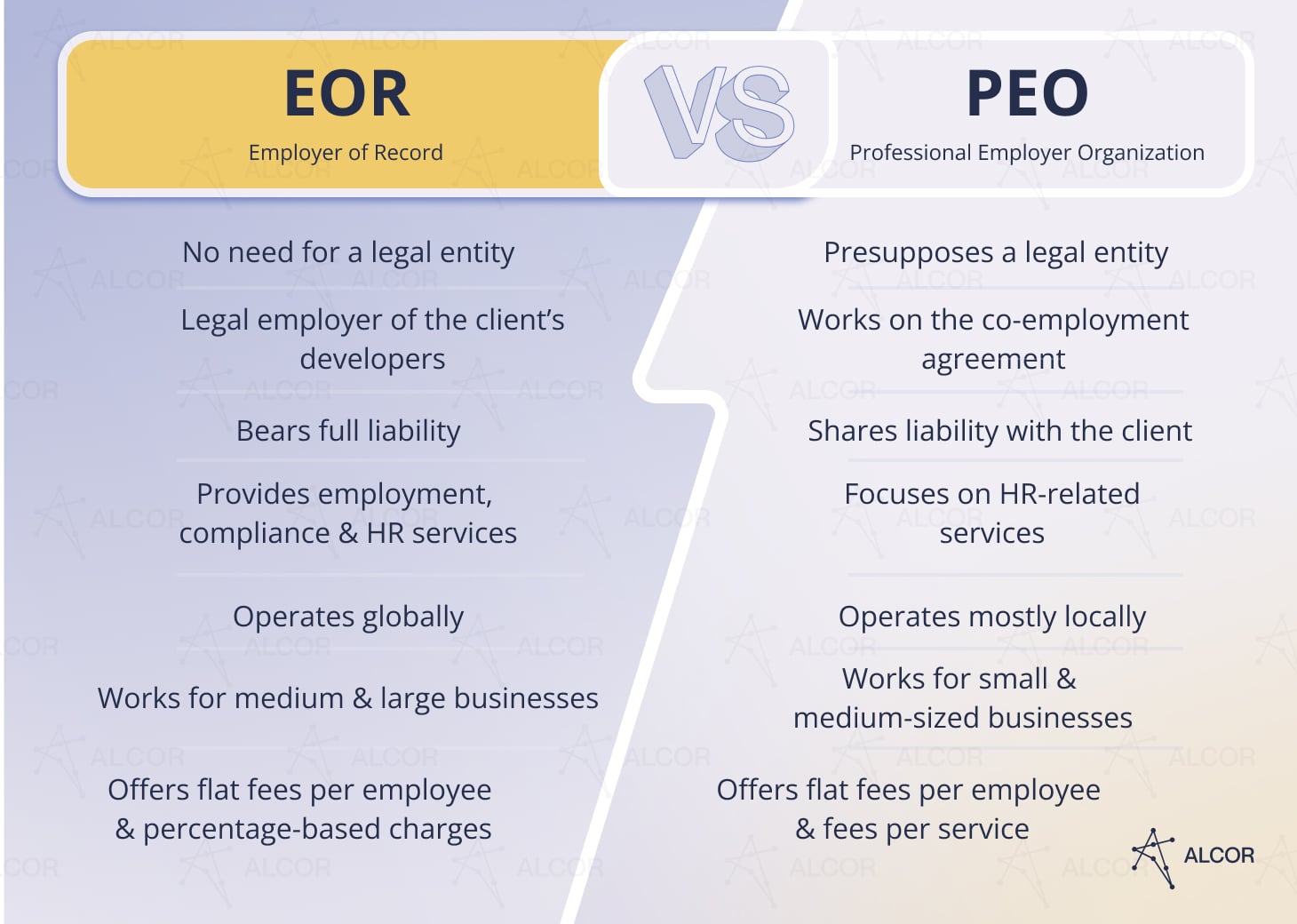
- You need your own legal entity. If you’re not legally present in the country where you’re expanding, there is no use in PEO. And business incorporation in Latin America can take up to 3 months and cost tens of thousands of dollars.
- You still share liability. Co-employment places additional legal strain on you. Plus, you need to keep responsibilities clear to avoid noncompliance and potential legal disputes.
- Your expansion gets stuck within one border. PEOs are usually specialized in a single market, meaning they won’t be able to scale HR operations as your team grows.
Employer of Record
An Employer of Record (EOR) legally employs software engineers in a country where you don’t have legal representation. EOR becomes a legal employer on paper and manages compliance, payroll, and other admin, while you stay in the driver’s seat of managing day-to-day processes.
Pros
- Hire in weeks, not months. Use your EOR partner’s established legal entities and start onboarding your developers immediately, without compliance or operational hassle.
- Get compliance & liability shield. Contracts, payroll, taxes, work classification, and formal employment liability are all covered by your EOR partner.
- Expand fast globally. EORs are not limited to a single location. You can test new markets or build distributed teams according to your strategic goals.
Cons
- You may overspend in the long term. If you plan to build a large development team at scale, the per-employee cost may start to feel heavy. Opening your own legal entity may become more cost-effective.
- You may face exit friction. Moving employees from an EOR to your own legal entity can require re-contracting and careful administrative coordination, while many providers also charge additional fees.
- You may experience limited customization. Most EORs offer one-size-fits-all solutions with standardized employment terms, payments, and benefits to simplify cross-border management, which may pose additional friction for your business.
So, in the battle between PEO and EOR for expanding tech companies, the latter clearly wins. EOR doesn’t push you to:
- commit to opening a legal entity in LATAM,
- allocate massive upfront legal and operational funds,
- take on extra liability and face legal exposure.
In other words, EOR supports how tech companies actually grow: fast, lean, and across borders.
Now, the most important question: which EOR provider should you choose? The one that:
- Has boots on the ground in Latin America, with owned entities, legal, payroll, and Customer Operations teams to navigate you through the local labor laws.
- Tailors cooperation contracts based on your needs and strengthens them with NDAs to protect your IP rights.
- Handles payroll end-to-end and any on-demand gross-to-net salary recalculations and payslip updates without delays or errors.
- Offers benefits for hiring Valley-caliber engineers: statutory packages plus tech-focused perks such as private healthcare, learning budgets, and stock options.
- Has a contractually bound service fee, with no hidden fees and no setup or exit markups.
That’s what Alcor provides with its EOR in Latin America tech companies. But we don’t stop there. Our EOR services go hand in hand with:
- Full-cycle recruitment: Access the top 10% of market engineers and hire them in 2-6 weeks, including in-demand AI engineers, through our 40 in-house recruiters. Integrate them into your company, culture, and practices from day 1 and enjoy an average talent retention of about 2.5 years.
- Operational support: From office/co-working space leasing to equipment procurement, employer branding, visa and insurance management – get whatever extra service you need to sustain and grow your engineering team abroad, without prepayments.
Together, they help you build and scale a tech R&D center in Latin America or Eastern Europe without the need to estabslih own legal entity, deal with compliance risks, or juggle vendors. Such mature tech companies and unicorns as Backstory, Pindrop, Sift, and Ledger have already scaled their engineering teams from 0 to 30+ senior engineers with Alcor’s turnkey R&D center solution.
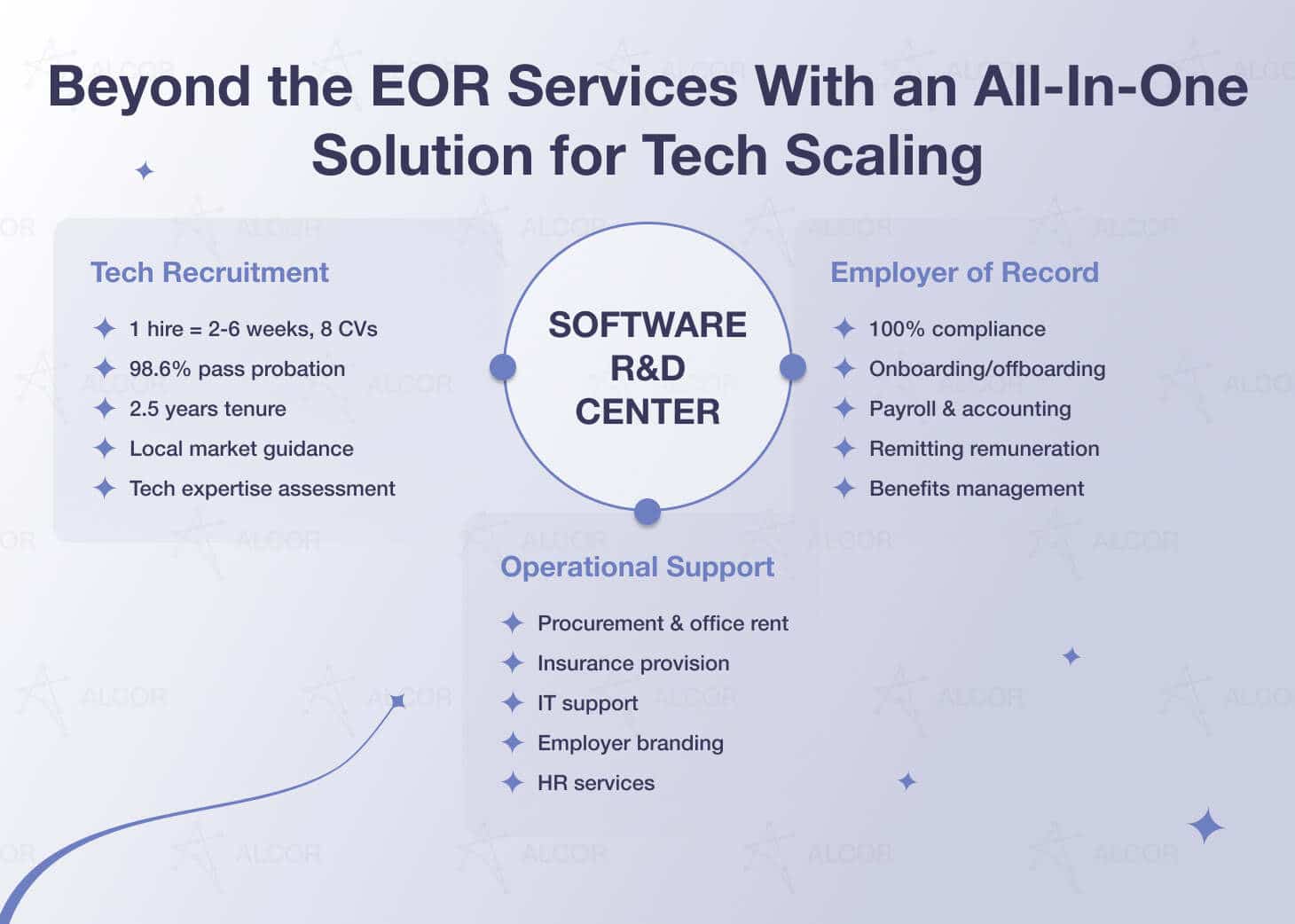
Here’s an example of how our it works in practice.
Franki, a US startup, was looking to supercharge its experience app in LATAM without the delays of entity setup or compliance risks. By expanding through Alcor’s R&D center solution, they:
- Built a mobile development team of 2 iOS, 3 Android, and 2 QC Engineers with rare expertise in RxSwift.
- Got contract management, full compliance with Mexican labor laws, and all benefits and PTO covered.
- Received all needed equipment for their dev team to work productively from day one.
Achievement: Thanks to their development team in Mexico and Alcor’s admin ops support, Franki doubled its revenue in 2024.
Make your scaling goals in LATAM a reality! Book a call and let’s discuss your needs.