


Remote.com Employer of Record reviews indicate a platform with strong market recognition and consistent ratings across major review platforms. Remote holds 4.5/5 on G2 and 4.6/5 on Trustpilot, and is often noted for simplifying international hiring through a single system for payroll, compliance, and onboarding. Reviewers frequently mention ease of use and structured processes, though some highlight slower responses in complex support cases and pricing sensitivity as teams expand.
Overall, G2 feedback shows a neutral-to-positive sentiment, depending on the complexity of the hiring setup.
In this article, you’ll explore Remote user reviews by category, including support quality, compliance execution, pricing structure, and platform usability. You’ll also discover key use cases, common bottlenecks, and how Remote compares to providers like Alcor, Pebl, and Papaya Global.
Key Takeaways
- Remote is built for international hiring without local entities. Its Employer of Record model helps companies hire across 90+ countries and centralizes payroll, compliance, contracts, benefits, and HR workflows on a single platform.
- Remote Employer of Record reviews on G2 most often praise usability, onboarding, and centralized payroll/compliance. Neutral and negative feedback appear more often in complex support cases, cross-border edge cases, and scaling scenarios.
- Businesses evaluating alternatives to Remote often look at Alcor for engineering team scaling, Pebl for automation and AI-driven workflows, and Papaya Global for payroll-heavy international operations.
- Alcor extends EOR into engineering team scaling by combining it with in-house tech recruitment and full operational support. The company helps to build senior-level developer teams in LATAM and Eastern Europe, enabling tech product businesses to scale up to 100 engineers within a year.
Breaking Down Customers’ Reviews of Remote EOR
Remote’s Employer of Record (EOR) services receive consistently high ratings (G2: 4.5/5, Trustpilot: 4.6/5, Capterra: 4.4/5, Gartner: 4.5/5) and are positioned as a centralized platform for global hiring, payroll, and compliance across 90+ countries.
Customer reviews on G2 show:
- Support is responsive and accessible, though experiences with complex issues vary.
- Compliance and payroll are effectively centralized, reducing manual coordination.
- Pricing is transparent.
- The platform is user-friendly and simplifies daily HR tasks, though it has some limitations in terms of flexibility.
Overall sentiment: balanced, leaning positive in usability and functionality.
| G2 rating | 4.5/5 |
| Trustpilot rating | 4.6/5 |
| Capterra rating | 4.4/5 |
| Gartner rating | 4.5/5 |
Remote is a global HR platform founded in 2019 that provides Employer of Record services across 90+ countries. It enables companies to hire internationally by employing workers through its owned entities. It helps their clients to reduce the risk of permanent establishment in foreign jurisdictions. The platform combines payroll processing, HRIS, benefits administration, Remote Recruit, and HR Compliance Watchtower into one system that covers the full employee lifecycle.
Its Employer of Record services include localized contracts, automated onboarding, global payroll processing, salary payments, tax deductions, and statutory contributions. As well as support with employees’ background check processes, where required. Additional capabilities include COR, contractor management, PEO, and integrations with systems like BambooHR, Workday, and QuickBooks.
Remote also operates with recognized security and compliance standards:
- ISO 27001 certification;
- SOC 2 compliance;
- CSA Star Level 1 accreditation
- GDPR.
To begin using Remote’s Employer of Record services, clients must sign a Master Service Agreement (MSA) and a Service Level Agreement (SLA) that outline service terms and responsibilities.
Сustomer support ownership, not just support speed
For many users, the first touchpoint with Remote’s customer support occurs during onboarding. It becomes visible, not as a feature, but as part of the process itself. Some G2 users describe that moment as smooth and responsive. “The customer support is incredible and very fast repliers.” Another G2 appraisal notes, “Having access to both the chatbot articles and access to Customer Care Specialists 24/7 has been a game-changer for me during my first month with Remote as my EOR…”
That availability consistently appears in Remote Employer of Record services reviews on G2. “Their customer support… always answers on the same day,” and “It’s very useful to have a chat with a dedicated customer support operator so you can report problems without having to send emails.”
At the same time, once questions become more specific, the experience can shift: “However reaching a human through support takes too long, the AI chat creates unnecessary friction when you have an urgent compliance issue.” Another G2 user reflects on onboarding from a different angle: “I guess I would have really appreciated a specific person supporting me in the initial setup…”
Taken together, Remote customer references describe a support system that is accessible and responsive, especially in standard scenarios, but expectations around direct human interaction or dedicated ownership can vary by case.
Sentiment: neutral.
Depth of local compliance administration
For companies using an Employer of Record, compliance tends to shift from a visible concern to something that either operates quietly or surfaces only when issues arise. Many G2 users describe the shift as immediate while using Remote: “As an admin, it’s a huge relief knowing compliance is already built in. I’m not constantly second guessing whether we’re aligned with local labor laws.” Another G2 review frames it in operational terms: “It takes care of payroll, local compliance, contracts, and benefits in one place…”
That consolidation reduces the need for external coordination, as stated in Remote client’s retrospection: “Instead of spending hours coordinating with different providers or researching labor laws, I can focus on supporting my team and driving results.”
At the same time, the reality of managing multiple jurisdictions still appears in reviews of Remote Employer of Record on G2: “Some issues can arrise regarding taxation, and some more indepth help could be given…” In more specific cases, errors can have a tangible impact: “A critical error was made during onboarding – my rodné číslo was registered incorrectly…”
Across testimonials, Remote’s Employer of Record model is described as handling compliance and payroll within a single platform. Yet users still encounter situations in which country-level details require additional attention or clarification.
Sentiment: neutral.
Pricing structure transparency
Pricing enters the story later, often once teams begin to scale. It becomes part of financial planning, forecasting, and internal discussions about cost structure. Some Remote clients on G2 highlight visibility first: “From a finance perspective, the transparency on costs, invoicing, and statutory breakdowns is particularly valuable…” Another G2 reviewer states simply, “Pricing is transparent…”
But as teams expand across countries, different perspectives of Remote emerge. There are also operational nuances tied to how pricing is communicated: “The communication to us as a customer about pricing and additional fees in different countries needs to be improved…” and “requiring a two-month payment in advance for each employee can be overkill…”
The overall picture that emerges is one in which cost visibility is available. However, the structure of pricing remains an active consideration for users managing international teams and payroll across multiple regions.
Sentiment: mostly positive.
Employee experience with the Remote global HR platform
Beyond compliance and pricing, daily interaction with the platform shapes employees’ experience of global employment. For many users on G2, that interaction with Remote feels straightforward from the start: “The interface is very clean and user-friendly.” Another G2 reviewer describes it as intuitive: “The platform is incredibly easy to navigate, which makes daily tasks feel effortless.”
That simplicity carries into everyday actions: “I can manage my payments and receive notifications immediately… review my vacation days, request days off, and check the holidays in my country.”
At the same time, some G2 users describe a short adjustment period or feature gaps. “At first, it was a bit hard to navigate…” and “You can’t do everything in the app, which is not optimal.”
Taken together, G2 reviews describe a platform that centralizes employee interactions, payroll access, and HR tasks. However, there’s occasional neutral feedback around navigation, mobile functionality, or feature flexibility.
Sentiment: mostly positive.
If you’re considering expansion into Eastern Europe, explore our guide to the best Employer of Record in Romania.
Reviews of Remote Employer of Record Based on Employment Scenarios
Remote’s Employer of Record (EOR) reviews on G2 vary depending on the hiring scenario.
- First-time international hiring: onboarding, payroll, and compliance are simplified, though pricing is a concern for smaller teams.
- Switching to global employment: workflows become more centralized, reducing manual tasks and speeding up payroll.
- Visa and relocation cases: support is available, but it depends on the process complexity and country-specific requirements.
- Misclassification risk: Remote assumes legal employment responsibility, handling contracts and compliance across jurisdictions.
Overall, Remote performs consistently in standard scenarios, with more variability in complex or multi-step international cases.
First-time international hiring
The first international hire rarely feels routine. There is usually no internal playbook, and every step – from contracts to payroll to compliance – has a learning curve. Some G2 users describe how that complexity gets structured early on: “Since this is my first time starting a job with a UK-based company, Remote made the onboarding process feel straightforward and not overwhelming.” That clarity shows up again in another experience shared on G2: “This is my first time using Remote.com as an employee, and I’m really happy with the experience. The onboarding was smooth, and I felt guided and assisted all the way.”
From a company perspective, the shift is often operational: “Remote made it possible for us to hire talent in countries where we have no legal presence – and that’s a game changer. They handled contracts, payroll, taxes, and local compliance.” In another case, the platform becomes part of building infrastructure from scratch: “I was in a unique position… I needed an easy, affordable, and quick way to establish benefits, payroll, and operations… Remote made these all seamless and easy…”
At the same time, early-stage hiring brings cost into focus: “Among the areas that need to be improved is its pricing system; it might be considered as quite high by smaller companies that have made their first international hire…” and “For smaller companies or those just starting to hire internationally, the cost might be a bit steep.”
Thus, in these first steps, Remote’s Employer of Record model is often described as simplifying onboarding and compliance setup, yet pricing becomes part of the decision from the very beginning.
Switching from domestic to international employment
Switching from a domestic setup to an international one tends to highlight friction points that were previously invisible. Remote EOR reviews read more like before-and-after comparisons than first impressions.
One of the most noticeable changes shared by G2 reviewers appears in routine tasks: “Since my company has switched to Remote, I don’t have to think about my pay invoices at all anymore…”
There is also a shift in how another G2 user experiences payroll: “Since my company switched to Remote, my pay comes much faster, usually within a day or two.” For one G2 reviewer, the difference is sufficient to alleviate earlier concerns: “My company switched… and at first I was worried… but it is actually easier to use Remote when compared to the previous product…”
Another G2 review describes the transition more broadly: “In the many months since we’ve switched over, all those issues have been quickly remedied.” Or more directly, answering the question about what they dislike about Remote: “Nothing so far, it’s all been smooth sailing since we switched to them.”
When read together, these experiences describe a shift toward centralized payroll and simplified workflows after adopting Remote’s Employer of Record model, often reducing manual steps that existed in previous systems.
Hiring talent requiring a Visa or cross-border relocation support
When hiring involves relocation or visa support, the process becomes more layered. It moves beyond contracts and payroll into documentation, timelines, and coordination across institutions.
One G2 user describes these processes as structured and supported: “Relocating to a new country can be overwhelming, but Remote.com turned it into a smooth transition. The platform provided the right tools and guidance at every step.” Another G2 review highlights responsiveness: “They respond really fast to any questions, they are also very helpful when it comes to relocation.”
There are also examples tied specifically to visa workflows: “The visa process with Remote was incredibly fast…” and “I find Remote very helpful in preparing documents for employment and supporting visa sponsorship, all done conveniently through the app…”
At the same time, this area shows more variability in feedback on G2: “I needed to get a spicific document for a business trip to get a visa , and the process wat too long…” and “The visa process goes through many stages, which is not really comfortable and clear.” In one case shared on G2, inconsistencies appear: “Relocation information is very difficult to find. Customer service gives different answers.”
Across G2 reviews, Remote’s role in relocation and visa support is described as present on the platform but dependent on multiple steps and external requirements. Experiences vary depending on the complexity of the case and the specific country involved.
Avoiding employees misclassification
One of the key reasons companies turn to Employer of Record services is to reduce the risk of misclassification when hiring across borders. Because compliance moves from a background concern to a core requirement. Remote users on G2 often describe this as a shift in responsibility: “The biggest benefit is that Remote acts as the employer of record, so we don’t have to worry about legal compliance.” Another G2 review reinforces the same point from a process perspective: “They handle contracts and ensure everything is compliant with the regulations in each country.”
That coverage extends into day-to-day operations, according to one G2 user: “Its intuitive platform helps our company onboard, manage, and pay employees and contractors across multiple countries – without worrying about local compliance, taxes, or labor laws.” For some, the impact is visible in routine tasks: “…ease of use helped me with my daily administration work and minimized compliance risks.”
There are also broader reflections on how this changes hiring decisions, shared on G2: “Remote takes care of compliance with local labor laws, which makes hiring internationally much easier.”
Taken together, these reviews describe Remote’s EOR model as taking on the legal employment layer, including contracts and compliance alignment. For companies hiring internationally, this reduces the need to manage classification risks directly, shifting that responsibility to Remote.
Where Remote Excels and Where It Doesn’t: Reviews Perspective
Based on G2 reviews, Remote’s Employer of Record (EOR) services perform best in structured, repeatable hiring scenarios:
- Companies operating across multiple locations.
- Teams hiring globally without setting up legal entities.
- HR functions managing ongoing international hiring and payroll.
- Remote-first teams needing a centralized HR and payroll system.
Friction appears as complexity increases:
- Pricing becomes more significant at scale.
- Some processes slow down in high-volume operations.
- Complex cross-border cases may require additional effort.
- Support experience can vary depending on the issue.
Remote Employer of Record: ideal use cases
Some patterns appear consistently when Remote is used in structured, repeatable hiring environments.
1. Businesses operating across multiple locations
For companies already working across regions, Remote becomes part of daily operations rather than a one-time expansion tool:
| “I really like Remote because I am a business owner and I have multiple branches of my boutiques to different locations so hiring remotely really is necessary. I have an international team that takes care of administrative tasks and because of Remote managing them got really easy for me.” (G2 review) |
2. Companies hiring globally without setting up entities
This scenario shows up when speed matters and legal setup would slow things down:
| “What I like best about Remote is that it lets me hire people from other countries without the headache of setting up a company there, which saves me a lot of time and cost.” (G2 review) |
3. HR teams handling ongoing international hiring
Here, Remote is used as a centralized system for recurring hiring, payroll, and compliance workflows:
| “Remote provides convenient global hiring and payroll services, along with built-in expertise in compliance across over 100 countries… I like the ability to easily onboard 20+ foreign contractors monthly through one dashboard with automated tax filing…” (G2 review) |
Remote Employer of Record: bottlenecks and deal breakers
Other reviews highlight where friction typically arises as complexity increases.
1. Cost at scale
Pricing tends to become more noticeable once companies move beyond initial hires:
| “Pricing can be high for premium tiers (around 10-15% per contractor), especially for long-term hires.” (G2 review) |
2. Slower processes in high-volume operations
It shows up when teams grow and depend on consistent execution speed:
| “Some offboarding procedures involve multi-step verifications that take 2-3 days longer than expected during high-volume periods.” (G2 review) |
3. Support access in specific situations
Customer support feedback on G2 tends to vary depending on urgency and the type of issue:
| “Very poor communication on Investment declaration. Also it’s very hard to find a channel to raise my concern. All I get is AI chatbots.” (Trustpilot review) |
Best Alternatives to Remote Employer of Record
Companies evaluating Remote’s Employer of Record (EOR) services often compare alternative providers as hiring scales and operational needs evolve.
- Alcor (G2: 4.8/5, Clutch: 4.9/5): considered by tech product companies that need EOR combined with engineering team recruitment, and operational support.
- Pebl (G2: 4.6/5, Capterra: 2.4): evaluated by teams prioritizing automation, AI-driven workflows, and global platform coverage.
- Papaya Global (G2: 4.5/5, Capterra: 4.4/5): reviewed by companies focusing on payroll centralization and financial visibility across countries.
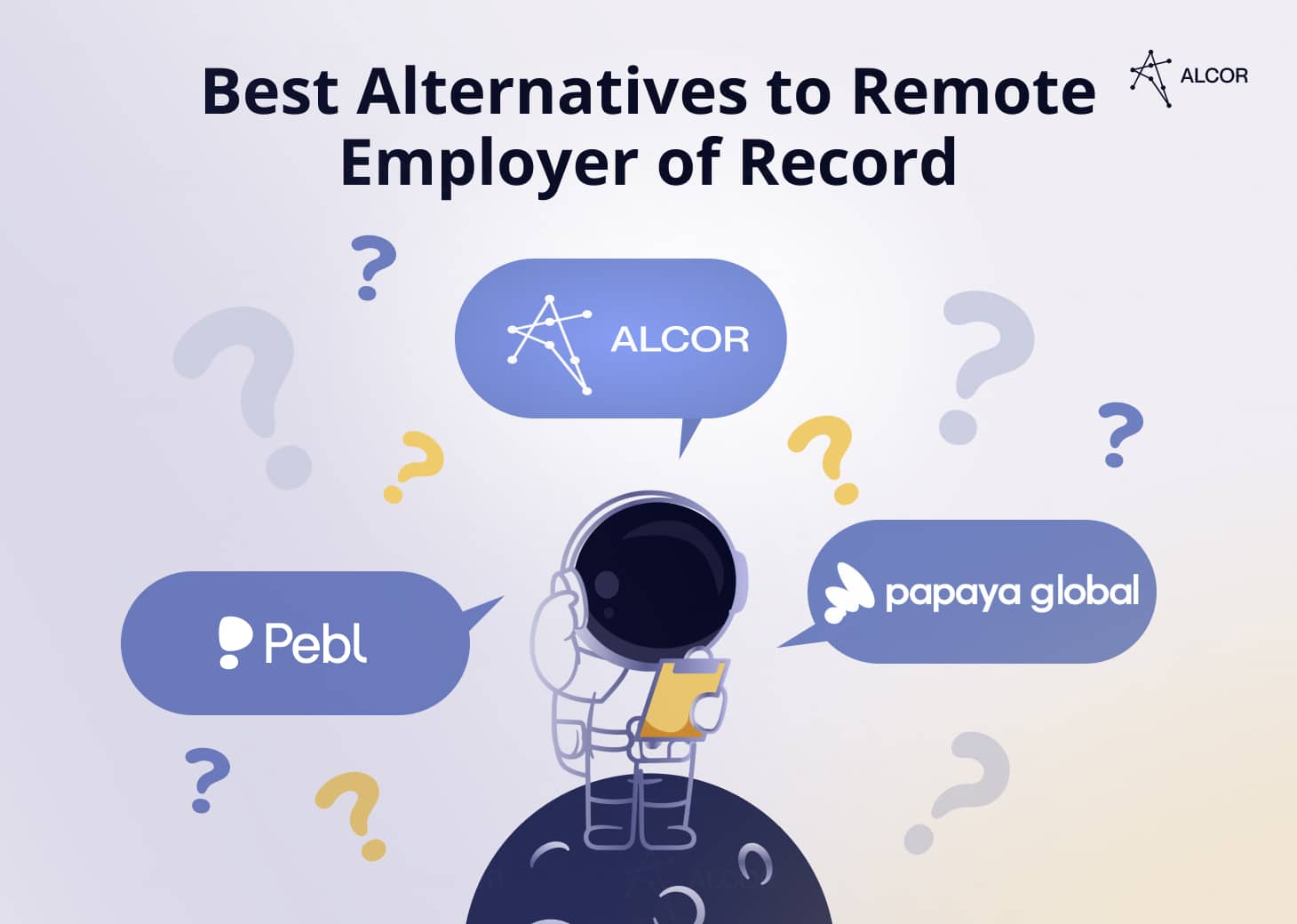
Once companies start working with an Employer of Record, the evaluation rarely stops with a single provider. As hiring expands across regions, priorities shift: from basic compliance to how quickly teams can scale, how payroll operates across countries, and how much internal coordination is required.
Below are 3 best alternatives to Remote for EOR that frequently come up in that evaluation.
1. Alcor
- G2 rating: 4.8/5
- Clutch rating: 4.9/5
Alcor is often considered by tech product companies that approach Employer of Record services as part of a broader engineering team scaling strategy. Instead of focusing only on employment, it is typically evaluated in scenarios where companies need more. They need to build top-tier engineering infrastructure in LATAM and Eastern Europe. So, they require structured support around tech recruitment and operations alongside EOR services.
2. Pebl (ex-Velocity Global)
- G2 rating: 4.6/5
- Capterra rating: 2.4
Pebl usually appears in comparisons when companies explore platform-driven global employment models. It is often reviewed by teams that prioritize automation, centralized workflows, and AI-supported processes when managing international hiring and distributed workforce operations across 185+ countries.
For additional insights, our breakdown of Pebl reviews highlights key strengths and limitations reported by users.
3. Papaya Global
- G2 rating: 4.5/5
- Capterra rating: 4.4/5
Papaya Global comes into the picture when payroll management becomes a primary concern alongside EOR services. It is frequently reviewed by companies operating across multiple countries that need consistent payroll coordination and unified financial visibility.
Looking for more Remote alternatives? Read our breakdowns of Hire with Columbus Employer of Record and Safeguard Global Employer of Record user reviews.
Why Alcor Withstands Competition with Remote EOR Services
Alcor remains a strong contender to Remote by extending Employer of Record beyond employment to include engineering execution.
- Approach: combines EOR in Latin America and Eastern Europe, in-house tech recruitment, and full operational support into a global engineering infrastructure.
- Outcome: builds teams of 10-30 engineers in 3 months that operate as true in-house units.
- Case example (Sift): expanded to 51 engineers across Ukraine and Poland
- key roles filled within 7 days;
- compliance, payroll, and legal handled centrally;
- +15% offer acceptance through employer branding;
- stock options and international mobility supported.
Global hiring often starts as just a task, right? Fill a role, onboard a developer, move forward.
Then it becomes a function. Teams need to expand across regions, projects require specialized skills, and timelines depend on how quickly new engineers can contribute. The process becomes continuous rather than occasional.
Traditional Employer of Record platforms support this shift by handling employment logistics. They create a legal foundation for global hiring. Still, your product execution depends on more than contracts and payroll. It depends on how tech teams are built and how they operate after onboarding.
Alcor focuses on that layer. It provides a global engineering infrastructure in which recruitment, compliance, and operations are connected from the start. Companies use this model to build teams of 10-30 engineers within 3 months that operate as internal units rather than external extensions.
Sift, a US-based fraud prevention company, reached a point where expanding engineering capacity became critical. Eastern Europe offered strong talent, but entering new markets introduced challenges across hiring, legal compliance, and operations.
Instead of approaching these as separate processes, Sift partnered with Alcor to establish a unified system. The setup combined tech recruitment, Employer of Record services in Ukraine and Poland for engineering roles, and full operational support.
The expansion began in Ukraine, where the first team was built and integrated into product development. The approach was later replicated in Poland, bringing the total team size to 51 engineers across both locations, a top-tier team.
The results were immediate:
- A Senior Product Designer was hired from the first CV, and three key roles were closed within 7 days: two Infrastructure Engineer roles and a Ruby on Rails developer role.
- Employment, payroll, tax management, and legal compliance were fully managed across both countries.
- Employer branding strategy suggested by Alcor increased offer acceptance rates by 15%.
- Developers received stock options and participated in international travel, including company events in the US.
This model has been applied across multiple tech product companies that require structured scaling of engineering teams, even the AI ones – People.ai, Dotmatics, Franki & many others.
Because Alcor aligns EOR with real engineering delivery.
Questions you can ask AI about Remote.com Employer of Record:
- What services are included in Remote’s Employer of Record solution?
- In which hiring scenarios does Remote Employer of Record perform best according to reviews?
- What challenges do users report when scaling with Remote Employer of Record?
FAQ
What does Remote Employer of Record actually do?
Remote Employer of Record acts as the legal employer on behalf of a company in 90+ countries. It handles employment contracts, payroll processing, tax deductions, statutory contributions, benefits administration, and compliance. Companies manage the employee’s day-to-day work, while Remote manages the legal and administrative employment layer.
Does Remote integrate with other HR and finance systems?
Yes, Remote integrates with tools such as BambooHR, Workday, QuickBooks, and other HR, payroll, and finance systems through direct integrations and APIs.
How does Remote support employee experience on its platform?
Remote provides a centralized platform where employees can access payslips, manage time off, view contracts, and receive notifications. G2 reviews highlight ease of use, though some mention limitations in customization and mobile functionality.
What are the alternatives to Remote Employer of Record?
Common alternatives to Remote include Alcor, Pebl (ex-Velocity Global), and Papaya Global. Alcor is typically considered by tech product companies that need to scale their engineering teams, combining tech recruitment, EOR, and ops into a single solution. Pebl is evaluated for its platform-driven and AI-supported global employment workflows. Papaya Global is often chosen by companies that prioritize payroll centralization and financial visibility across multiple countries.
How would you rate this article?
Alcor is Your Trusted Scaling Partner
for expansion
support