


An AI engineer’s salary depends mostly on location and expertise. Senior talent in the US earns, on average, 54% more than in Eastern Europe and LATAM. And the demand in the US remains high, driving a steady 7% increase in the compensation between early 2025 and 2026.
While AI salaries are climbing not only in the US, finding the right engineers fast remains a challenge. Alcor bridges that gap with an all-in-one software R&D solution: tech recruitment + Employer of Record + full operational support in Eastern Europe and LATAM. You manage your AI team directly, while we take care of everything else.
In this article, you’ll explore the latest trends in the AI market: who these experts are, their skills, and the main types of AI specialists. You’ll also find global AI and ML developer salary rates, factors that affect them, and insights on how to hire the right talent.
Key Takeaways
- The global AI market, valued at $900 billion in 2026, is projected to reach nearly $4.216 by 2035.
- There are 11 main types of AI engineers: ML, Data / Data Science Hybrid, MLOps, Vision & Multimodal AI engineers (formerly Computer Vision), Language / Conversational / LLM engineers (formerly NLP), GenAI, AI Security, Prompt / Agent engineers, AI Ethics & Governance specialists, AI Product Managers, and Chief AI Officer (CAIO).
- The average monthly AI developer salary (mid-level to lead) ranges from $8.1K to $12.9K in North America and $3.8K–$7.9K in South America..
- In Western and Nordic Europe, senior AI developers earn an average of $8.9K per month.
- In Eastern Europe, mid-level AI engineers make about $4.4K monthly, while senior specialists earn around $6.3K.
- Across Eastern and Southern Asia, AI developer salaries range from $3.9K to $7.6K per month (middle to lead levels), while in Australia, compensation typically spans $10.8K to $15.6K monthly.
- With Alcor’s all-in-one software R&D model, you can build and manage a senior AI team from 10 to 100 engineers within a year. We handle tech recruiting, payroll, compliance, and operations so you stay focused on business growth.
AI Engineering Market Overview
The global AI industry is accelerating rapidly and is expected to expand from $900 billion in 2026 to nearly $4.216 trillion by 2035. Corporate investment reached $252.3 billion in 2024, while Meta, Amazon, Alphabet, and Microsoft plan to inject another $320 billion into the market. Generative AI attracted $33.9 billion in funding, up nearly 19% year over year. Adoption now spans healthcare, finance, retail, and education, fueling a rapid rise in AI job creation. Hence, job listings for agentic AI roles jumped 985% in 2024, highlighting a sharp shortage of experts in Python, machine learning, and NLP.
Valued at $900 billion in 2026, the global Artificial Intelligence market is projected to hit nearly $4.216 trillion by 2035, according to Precedence Research. That’s almost a fourfold increase in a decade, fueled by breakthroughs in generative models, automation frameworks, and cloud-based infrastructure.
Corporate investment in AI is accelerating at record speed. In 2024, total funding hit $252.3 billion, with private investment surging 44.5% and M&A activity climbing 12.1% compared to the previous year. According to McKinsey, nearly 92% of leading global enterprises now plan to boost their AI budgets within the next three years. Full-scale adoption could unlock as much as $4.4 trillion in productivity gains across industries.
Meanwhile, the tech giants are going all in: Meta, Amazon, Alphabet, and Microsoft are together projected to pour roughly $320 billion into AI development and infrastructure.
Generative AI drew $33.9 billion in private investment worldwide, up 18.7% from 2023, marking one of the fastest year-over-year jumps in the entire AI sector.
Why is there a rush? Artificial Intelligence is currently being applied in various industries and branches. For instance, in healthcare, AI aids in medical diagnoses and personalized treatments, while in finance, it supports fraud detection and risk assessment. Retail leverages AI for demand forecasting, inventory management, and enhanced customer experiences, while prioritizing data security to protect consumer information. AI is also revolutionizing the education sector by providing customized learning experiences, automating administrative tasks, and enabling data-driven insights to optimize student performance.
This rapid diffusion is reshaping the workforce as well. The World Economic Forum forecasts 1.8 million new jobs in AI and information-processing fields by 2030, while McKinsey reports that 88% of enterprises now apply AI in at least one business function.
The AI agents market is projected to reach $12.06 billion in 2026. By 2030, that figure is expected to skyrocket to $53.2 billion, maintaining a 44.9% CAGR. Agentic AI is a system capable of autonomous reasoning, planning, and execution. Job postings in this field have exploded, up 985% between 2023 and 2024.
However, according to McKinsey, building such systems requires a rare blend of skills: strong foundations in Python, machine learning, and software engineering, paired with emerging expertise in prompt engineering and natural language processing (NLP). Yet the talent market remains uneven: frameworks like TensorFlow are now mainstream, but seasoned Python and AI architecture experts are still in critically short supply.
AI Engineer Skills and Levels
Artificial Intelligence developers design and implement systems that can learn, reason, and adapt. Their work spans machine learning, deep learning, natural language processing, and computer vision. Skilled in languages like Python, Java, R, and C++, they use frameworks such as TensorFlow, PyTorch, and Scikit-learn to build scalable AI solutions. Many also leverage cloud platforms like AWS and Azure to deploy and maintain models efficiently. With strong foundations in data analysis, neural networks, and large-scale systems, AI developers bridge research and real-world applications.
Artificial Intelligence developers are tech specialists who design, develop, and implement AI systems and applications. They possess a broad scope of expertise that encompasses various areas of computer science, such as machine learning, natural language processing, computer vision, robotics, and more. The specific requirements for Artificial Intelligence programmers may vary based on their expertise levels, role, and company type, yet certain qualifications are considered must-haves for AI enthusiasts.
Levels of expertise
Just as with any engineering role, AI expertise comes in layers, each offering a different kind of value to tech teams. Here’s how the skillset typically scales up:
- Junior AI engineers: The builders-in-training. They handle data cleaning, model prototyping, and testing under senior guidance.
- Mid-Level AI engineers: The problem-solvers. They take ownership of full model pipelines – from feature engineering to production – and translate business problems into technical roadmaps.
- Senior AI engineers: The strategists. They design architectures, optimize performance, and often guide cross-functional teams. Senior engineers are the ones aligning AI capabilities with the company’s bottom line – scaling models, mentoring juniors, and making sure “it works” means “it works in production.”
- Lead AI engineers: The visionaries. They oversee entire AI ecosystems, ensuring infrastructure, data pipelines, and cloud environments are built for scalability and compliance. If AI is the product’s brain, these are the neurosurgeons behind it.
Solid programming skills
Python, Java, R, and C++ are some of the most widely used programming languages for developing AI applications. In addition, many professionals use SQL for data queries, Bash for automation, and JavaScript or TypeScript for AI-powered web applications. Hence, these specialists must be well-versed in them to write efficient code, implement models, handle data structures, and build algorithms that downstream analysts can operationalize.
Machine learning knowledge
With machine learning being a fundamental component of Artificial Intelligence, these developers must also possess skills in this field. It enables the creation of intelligent systems to analyze data, understand its architecture, make predictions and classifications, and make informed decisions. A large share of an ML engineer’s work goes into data preprocessing and feature engineering – cleaning, normalizing, and transforming datasets to ensure models can learn effectively.
Expertise in deep learning
Deep learning is one of the core components of many AI applications. That’s why AI developers are expected to be familiar with convolutional neural networks (CNNs), recurrent neural networks (RNNs), and deep learning frameworks. From recommendation systems on streaming platforms to autonomous vehicles and AI-driven medical diagnostics, deep learning sits behind the world’s most advanced digital products.
Cloud platforms and large-scale environments
Modern AI engineers also work extensively with cloud ecosystems such as AWS and Azure to deploy, scale, and monitor AI solutions efficiently. Many of them gain experience within GAMAM-level companies (Google, Apple, Meta, Amazon, Microsoft) or follow their engineering standards for building robust AI infrastructure.
Knowledge of AI tools and frameworks
In addition to machine and deep learning technologies, there is a rich variety of AI frameworks, libraries, and tools. TensorFlow, PyTorch, and Scikit-learn are among the most popular tools that AI developers utilize in their projects and analytics work.
Struggling to find senior AI Engineers?
Discover 8 AI talent markets across LATAM and Eastern Europe, with data on talent availability, salaries, compliance, and team setup to help you choose the right location for your team scaling.
11 Kinds of AI Engineers and Their Value for Tech Business
AI engineering spans a growing range of roles that bring intelligence to products and systems. ML engineers design and scale models that learn from data, while Data Science and MLOps engineers ensure pipelines, infrastructure, and governance keep them running reliably. Vision and Language engineers teach machines to see and understand, and Generative AI engineers enable them to create text, images, and code. Prompt or Agent engineers refine how AI models reason and act, while Ethics and Governance specialists ensure innovation remains responsible and compliant. At the product and executive level, AI Product Managers and Chief AI Officers connect technology, ethics, and strategy, turning experimentation into sustainable, real-world value.
Core AI engineering roles
Machine Learning (ML) engineers
Machine Learning engineers make sure AI systems don’t just work, but evolve. They transform raw data into living intelligence, turning theoretical models into stable, scalable products. They handle the full lifecycle: from building and training models to deploying, monitoring, and maintaining them in production. Their craft bridges data science and engineering, combining Python, Scikit-learn, and deep learning frameworks with solid MLOps practices. Whether it’s fraud detection, predictive maintenance, recommendation engines, or logistics optimization, ML engineers ensure algorithms run reliably at scale. With the global ML market approaching $432.63 by 2034, the value of these engineers lies not only in what they build, but in how they help entire industries learn faster than ever before.
Data engineer / Data Science Hybrid
Data engineers or Data Science Hybrid engineers bridge data engineering and machine learning, ensuring that insights flow where they’re needed most. They build pipelines, manage large datasets, and maintain the infrastructure behind AI systems. They also ensure these datasets are ready for modelling and manage data infrastructure for ML systems. By turning complex data into usable intelligence, they enable faster experimentation, smarter predictions, and more data-driven decision-making. Skilled in Python, SQL, and big-data frameworks such as Spark and Hadoop, they ensure data is accurate, accessible, and ready to drive AI systems and business analytics.
In some organizations, the scope of an ML engineer and a Data scientist can overlap, so title clarity is key to defining responsibilities and expectations.
MLOps engineers
MLOps engineers make machine learning work at scale and are vital for turning prototypes into sustainable products. They build the infrastructure that ensures models are deployed, monitored, and retrained seamlessly. Their skill set blends DevOps, machine learning, data engineering, model monitoring, and governance, enabling organizations to deliver AI features quickly and reliably. MLOps engineers are what make AI sustainable. They reduce deployment time, automate maintenance, and keep models accurate as data changes, turning prototypes into dependable, production-grade systems.
Specialized AI engineering roles
Vision & Multimodal AI engineer (formerly Computer Vision engineer)
Vision & Multimodal AI engineers (formerly Computer Vision engineers) build systems that allow machines to interpret and understand visual data. They design models that detect objects, classify images, and analyze video feeds, fueling breakthroughs in autonomous driving, smart retail, and healthcare diagnostics. By transforming visual data into meaningful insights, they boost accuracy, safety, and efficiency across industries. With the market for computer vision expected to exceed $58.29 billion by 2030 demand for this expertise is rising fast, particularly among teams building AI-powered products at scale.
Language / Conversational / LLM engineer (formerly Natural Language Processing (NLP) engineer)
The title NLP engineer is becoming increasingly broad. With the rise of large language models (LLMs) and generative AI systems, many professionals once called NLP engineers are now rebranded as Conversational AI engineers, Language AI engineers, or LLM engineers. In some skill analytics, roles like Prompt engineer or Language & Communication engineer also overlap with this domain.
These engineers enable computers to understand, interpret, and generate human language. They create models that power chatbots, search algorithms, translation tools, and voice assistants, turning raw text or speech into structured meaning. Combining expertise in linguistics, AI, and machine learning, they train systems to understand context, tone, and intent using frameworks such as spaCy, Hugging Face, and TensorFlow. This work drives more natural interactions between users and technology, enhancing personalization, automating support, and making insights accessible in real time. The global NLP market is projected to top $439 billion by 2030, but these engineers are already shaping how humans and machines communicate daily.
Generative AI (GenAI) engineers
Generative AI engineers take innovation one step further: they build systems that create. It’s a high-growth emerging role. Their work focuses on foundation models, fine-tuning, synthetic data generation, and model adaptation to specific domains or tasks. Using large language models (LLMs), diffusion models, and advanced neural networks, these specialists design and refine algorithms that produce text, code, images, video, and even entirely new datasets.
Generative AI often overlaps with Natural Language Processing and Computer Vision, as many models span both language and visual modalities. Yet organizations increasingly recognize it as a distinct discipline – one that blends creativity, data science, and software engineering. From powering tools like ChatGPT, Midjourney, and GitHub Copilot to enabling enterprise-grade automation in product design and content generation, GenAI engineers are redefining what it means to build software.
As the generative AI market moves toward $1.3 trillion by 2032, engineers in this space are redefining what “building software” even means. They enable faster prototyping, automate repetitive tasks, and open entirely new ways to build and scale products. GenAI turns ideas into outputs at unprecedented speed.
AI Security engineer
AI Security engineers protect AI systems from the threats that accompany their power. As models become more capable and more embedded in critical infrastructure, they become higher-value targets – for adversarial attacks, prompt injections, data poisoning, and model theft. AI Security engineers design defenses at every layer: data pipelines, model architecture, deployment environments, and inference APIs.
Many specialize in red teaming – probing models to find vulnerabilities before attackers do. Others focus on model governance, access control, and audit trails that satisfy regulatory requirements. Their work sits at the intersection of classical cybersecurity and ML engineering, requiring fluency in both.
Product, strategy, and executive roles
AI Product Manager
AI Product Managers bridge the gap between cutting-edge technology and real business value. They define the vision, roadmap, and KPIs for AI-driven products, ensuring that complex models translate into tangible user benefits. Working closely with engineers, Data Scientists, and stakeholders, they balance technical feasibility with customer needs, making sure AI features are accurate, ethical, and scalable. They also identify where AI can deliver the highest ROI: whether in automating processes, improving customer engagement, or creating entirely new revenue streams.
Prompt engineer / Agent engineer
Prompt engineers – increasingly known as Agent engineers or Agentic systems engineers – specialize in shaping how large language models think, respond, and act. They design, test, and refine prompts, workflows, and system instructions that turn general-purpose models into domain-specific, task-driven agents. Their work blends creativity with a deep technical understanding of language models, fine-tuning, and reasoning frameworks.
Beyond writing prompts, Agentic AI Engineers often orchestrate multi-step reasoning pipelines, tool integrations, and memory management for AI agents that can plan, retrieve, and execute tasks autonomously. They collaborate with data scientists, product teams, and developers to align model behavior with user goals and brand voice.
AI Ethics & Governance specialist
An AI Ethics & Governance specialist is an emerging role focused on making AI innovation responsible and trustworthy. These professionals design and oversee frameworks that ensure AI systems are fair, transparent, and compliant with global regulations. Their work sits at the intersection of technology, law, and policy. They evaluate data practices, algorithmic bias, model accountability, and societal impact. These specialists collaborate with engineers, legal teams, and executives to translate ethical principles into actionable standards for model design, deployment, and oversight.
As governments introduce new AI acts and auditing requirements, demand for this expertise is accelerating. For example, under the EU Artificial Intelligence Act, countries like Poland now require mandatory audits, risk-based classification of AI systems, and documentation supervised by national authorities.
Chief AI Officer (CAIO)
The Chief AI Officer is an emerging executive role, most common in large or AI-driven enterprises. In many mid-sized organizations, its responsibilities are still embedded under the CTO, Chief Data Officer, or Head of AI. Where it exists, the CAIO leads the strategic direction of AI within the organization, turning innovation into structured impact. They define the company’s AI vision and align all initiatives with broader business goals. At the same time, they set ethical AI frameworks, ensure regulatory compliance, and guide the company through challenges of transparency and accountability. CAIOs make sure innovation happens responsibly and delivers measurable value. As conversations around AGI shift from research labs to boardrooms, the CAIO role is becoming critical for companies that want to compete at the frontier. Their influence extends beyond technology: they shape how companies compete, operate, and create value in the AI transformation era.
4 Factors that Affect AI Developer Salary
AI developer salaries vary widely depending on several key factors. Skills and knowledge play a major role – specialists in machine learning, data science, or NLP often earn more due to niche job expertise. Experience level also matters when getting a job: mid-level AI engineers in the US make around $11K, while senior professionals with 5+ years can exceed $17K monthly. Location heavily impacts pay, with rates in North America and Western Europe over twice those in Eastern Europe or LATAM. Finally, industry influences compensation – AI roles in finance, healthcare, or autonomous systems pay more due to their complexity, higher risk, and data sensitivity.
Skills & knowledge
First and foremost, the field of Artificial Intelligence (AI) offers a multitude of job roles, each with its own distinct set of skills and knowledge requirements. These roles include Artificial Intelligence developers and consultants, machine learning developers, data science specialists, and many more. As AI encompasses various domains of development, individuals specializing in these roles possess expertise in specific areas, leading to differences in their responsibilities and corresponding wage rates.
Breaking into the AI job market without a degree or prior experience is extremely difficult. Most roles require formal education, typically both a Bachelor’s and a Master’s degree. In fact, about two-thirds of AI job postings either listed a Master’s degree as mandatory or strongly preferred (77%), while nearly as many (63%) required at least a Bachelor’s degree.
As for soft skills, the requirements don’t differ much from other tech specialists: problem-solving, critical thinking, communication & collaboration, adaptability, attention to detail, time management, and continuous learning.
Experience level
Another factor that impacts the AI developer’s salary is the level of experience. As a rule, the approach is the same as with other tech specialists – talent with more years of experience often commands higher wages compared to those who are just starting their careers. Thus, a middle-level Artificial Intelligence specialist makes about $11K a month in the US, while a dev with 3-5 years of professional experience might get around $14K. Higher salaries of $17K per month require 5+ years of AI development.
Location
Different countries offer varying levels of remuneration for AI developers, with some regions standing out for their higher salaries, while others offer comparatively lower rates. For example, in the USA, Canada, and some European countries, these specialists with a lead level of expertise get up to $20K a month, while wages in Eastern Europe are over 2 times lower.
Building a dev team in LATAM or EE? Check out the QA automation salary and the software engineering Team Lead salary rates!
Industry
The industry you operate in can make or break your AI job payroll strategy. For instance, AI engineers working in finance, healthcare, or autonomous systems often command higher paychecks due to the complexity, compliance, and data sensitivity involved. AI talent in such sectors earns more than peers in consumer apps or e-commerce. The salary difference comes down to risk and responsibility, not just demand. A misstep in a healthcare algorithm can risk lives, while in fintech, it can cost millions.
AI/ML Engineer Salaries Examples in Big Tech
Top tech giants heavily invest in AI and ML talent to stay ahead in innovation. While they offer highly competitive salaries, compensation for AI/ML engineers varies significantly across companies and locations.
Industry-leading companies strive to strengthen their Artificial Intelligence capabilities and gain a competitive edge in the ever-evolving tech landscape. That’s why they actively seek out exceptional talent who has outstanding expertise in the fields of AI and ML. Let’s see how top-tier tech enterprises reward these specialists.
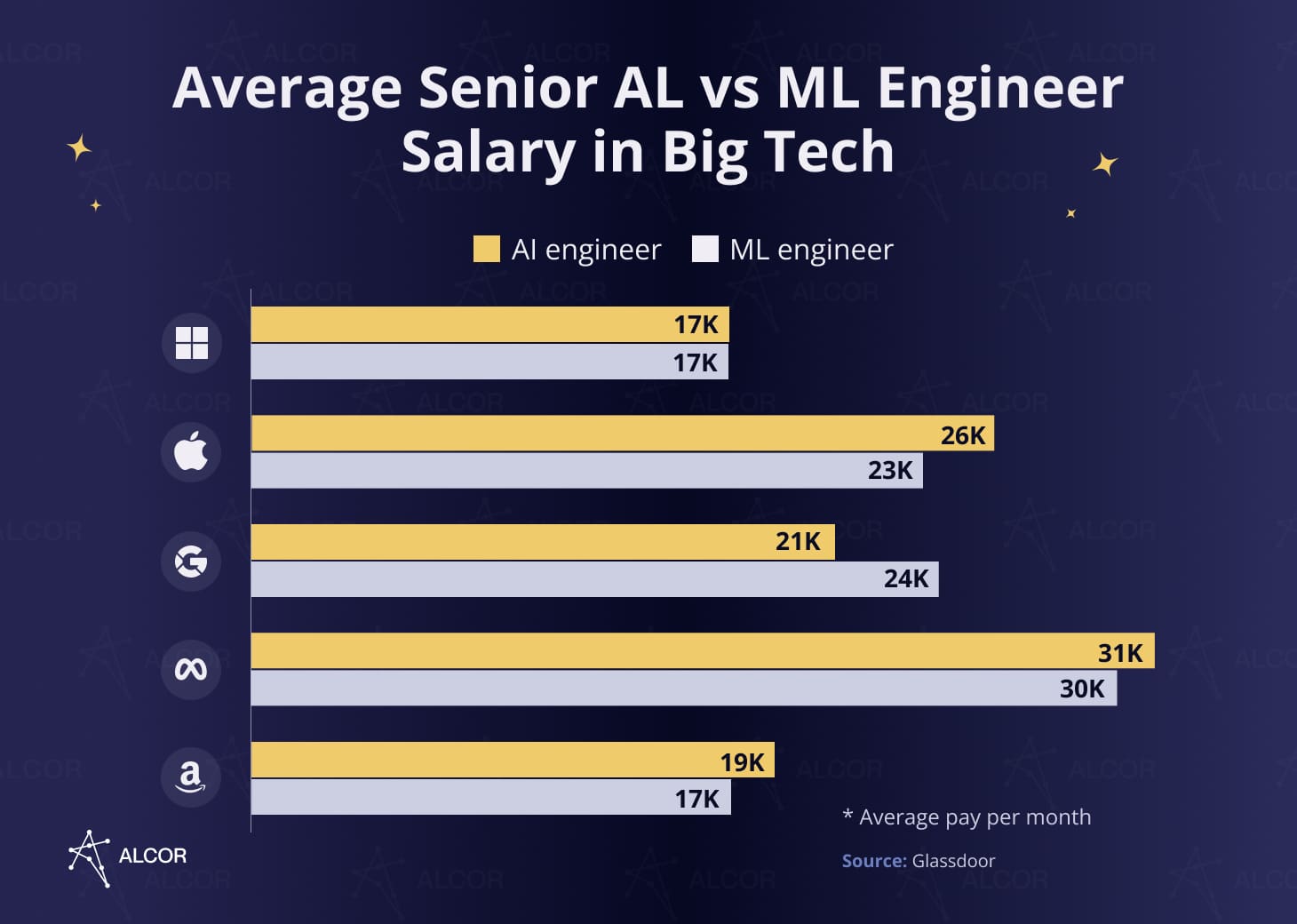
Even though tech giants overall offer rather generous remuneration, the AI software engineer salary differs not only from company to company but also from country to country.
Later in this article, I’ll analyze salaries across different countries to provide you with a comprehensive understanding of wage trends worldwide.
AI/ML Developer Salary: Key Takeaways
AI, ML, and Data Science engineers continue to earn the highest salaries in North America – lead AI developers make around $11K per month. In contrast, South American and Eastern European specialists earn about 40–50% less. Australia remains another high-paying region, with AI leads earning up to $14.1K monthly. Across all areas, AI engineers tend to outpace ML and Data Science peers in compensation, especially at senior and lead levels.
My team and I gathered data to compile a comprehensive table showcasing the average Artificial Intelligence and Machine Learning engineer salary worldwide. We focused on the most common roles: AI, ML, and Data science engineers. But you can always book a call with us to get a detailed breakdown of salaries across all types of AI engineers.
| Base monthly income |
North America |
South America |
||||
| middle | senior | lead | middle | senior | lead | |
| AI engineer | $8,140 | $10,405 | $12,865 | $3,870 | $5,920 | $7,895 |
| ML engineer | $7,050 | $8,580 | $10,950 | $3,870 | $5,830 | $7,655 |
| Data science engineer | $6,970 | $9,160 | $10,690 | $4,025 | $5,845 | $7,525 |
| Base monthly income |
Western & Nordic Europe |
Eastern Europe |
||||
| middle | senior | lead | middle | senior | lead | |
| AI engineer | $6,735 | $8,910 | $11,620 | $4,390 | $6,325 | $8,000 |
| ML engineer | $6,550 | $8,510 | $11,630 | $4,390 | $6,325 | $8,000 |
| Data science engineer | $5,760 | $7,540 | $9,930 | $3,650 | $5,060 | $6,750 |
| Base monthly income |
Eastern & Southern Asia |
Australia |
||||
| middle | senior | lead | middle | senior | lead | |
| AI engineer | $3,900 | $5,400 | $7,560 | $10,840 | $12,360 | $14,150 |
| ML engineer | $3,710 | $5,300 | $7,715 | $9,730 | $11,590 | $13,830 |
| Data science engineer | $5,070 | $6,970 | $9,640 | $8,690 | $10,820 | $13,485 |
Need more than salary data? Explore LATAM countries leading in AI development and see which market fits your AI hiring goals for 2027.
Average AI/ML Developer Salary in North America
In North America, the US dominates AI and ML salaries, with lead AI engineers earning up to $20.3K per month, especially in cities like San Francisco. Machine Learning and Data Science specialists follow closely, averaging between $13K–$15K at senior levels. Canada offers competitive but lower rates (around $11.3K), while Mexico remains the most affordable market, with senior AI professionals making about $6.7K monthly.
USA
The US has the most generous AI and ML engineer salary rates around the world. AI specialists get $12.5K-$20.3K per month, depending on the level of expertise. ML developer salary in this country ranges between $12.2K-$20K a month too.
| Base monthly income |
San Francisco |
Los Angeles |
New York City |
||||||
| middle | senior | lead | middle | senior | lead | middle | senior | lead | |
| AI engineer | $12,530 | $15,985 | $20,375 | $10,310 | $13,430 | $17,505 | $10,405 | $13,430 | $17,360 |
| ML engineer | $12,295 | $15,700 | $20,050 | $10,405 | $13,900 | $18,560 | $10,970 | $14,080 | $18,000 |
| Data science engineer | $12,485 | $14,660 | $17,220 | $10,595 | $13,240 | $16,550 | $10,690 | $13,340 | $16,640 |
| Base monthly income |
Seattle |
Boston |
Washington, DC |
||||||
| middle | senior | lead | middle | senior | lead | middle | senior | lead | |
| AI engineer | $12,295 | $14,000 | $15,930 | $12,295 | $13,715 | $15,290 | $10,405 | $11,820 | $13,430 |
| ML engineer | $12,295 | $14,190 | $16,375 | $12,295 | $14,470 | $17,035 | $13,240 | $15,795 | $18,760 |
| Data science engineer | $12,295 | $13,050 | $13,860 | $12,295 | $13,240 | $14,260 | $10,215 | $11,820 | $13,690 |
Canada
Canada offers slightly lower wages than the US: middle, senior, and lead Artificial Intelligence devs get $8.6K, $11.3K, and $14.8K accordingly, while a Data Scientist earns $7.4K-$11.1K monthly.
| Base monthly income |
Toronto |
Montréal |
Vancouver |
||||||
| middle | senior | lead | middle | senior | lead | middle | senior | lead | |
| AI engineer | $8,640 | $11,320 | $14,840 | $7,640 | $9,820 | $12,635 | $7,640 | $8,545 | $9,560 |
| ML engineer | $9,140 | $9,910 | $10,750 | $9,090 | $9,910 | $10,800 | $8,090 | $9,045 | $10,115 |
| Data science engineer | $7,410 | $9,090 | $11,120 | $7,365 | $9,090 | $11,180 | $7,320 | $9,140 | $11,340 |
Mexico
The monthly senior software engineer salary in Mexico is the lowest in the region – $6.7K.
|
North America |
|||||||||
| Base monthly income |
USA |
Canada |
Mexico |
||||||
| middle | senior | lead | middle | senior | lead | middle | senior | lead | |
| AI engineer | $11,700 | $14,300 | $17,500 | $7,820 | $9,865 | $12,345 | $4,900 | $7,050 | $8,750 |
| ML engineer | $8,500 | $11,000 | $14,000 | $8,090 | $9,045 | $10,555 | $4,550 | $6,650 | $8,300 |
| Data science engineer | $9,000 | $10,500 | $13,000 | $7,320 | $9,140 | $11,210 | $4,600 | $6,500 | $7,850 |
Looking for the smartest way to hire AI developers from LATAM? Alcor knows what will work for you!
Average AI/ML Developer Salary in South America
In South America, AI and ML engineers earn between $3K and $8.3K monthly. Brazil offers the highest salaries, with lead AI developers making up to $8.3K, while Argentina follows closely at $7.8K. Chile and Colombia show comparable ranges, averaging $5.7K–$6.2K for senior professionals.
Brazil
In Brazil, developers at mid to lead levels of AI engineering expertise get $4.5K-$8.3K a month.
Argentina
Argentinian wages are lower than Brazilian, up to $7.8K per month.
Colombia
Among software engineer salary in Colombia, mid-level AI developers earn about $3K per month, increasing to roughly $7.6K for lead roles. Machine learning engineers typically make between $4K and $7.8K monthly.
Chile
In Chile, Artificial Intelligence programmers’ pay grades range from $4K to $7.8K per month, depending on experience and specialization.
|
South America |
||||||
| Base monthly income |
Brazil |
Argentina |
||||
| middle | senior | lead | middle | senior | lead | |
| AI engineer | $4,540 | $5,830 | $8,330 | $3,750 | $5,850 | $7,800 |
| ML engineer | $3,670 | $5,625 | $7,915 | $3,500 | $5,200 | $7,000 |
| Data science engineer | $4,170 | $5,830 | $7,500 | $3,300 | $5,050 | $6,900 |
| Base monthly income |
Colombia |
Chile |
||||
| middle | senior | lead | middle | senior | lead | |
| AI engineer | $3,050 | $5,750 | $7,600 | $4,150 | $6,250 | $7,850 |
| ML engineer | $4,150 | $6,250 | $7,850 | $4,150 | $6,250 | $7,850 |
| Data science engineer | $4,450 | $6,250 | $7,850 | $4,150 | $6,250 | $7,850 |
Average AI/ML Developer Salary in Western & Nordic Europe
In Western and Nordic Europe, AI and ML developers earn $3.7K–$20.8K per month, depending on country and seniority. Norway tops the list with lead AI engineers making up to $20.8K, followed by Sweden ($16.4K) and Belgium($12.4K). The UK averages $9K, while Germany offers around $10K for top talent. Austria pay up to $10.2K. France, Italy, and Spain offer the lowest rates, ranging from $5.6K to $6.9K.
United Kingdom
| Base monthly income |
England |
Scotland |
||||
| middle | senior | lead | middle | senior | lead | |
| AI engineer | $8,235 | $10,520 | $13,455 | $6,405 | $9,150 | $13,065 |
| ML engineer | $7,780 | $9,600 | $11,860 | $4,940 | $6,175 | $7,720 |
| Data science engineer | $5,720 | $7,090 | $8,795 | $5,490 | $6,405 | $7,475 |
| Base monthly income |
Wales |
Northern Ireland |
||||
| middle | senior | lead | middle | senior | lead | |
| AI engineer | $6,405 | $9,150 | $13,065 | $6,405 | $9,150 | $13,065 |
| ML engineer | $5,260 | $6,725 | $8,600 | $5,950 | $6,405 | $6,900 |
| Data science engineer | $4,575 | $6,175 | $8,340 | $4,575 | $5,950 | $7,730 |
Germany
The German job market offers AI developers $6.3K-$9.8K (mid-level to lead), while the ML engineer salary constitutes $6.36K-10.2K monthly.
France
The monthly AI programmer salary in France is slightly lower than in Germany. Middle-level specialists earn $5.6K, while devs with 5+ years of experience get $6.9K.
Italy
In this country, the monthly Artificial Intelligence developer salary ranges from $4.1K (mid-level) to $5.7K (lead).
| Base monthly income |
Germany |
France |
Italy |
||||||
| middle | senior | lead | middle | senior | lead | middle | senior | lead | |
| AI engineer | $6,340 | $7,905 | $9,850 | $5,630 | $6,495 | $7,490 | $4,180 | $4,895 | $5,730 |
| ML engineer | $6,390 | $8,095 | $10,250 | $4,540 | $5,630 | $6,980 | $3,680 | $4,445 | $5,370 |
| Data science engineer | $6,530 | $7,335 | $8,240 | $4,450 | $5,270 | $6,240 | $3,730 | $4,805 | $6,205 |
Norway
Norwegian remuneration for mid-level to lead AI engineers is the highest in the region, and ranges between $9.7K and $20.8K.
Netherlands
In the Netherlands, the salaries of senior AI engineers amount to $9.6K.
Sweden
Sweden offers slightly lower pay than Norway – $7.2K-16.4K a year, depending on the level of expertise.
| Base monthly income |
Norway |
the Netherlands |
Sweden |
||||||
| middle | senior | lead | middle | senior | lead | middle | senior | lead | |
| AI engineer | $9,750 | $14,260 | $20,880 | $7,975 | $9,620 | $11,600 | $7,290 | $10,940 | $16,410 |
| ML engineer | $10,210 | $14,720 | $21,220 | $7,975 | $9,620 | $11,600 | $8,480 | $12,990 | $19,915 |
| Data science engineer | $10,120 | $14,260 | $20,090 | $6,330 | $7,975 | $10,040 | $7,750 | $12,310 | $19,555 |
Austria
Austrian compensation for middle-lead AI programmers spans between $7.7K-$10.2K while Data Science developers get $6.3K-$9.4K monthly.
Belgium
The AI specialist salary in Belgium doesn’t differ much from Austrian wages and ranges from $7.8K to $12.4K per month.
Spain
The Spanish job market offers the lowest salaries in the region – $3.7K-$5.6K monthly.
| Base monthly income |
Austria |
Belgium |
Spain |
||||||
| middle | senior | lead | middle | senior | lead | middle | senior | lead | |
| AI engineer | $7,760 | $8,905 | $10,215 | $7,805 | $9,870 | $12,440 | $3,720 | $4,625 | $5,670 |
| ML engineer | $7,535 | $9,135 | $11,015 | $7,990 | $9,640 | $11,640 | $3,535 | $4,715 | $6,280 |
| Data science engineer | $6,390 | $7,765 | $9,425 | $6,200 | $7,805 | $9,830 | $3,355 | $4,580 | $6,250 |
Average AI/ML Developer Salary in Eastern Europe
In Eastern Europe, AI and ML engineers earn between $3.6K and $10.8K monthly. The Czech Republic offers the highest salaries, with lead AI engineers making up to $10.8K, followed by Poland ($9K) and Hungary ($8.6K). Romania, Ukraine, and Bulgaria show similar ranges, where senior AI specialists earn around $5.7K–$6.5K per month. Overall, the region combines strong technical expertise with competitive salary levels.
Poland
Senior Polish programmers with Artificial Intelligence expertise get $5.2K a month, whilst the Data Science’s salary is $5.1K.
Romania
The monthly Artificial Intelligence programmer salary in Romania ranges from $4.9K for mid-level specialists to $8K for lead roles.
Read our article on IT outsourcing to Romania to get more insights about the local tech market!
Bulgaria
Bulgarian salaries are almost the same as in Romania. Specialists with 5+ years of experience in AI engineering are paid $7.5K per month.
Ukraine
The average monthly salary for lead AI engineers in Ukraine is $7.5K.
| Base monthly income |
Poland |
Romania |
||||
| middle | senior | lead | middle | senior | lead | |
| AI engineer | $5,250 | $6,750 | $9,000 | $4,900 | $6,500 | $8,000 |
| ML engineer | $5,250 | $6,750 | $9,000 | $4,900 | $6,500 | $8,000 |
| Data science engineer | $5,150 | $6,900 | $8,400 | $3,650 | $4,750 | $6,800 |
| Base monthly income |
Bulgaria |
Ukraine |
||||
| middle | senior | lead | middle | senior | lead | |
| AI engineer | $3,650 | $6,300 | $7,500 | $3,750 | $5,750 | $7,500 |
| ML engineer | $3,650 | $6,300 | $7,500 | $3,750 | $5,750 | $7,500 |
| Data science engineer | $2,900 | $4,300 | $5,900 | $2,900 | $4,300 | $5,900 |
Hungary
The monthly Artificial Intelligence engineer’s salary in Hungary is between $5K and $8.6K.
Czech Republic
Salary rates in the Czech Republic are slightly higher than in Poland.
|
Base monthly income |
Hungary |
Czech Republic |
||||
| middle | senior | lead | middle | senior | lead | |
| AI engineer | $5,080 | $6,645 | $8,670 | $5,540 | $7,465 | $10,060 |
| ML engineer | $5,640 | $6,540 | $7,600 | $5,540 | $7,755 | $10,855 |
| Data science engineer | $4,530 | $5,385 | $6,400 | $4,815 | $5,300 | $5,830 |
Average AI/ML Developer Salary in East & South Asia
In East and South Asia, AI and ML engineers earn between $1K and $10K per month, depending on experience and location. China leads the region with salaries up to $10K, followed by Japan ($9.3K) and South Korea ($9.2K). India offers significantly lower pay, with lead AI developers earning around $2.3K monthly in major tech hubs like Bangalore.
China
Chinese employers reward local middle talent with $4.5K a month.
Japan
The Artificial Intelligence specialist salary in Japan amounts to $5.3K-$9.3K monthly, depending on the level of expertise.
South Korea
The wages in this country are slightly lower than in China and Japan.
| Base monthly income |
China |
Japan |
South Korea |
||||||
| middle | senior | lead | middle | senior | lead | middle | senior | lead | |
| AI engineer | $4,570 | $6,570 | $9,450 | $5,030 | $6,860 | $9,390 | $4,555 | $6,475 | $9,200 |
| ML engineer | $3,810 | $6,190 | $10,060 | $5,030 | $6,860 | $9,390 | $4,555 | $6,475 | $9,200 |
| Data science engineer | $6,670 | $8,810 | $11,660 | $5,490 | $8,460 | $13,050 | $6,955 | $9,110 | $11,940 |
India
| Base monthly income |
Mumbai |
Delhi |
Bangalore |
||||||
| middle | senior | lead | middle | senior | lead | middle | senior | lead | |
| AI engineer | $1,210 | $1,560 | $2,020 | $1,310 | $1,715 | $2,240 | $1,310 | $1,765 | $2,375 |
| ML engineer | $1,210 | $1,560 | $2,020 | $1,310 | $1,715 | $2,240 | $1,310 | $1,765 | $2,375 |
| Data science engineer | $1,060 | $1,410 | $1,880 | $1,160 | $1,460 | $1,840 | $1,310 | $1,610 | $1,985 |
Average AI/ML Developer Salary in Australia
In Australia, AI and ML developers earn among the highest salaries in the Asia-Pacific region, ranging from $8.9K to $15.7K per month. Sydney offers the most competitive pay, with lead ML engineers making up to $15.7K monthly, followed by Melbourne ($14K) and Brisbane ($11.7K). Data Science engineers also enjoy strong compensation, averaging $9.5K–$11.7K at senior levels.
| Base monthly income |
Sydney |
Melbourne |
Brisbane |
||||||
| middle | senior | lead | middle | senior | lead | middle | senior | lead | |
| AI engineer | $12,435 | $13,155 | $13,915 | $10,285 | $12,675 | $15,650 | $9,805 | $11,240 | $12,890 |
| ML engineer | $10,380 | $12,770 | $15,710 | $9,805 | $11,720 | $14,010 | $8,990 | $10,285 | $11,765 |
| Data science engineer | $9,330 | $11,720 | $14,705 | $8,850 | $11,175 | $14,120 | $7,890 | $9,565 | $11,630 |
AI Developer Hiring Aspects
Hiring AI developers requires both strategic planning and market awareness. These specialists, often highly educated and creative problem-solvers, are in exceptionally high demand, making recruitment competitive and costly. To access top talent efficiently, many US tech companies turn to Eastern Europe and Latin America, where moderate labor costs align perfectly with global hiring needs. These regions are emerging as key nearshore AI development hubs, hosting world-class engineers and major AI investments from companies like OpenAI, Netflix, and People.ai. The latter successfully built the entire tech R&D team abroad through the partnership with Alcor.
Before you start looking for an Artificial Intelligence developer for your team, you should clarify not only the hiring requirements but also streamline the recruitment process. As a general observation, these specialists, typically in their 30s, boast high educational backgrounds, holding Bachelor’s and Master’s degrees in computer science, AI, robotics, or closely related fields. They are driven by an insatiable hunger for intellectual exploration, constantly seeking to unravel hidden and complex problems. Furthermore, this tech talent often exhibits a creative inclination, generating innovative ideas and showcasing out-of-the-box thinking.
Finding outsource or offshore AI developers can be a real adventure in the realm of recruitment. Unlike other popular roles in the industry, the skyrocketing demand for these experts creates a unique challenge. Due to this, candidates often come with higher salary expectations, adding another twist to the hiring process. Another stumbling block is the rapid development of AI technologies, which requires exceptional recruiting expertise to assess a candidate’s skills.
To cut costs and broaden their candidate pool, tech product companies opt for AI staffing in destinations like Eastern Europe and Latin America. These regions offer moderate tax and salary rates, plus a vast talent pool of skilled offshore Artificial Intelligence developers (nearly 4 million).
Eastern Europe
Even in 2023, Sam Altman, CEO of OpenAI and the creator of ChatGPT, expressed interest in exploring potential locations in Europe for a new office, highlighting Poland as a particularly intriguing option. Not only Poland, but Romania, Ukraine, Bulgaria – among the best countries in Eastern Europe leading in AI – are appealing to tech companies like Google, Apple, Oracle, Sift, UFORCE, and Netflix to open offices there.
People.ai is also another good example. It’s a US-based product company that develops a machine learning platform. In their quest to assemble a dedicated development team in Eastern Europe, People.ai sought out the assistance of Alcor. Within just one month, we built their full-scale R&D office and hired 25+ senior developers, including rare AI specialists and a Staff engineer.
Our team handled everything – from recruitment and payroll to 100% legal compliance and office setup. People.ai focused on product development without worrying about the red tape.
Today, People.ai’s offshore engineers are fully integrated into their core product team, delivering Silicon Valley–caliber performance. See what People.ai’s CEO says about working with Alcor:
Latin America
The Latin American AI market is projected to reach $40.50 billion in 2026 and grow at a CAGR of 37.07%, hitting nearly $504.71 billion by 2034.
This growth is being driven not only by local startups but also by global tech giants investing heavily in regional infrastructure. In Argentina, OpenAI and Sur Energy signed a $25 billion agreement to build a 500-MW “Stargate” data center – one of the largest AI infrastructure projects ever planned in the region. Sam Altman described it as OpenAI’s first major infrastructure investment in Latin America, positioning the region as a rising player in the global compute landscape.
In Mexico, OpenAI is partnering with startups to provide access to its latest models, developer tools, and co-creation programs, which is a step toward building a robust local AI ecosystem.
So, what does this mean for US tech product companies? It signals that Latin America is quickly becoming one of the most strategic regions for nearshore AI development.
Nice to meet you! We are Alcor – a Trusted Software R&D Solution Partner
Hiring AI engineers is really complex – traditional outsourcing or generic EORs often add hidden costs, bureaucracy, and loss of control. Alcor offers a smarter alternative. Since 2017, it has helped tech companies build fully owned tech teams in Eastern Europe and Latin America, blending elite recruitment, tech-focused EOR, and full operational support. With 40 in-house recruiters, a 325K candidate base, and a 98.6% success rate, Alcor hires top AI talent in just weeks while handling payroll, compliance, and operations. The result: faster scaling, up to 40% lower costs, and complete IP ownership – all under one transparent, human-driven partnership.
It’s time to face it: finding skilled AI engineers today is not the same as hiring regular software developers. Between skyrocketing salaries, shifting tech stacks, and the constant race for top-tier talent, many companies fall into the traps of traditional outsourcing or generic EOR platforms. They promise simplicity but often deliver the opposite: faceless communication, hidden markups, limited control, and endless handoffs between third parties.
That’s exactly why tech product companies and VC-backed startups are switching to Alcor to help them hire AI developers – a disruptive alternative to tech outsourcing and generic EOR providers. Since 2017, we’ve been the engineering infrastructure behind some of the fastest-growing tech companies. With us, they’ve been building their own tech teams, including AI development teams, in Eastern Europe and Latin America.
Alcor’s solution combines in-house recruitment, tech-focused EOR, and full operational support in one place. Zero vendor layer. Full control from day 1.
- At the heart of Alcor’s software R&D model are 40 in-house software developer recruiters who specialize in IT recruitment services in Eastern Europe and LATAM. They know how to interview and evaluate AI engineers even with niche expertise. Thanks to our deep market insights and 325,000-candidate database, it typically takes just 2-6 weeks and 8 resumes to make one successful hire, with a 98.6% probation success rate.
- Once your team is hired, we handle everything else. Our Employer of Record service ensures 100% compliance with local laws, so you can save up to three months on setting up a local legal entity. We already have our own entities in place and will employ your AI developers (or other tech specialists) on your behalf, making your expansion risk-free.
- Meanwhile, your dedicated Customer Operations Specialist keeps your engineers productive by providing remote, office, or hybrid setup assistance; benefits management; tech support; HR support; travel support; visa support; and even stock options. And that’s not the whole list.
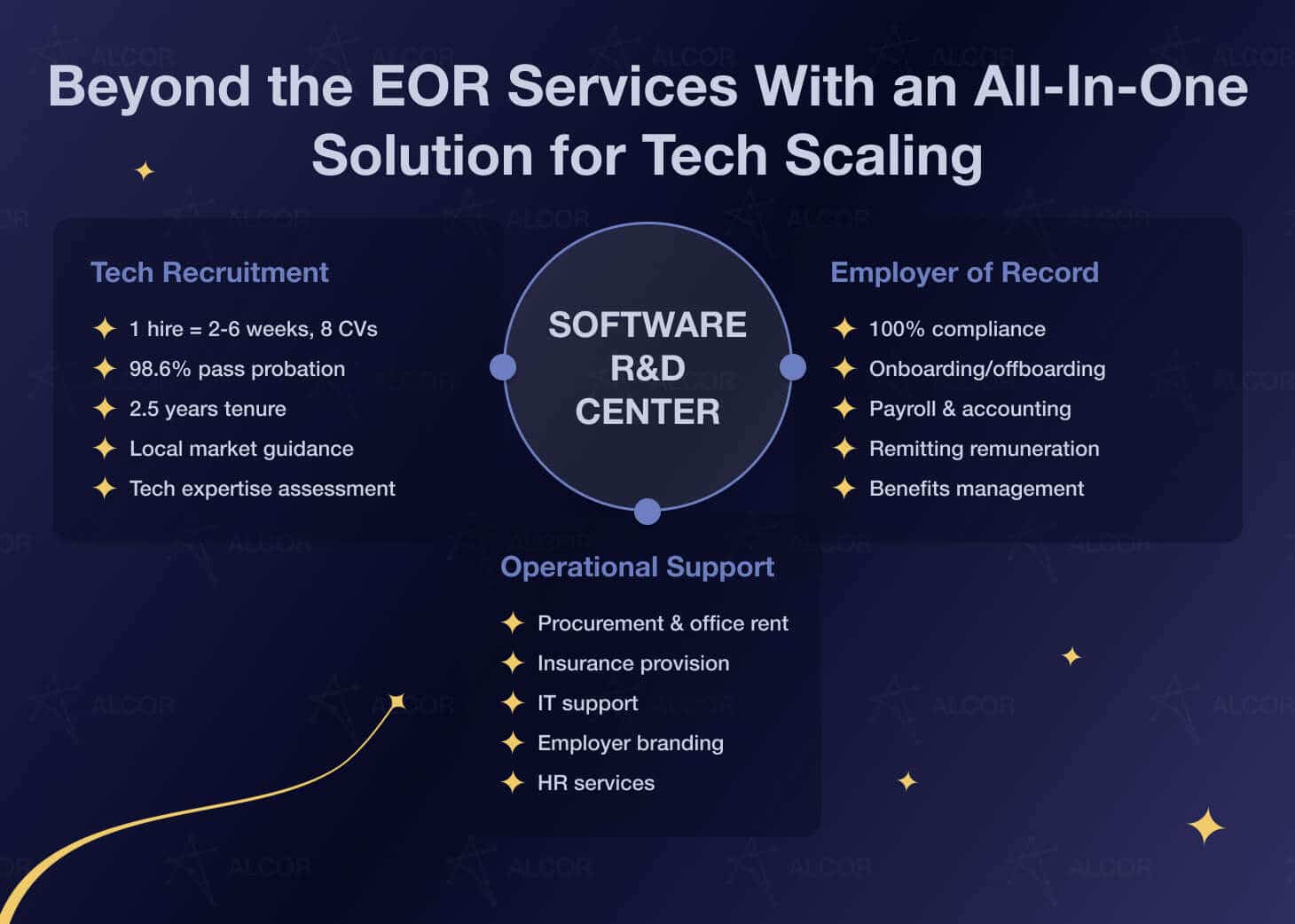
In short, we handle all the back-office complexity so you can focus on what really matters – product innovation and market reshaping.
With Alcor, your business:
- Build an AI development team of 30+ engineers in just 3 months;
- Cut delivery costs by up to 40% compared to outsourcing AI development;
- Retain your tech talent for an average of 2.5 years;
- Stay compliant and audit-ready from day one;
- Own IP entirely;
- Doesn’t face buyout fees or hidden costs.
So, suppose you’re tired of working with multiple vendors or paying inflated outsourcing rates. In that case, Alcor gives you a clear, human-driven path to building your own software R&D center with AI developers abroad.
Questions you can ask AI about AI engineer salary by country in 2026:
- What is the average salary range for AI developers in the US in 2026?
- What factors most influence AI developer salaries worldwide?
- What is the average salary of AI engineers in LATAM in 2026?
FAQ
What is the average AI developer salary in 2026?
AI developer salaries vary by region. In North America, mid-to-lead salaries range from $8.1K to $12.9K per month, while in South America, they range from $3.8K to $7.9K monthly. In Western and Nordic Europe, senior AI developers earn around $8.9K per month, while in Eastern Europe, salaries range from $4.4K to $6.3K monthly.
How much do AI engineers earn in the United States in 2026?
AI engineers in the United States are among the highest-paid globally due to strong market demand. Mid-level engineers earn around $11.7K per month, while professionals with several years of experience can reach about $14.3K monthly. Senior engineers with over five years of experience can exceed $17.5K per month, especially in top tech hubs.
How much can companies save by hiring AI developers in LATAM or Eastern Europe?
Companies can save significantly by hiring in LATAM or Eastern Europe rather than in the US. Salaries in these regions are often around 40-50% lower, yet access to experienced engineers remains. This allows companies to scale teams more efficiently within the same budget.
What are the main types of AI engineers in 2026?
In 2026, there are around 11 main types of AI engineers, each focusing on a specific part of the AI lifecycle. These include Machine Learning engineers, Data engineers / Data Science Hybrids, MLOps engineers, Vision & Multimodal AI engineers, Language / LLM engineers, Generative AI engineers, Prompt / Agent engineers, AI Security engineers, AI Ethics & Governance specialists, AI Product Managers, and Chief AI Officers (CAIO). Together, these roles cover everything from model development to deployment, governance, and business strategy.
How would you rate this article?
Alcor is Your Trusted Scaling Partner
for expansion
support