


Outsourcing software development to Colombia is climbing US CTOs’ agendas as AI talent gets pricier. According to PwC’s 2026 Global AI Jobs Barometer, jobs requiring AI skills are growing almost eight times faster than the overall job market and pay a 62% wage premium. Colombian tech hubs are keeping pace with that demand, with senior AI salaries about 53% below US rates.
I’m David Gomez, Lead of IT Recruitment in Latin America at Alcor. I work with VC-backed, PE-backed, and public tech product companies that have hit the US hiring wall and want to go beyond IT outsourcing to Colombia. By partnering with Alcor, you get software R&D centers that you fully own. Tech recruitment, COR/EOR, and full operational support all come from one partner. The result is a true in-house team of 10–30 software engineers within 90 days, optimized for today’s AI-driven development cycle.
In this article, you’ll learn why more US tech companies are choosing to hire software developers in Colombia and how to do it efficiently. You’ll also see how local salaries compare to US benchmarks, get a clear view of how Colombia stacks up against other LATAM tech hubs, and learn about an alternative to traditional outsourcing.
Key Takeaways
- Colombia’s ICT market is set to grow from $22.68 billion in 2025 to roughly $27.8 billion in 2027 and $37.70 billion by 2030, at 10.7% a year.
- Colombia is riding the AI boom: 24.5% of its working-age population uses generative AI, ahead of Chile, Argentina, Mexico, and Brazil. A national AI policy backs this with 106 actions through 2030.
- Colombia has over 202,000 tech specialists and 2,147 startups. Bogotá, Medellín, and Cali are its core tech hubs, with Barranquilla and Bucaramanga rising fast.
- Senior AI engineers in Colombia earn $93,000-$123,000 in annual base salary, compared to $189,000-$243,000 in the US.
- By partnering with Alcor, you get a true in-house team of 10–30 Silicon Valley-caliber engineers within 90 days, with full team & IP ownership and no vendor layer.
Colombia’s IT Outsourcing: Industry Overview
IT outsourcing in Colombia is a growing, AI-ready tech market backed by a strong ICT sector, deep talent, and rising startup hubs.
- Market size: Colombia’s ICT market was $22.68B in 2025, projected at ~$27.8B in 2027 and $37.70B by 2030.
- Exports: Computer services exports passed $1.75B in 2024.
- Talent: Colombia has 202,000+ tech specialists and 37,000 new ICT graduates yearly.
- Startups: Colombia has 2,147 startups and ranks #35 globally (StartupBlink 2026).
- Tech hubs: Bogotá, Medellín, and Cali lead, while Barranquilla and Bucaramanga are rising.
- AI: Colombia’s generative AI adoption is 24.5%, ahead of Chile, Argentina, Mexico, and Brazil. A national AI policy funds 106 actions through 2030.
Why is choosing to offshore software development to Colombia a strategic decision? Colombia combines a growing ICT sector, a deep talent pool, and one of the fastest-rising startup ecosystems in Latin America. Let the facts speak for themselves.

According to GlobalData, the country’s ICT market was valued at $22.68 billion in 2025. GlobalData expects it to reach $37.70 billion by 2030, growing 10.7% a year. At that pace, the market will reach roughly $27.8 billion in 2027, based on Alcor’s calculation. Exports show how much foreign companies already outsource software development to Colombia: computer services exports passed $1.75 billion in 2024, according to Portafolio.
Colombia’s tech talent pool is another draw for offshoring. The country is home to over 202,000 tech specialists, with 37,000 ICT graduates added each year, according to ProColombia. StartupBlink counts 2,147 startups in the country and ranks Colombia #35 globally, after 29.3% ecosystem growth in 2026.
According to Alcor’s recruitment expert, AI/ML and data science are among the fastest-growing and most active talent pools in Colombia right now. What makes them strong is the foundation underneath: Colombian engineers layer AI skills on top of an established base in Java, JavaScript/TypeScript, Python, and cloud. That depth makes the country’s AI talent more production-ready than in markets where AI skills exist without solid engineering fundamentals. In QA, Colombia also offers one of the strongest quality-to-cost ratios in LATAM.
Colombia has three main tech hubs:
Bogotá
Bogotá ranks #3 in Latin America, behind only São Paulo and Mexico City, per the Bogotá Chamber of Commerce. The capital led growth among the region’s three major entrepreneurial capitals at 9.2%, according to StartupBlink.
- Tech talent pool: 110,580 tech professionals, up 30% over five years, according to CBRE’s Scoring Tech Talent 2025
- StartupBlink startup ecosystem rating: #1 in Colombia and #64 globally, with 895 startups and $163.5M+ in total startup funding
- Top universities: National University of Colombia, University of the Andes, Pontifical Javeriana University
Medellín
Medellín leads all of Latin America in startup density, with 10.9 startups per 100,000 residents, ahead of Bogotá, Santiago, São Paulo, and Buenos Aires, according to Ruta N. In 2026, Medellín entered the global top 130 for the first time and became the 6th-strongest startup city in Latin America. The city pulled in roughly $157M in venture investment in 2025, a 400% year-over-year jump, as reported by The Rio Times, citing KPMG’s Colombia Tech Report 2026.
- StartupBlink startup ecosystem rating: #2 in Colombia and #130 globally, with 762 startups and 31.1% growth in 2026
- Top in: Energy, healthcare, and finance, according to Ruta N
- Top universities: University of Antioquia, Pontifical Bolivarian University, EAFIT University, CES University
Cali
Cali is the fastest mover on the list. It jumped 65 spots to #212 globally, with a 104.3% growth rate, StartupBlink reports.
- StartupBlink startup ecosystem rating: #3 in Colombia and #212 globally, with 219 startups
- Top in: SaaS and fintech
- Top universities: ICESI University, University of Valle, Pontifical Javeriana University Cali
Two rising tech hubs are also worth watching:
Barranquilla
The city attracted $469M in foreign direct investment in 2025, according to Forbes Colombia. In May 2026, the city hosted Barranqui-IA, the largest AI hackathon on Colombia’s Caribbean coast, with workshops run by Google, according to El Tiempo.
- StartupBlink startup ecosystem rating: #4 in Colombia, with 95 startups and 53.3% growth in 2026
- Top in: Fintech
- Top universities: Universidad del Norte, Universidad del Atlántico, Universidad de la Costa (CUC), Universidad Simón Bolívar
Bucaramanga
Bucaramanga anchors one of Colombia’s strongest deep-tech regions. In April 2026, Bucaramanga hosted Colombia 5.0, the national IT event, which drew 2,815 attendees, according to MinTIC.
- StartupBlink startup ecosystem rating: #5 in Colombia, with 25 startups and 40.4% growth in 2026
- Top in: Software and data
- Top universities: Universidad Industrial de Santander (UIS), Universidad Autónoma de Bucaramanga (UNAB), Universidad de Santander (UDES)
Both are still small, so for software development outsourcing in Colombia, they work best as second locations once a core team is running in Bogotá or Medellín.
The government’s National Digital Strategy 2023–2026 is fueling the rise of the Colombian IT industry. The Colombian government has also launched a National AI Policy (CONPES 4144) with a budget of approximately COP 479 billion (~$146.3 million), allocated to 106 actions until 2030. The policy aims to develop AI research, digital talent, and ethical use across the public and private sectors.
The result? According to the Microsoft AI Economy Institute, 24.5% of Colombia’s working-age population used generative AI in Q1 2026. That puts Colombia ahead of Chile, Argentina, Mexico, and Brazil.
AI is spreading through the workplace just as fast. According to EY’s Work Reimagined study, 92% of surveyed workers in Colombia use AI tools on the job, and 34% use them daily. The startup scene is moving in the same direction. The KPMG and BBVA Spark Colombia Tech Report 2026 names applied AI (solutions for productivity, operational efficiency, and industry specialization) as one of the ecosystem’s key growth lines. The report also calls AI the cross-cutting trend behind startup investment in 2025. Even the country’s largest tech congress followed suit: ANDICOM 2026, held in Cartagena in September, ran under the theme “Unleashing the Power of AI,” DPL News reported.
IT outsourcing in Colombia increasingly means access to AI-ready engineering talent. Alcor’s client data points to the same trend. AI/ML roles grew from 4.0% of all client requests in 2024 to 8.5% in 2025 and 12.7% so far in 2026. In Colombia specifically, AI-driven roles are now the dominant demand signal across industries, rather than concentrated in one sector, according to Alcor’s recruitment expert. For any strategy of IT outsourcing to Colombia, the next question is what hiring that talent costs, and that’s where the budget math begins.
How Much Software Development Outsourcing to Colombia Will Cost in 2027?
Outsourcing cost in Colombia for senior AI engineers in 2027 is $93,000–$123,000 in annual base salary, 53.2% below US rates on average.
- Employer contributions: ~30% on top of gross salary under full-time employment, and none under B2B contracts.
- Statutory extras: Prima de Servicios (1 month’s salary), Cesantía (1 month’s salary), and 12% Cesantía interest.
- Benefits: ~$3,300 per engineer per year.
- Tax incentive: A 30% income tax discount on qualified R&D investment.
Outsourcing cost in Colombia is a major reason why more North American tech product companies are turning their attention to LATAM. According to Alcor’s 2026 engineer compensation research, senior AI/ML engineers in the US each earn an average base salary of $222,000 per year. Facing that, it’s no surprise that many companies choose destinations like Colombia to stretch their budget and save over 50% on labor costs without sacrificing quality.
Payment models vary: some companies pay per hour, others per project, and many offer annual contracts. For consistency, we’re sharing annual salary data in the table below to help you compare senior tech specialists in Colombia and the US.
|
Senior Annual Base Salary, USD | ||
|
Role |
Colombia |
USA |
|
AI/ML Engineer |
$105,000 |
$222,000 |
|
MLOps Engineer |
$93,000 |
$189,000 |
|
AI Data Engineer |
$93,000 |
$210,000 |
|
LLM Engineer |
$96,000 |
$234,000 |
|
AI Infrastructure Engineer |
$123,000 |
$243,000 |
|
AI Platform Engineer |
$111,000 |
$228,000 |
According to Alcor’s 2026 salary research, based on active market observation and candidate pipeline data collected by Alcor’s in-house tech research and recruitment team. Figures are estimated annual base salaries in USD for 2026, a practical baseline for 2027 budgets.
As you can see, Colombian annual outsourcing rates for senior AI roles range between $93,000 and $123,000. For instance, the average AI/ML engineer salary in Colombia is $105,000, approximately 53% below the US average. Across all six roles, the gap averages the same. It’s like getting Silicon Valley-caliber skills without the Silicon Valley invoices.
Naturally, software development outsourcing rates in Colombia vary by seniority. According to Alcor’s research, Colombian salaries run 58.9% below US rates at mid-level and 45.1% below at lead level, averaged across 15 AI roles.
Turn your AI hiring pressure into a clear plan
Explore 8 tech markets across LATAM and Eastern Europe and get practical insights for building your AI engineering team.
But if you’re only looking at the annual price tag, you’re only seeing part of the picture.
Payroll taxes
If you hire tech specialists for Colombian software development under a B2B model, you have no payroll tax liability because they handle their own taxes.
But if you go the full-time employment route, be prepared to make mandatory contributions on top of the gross salary (remember, you can always outsource payroll via an Employer of Record provider). For example, a $5,000/month salary would cost your company roughly 30% extra, which includes:
1. Social Security Contributions (federal):
- Pension fund: 12%
- Health insurance: 8.5% (only above 10 × minimum monthly wage)
- Labor risks system: From 0.522%
2. Payroll taxes (local):
- Family Welfare (ICBF): 3%
- National Apprenticeship Service (SENA): 2%
- Family Compensation Fund: 4%
Local peculiarities
If you’re hiring under the FTE model, you should also include:
- Prima de Servicios (1 month’s salary, two installments);
- Cesantía (1 month’s salary per year worked, deposited into a third-party severance fund);
- Cesantía interest (12% of the Cesantía payment)
Recruitment fees
Hiring costs in Colombia vary based on the role’s seniority:
- 15% of gross annual wage for mid-level tech specialists,
- 20% for senior-level positions, and
- 25% and more for leads and top-tier talent.
Keep in mind that recruitment fees in the US are 10% higher than in Colombia, ranging from 25% to 35% of the annual salary.
Standard benefits package
In Colombia, tech companies typically offer a benefits package worth ~$3,300/year per engineer. It usually includes:
- Transportation/connectivity allowance: ~$500/year
- Health insurance: ~$1,500/year
- Meal vouchers or food allowances: ~$500/year
- Home office allowance: ~$800/year
That’s nearly $12,100 less than the US average, where annual benefits per tech specialist cost around $15,400.
To budget the full annual employment cost of a senior engineer in Colombia, add up:
- the gross annual salary;
- employer contributions (under an employment agreement);
- Prima de Servicios;
- a benefits package of ~$3,300;
- a one-time recruitment fee of 15–25% of the annual salary; and
- a monthly EOR/COR fee, if you don’t have a local entity.
Another reason why foreign tech companies go with nearshore software development to Colombia is Colombia’s business taxes and incentives. Under Law 2277 of 2022, companies that invest in research, technological development, and innovation projects qualified by Colombia’s National Council for Tax Benefits can deduct 30% of the invested amount from their income tax, according to Minciencias.
Colombia vs Other Latin American Countries
Colombia competes with Mexico, Brazil, Argentina, and Chile by combining US East Coast time-zone overlap with Latin America’s #2 startup ecosystem (StartupBlink 2026).
- Mexico: A larger talent pool (974,500 professionals) and higher Coursera skills rankings, but a #5 LATAM startup ecosystem.
- Brazil: The region’s largest tech market, with 1.2M ICT professionals and the #1 startup ecosystem in LATAM.
- Argentina: Stronger English (#1 in LATAM, EF EPI), but a smaller talent pool (176,000) and a #4 startup ecosystem.
- Chile: Leads LATAM in innovation (GII 2025), but has a smaller talent pool (160,000) and ranks below Colombia for business environment (StartupBlink IBEI 2026).
Colombia vs Mexico
When evaluating outsourcing destinations, Mexico naturally comes up as one of Colombia’s key competitors. Proximity is a major advantage: with just a 4-hour flight from San Jose, CA, to Mexico’s top tech hubs, companies can easily schedule on-site visits and maintain close collaboration with their engineering teams. However, Colombia’s time zone is close, too. Colombia’s GMT-5 matches New York in winter and sits one hour behind it in summer, so teams outsourcing software development to Colombia get full overlap with the US East Coast.
But Mexico’s tech talent pool is significantly larger. Mexico has around 974,500 professionals across software development and related fields, and produces 174,476 new STEM and ICT graduates each year, per Mexico’s Ministry of Economy.
Mexican developers are especially strong in programming languages like PHP, Java, C#, Python, and Ruby. According to the Coursera Global Skills Report 2025, Mexico ranks 13th in LATAM for overall skills and 14th for tech skills. Colombia ranks 16th in both. However, Colombia pulls ahead on its startup ecosystem. StartupBlink’s Global Startup Ecosystem Index 2026 places Mexico 3 spots lower than Colombia – #5 (#47 globally) after a 2.9% decline.
Want to scale your tech product team in Mexico fast, fully compliant, and with no hidden costs?
Franki, a California-based startup, answered yes to this question and contacted Alcor. The deal was sealed right away. It chose Mexico for its first move into Latin America. The country was nearshore to its HQ and had top-tier mobile engineering talent.
By partnering with Alcor, Franki got:
- A rare stack with zero compromise: 20 qualified candidates for senior iOS roles requiring RxSwift, a skill set that is hard to find in any market.
- Senior hires in 4–5 weeks each: The first 7 hires (2 iOS Engineers, 3 Android Engineers, and 2 QC Engineers) all passed probation.
- A real in-house team from day one: Engineers were employed under Franki’s terms and reported directly to Franki’s leadership, with no vendor in between.
- Pricing transparency from day one: Salaries and fees were set upfront and held throughout. Franki called it a “WOW moment” before the team was even built.
- A first LATAM entry without a learning curve: Compliant payroll, contracts, IP protection, benefits, and PTO, with no local entity required.
- A foundation for growth: Franki’s revenue doubled quarter over quarter in 2024. In 2025, it launched Franki for Franchises and Franki for Brands.
Colombia vs Brazil
Another major player in the LATAM region is Brazil, the region’s largest tech market. Brazil counted 1.2 million ICT professionals in December 2025, according to Brasscom’s 2025 Diversity Report. Brasscom also projects up to R$2 trillion (~$386 billion) in technology investment between 2026 and 2029, led by cloud services and AI, Teletime reported. Brazil’s digital infrastructure is growing too: according to the same report, data center capacity is set to rise from 1,063 MW in 2025 to 2,629 MW by 2030.
Brazil also offers a business-friendly ecosystem. It holds #1 in LATAM and #26 globally in StartupBlink’s Global Startup Ecosystem Index 2026. Overall, StartupBlink reports 5,196 startups in the country.
Want to hire top developers in Colombia? We provide IT staffing in Bogotá, Medellín, and Cali!
Colombia vs Argentina
One of the most common outsourcing destinations in South America is Argentina. Its tech talent pool is smaller than Colombia’s, consisting of 176,000 tech specialists, according to Alcor’s research. Even so, Argentinian developers rank #1 in LATAM (#26 globally) in the EF English Proficiency Index, 16 spots above Colombia (#17 in LATAM). Argentina is also #3 in LATAM on TopCoder, three spots above Colombia.
Argentina’s business landscape is growing too, making it an even more attractive place to outsource software development. In StartupBlink’s Global Startup Ecosystem Index 2026, Argentina climbed to #4 in LATAM (#46 globally) after two years in fifth place. That still leaves it two spots behind Colombia.
Colombia vs Chile
Chile is also a favorite LATAM destination for tech product companies. While the Chilean talent pool is smaller than Mexico’s or Colombia’s (160,000 tech professionals), it offers a broad skill set. Chilean developers work confidently with a wide range of technologies, including Java, Python, PHP, Node.js, and ASP.NET.
Chile ranks 3rd in LATAM for overall skills and 4th for tech skills in the Coursera Global Skills Report 2025, and 2nd in LATAM on TopCoder. It also leads the region in the Global Innovation Index 2025 (#51 globally), where Colombia places 5th (#71 globally). On the business side, Colombia holds the edge. StartupBlink’s Innovators Business Environment Index 2026 ranks Colombia #4 in LATAM (#47 globally), two spots ahead of Chile (#6 in LATAM, #57 globally).

Better Than Outsourcing to Colombia
Building a true in-house engineering team in Colombia is better than outsourcing: engineers report directly to you, and you own all IP & the team from day one.
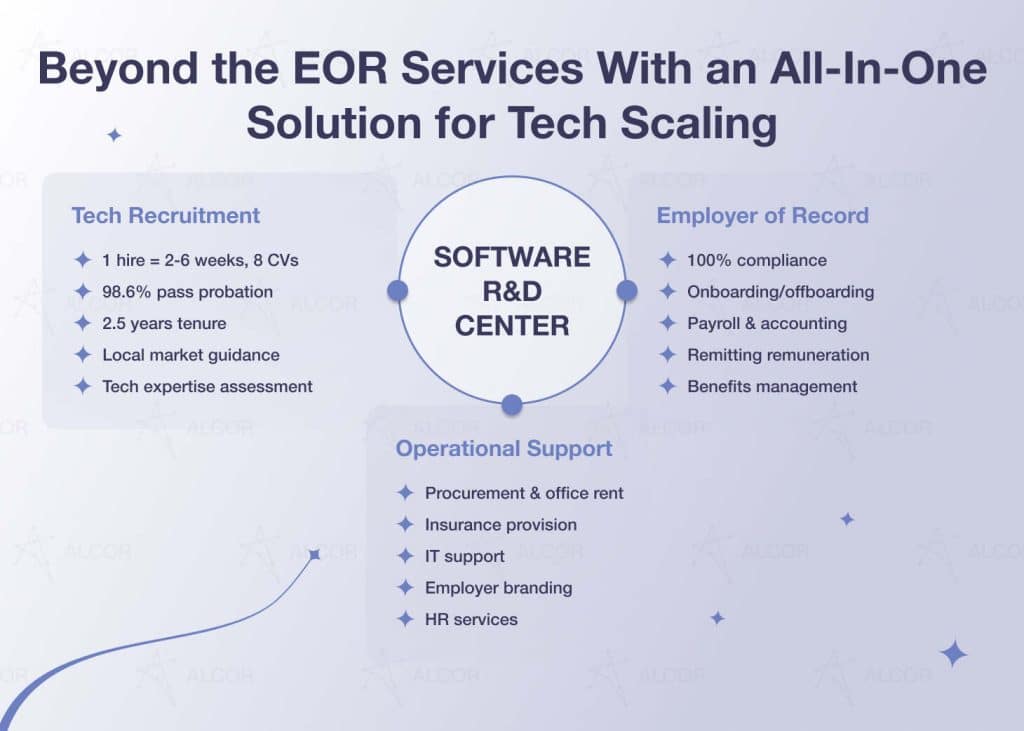
- Speed of recruitment: Tech product companies get 10–30 senior AI and product engineers within 90 days.
- Quality: Clients approve 80% of candidates, and 98.6% of hires pass probation.
- Compliance: EOR/COR services cover contracts, payroll, and benefits with no local entity.
- Full operational support: Everything’s handled by one dedicated Customer Operations Manager.
- Proof: Dotmatics built a 30-engineer team in 12 months before its $5.1B Siemens acquisition.
If your Colombian IT outsourcing strategy keeps hitting the same wall, you’re not alone. Many companies that outsource developers in Colombia run into the same story: engineers stay loyal to the vendor instead of your roadmap, contracts are priced by the hour, and your IP sits one layer away. Switching to staff augmentation or IT outstaffing doesn’t change the math either. Your remote engineers are still hired, managed, and retained by someone else. For VC-backed, PE-backed, and public tech product companies that need engineers their US market can’t supply, the solution to successful IT outsourcing to Colombia is a surprising one: stop outsourcing. Because there is a better way to get them.
By partnering with Alcor, you get your own software development center in Colombia: a true in-house team of 10–30 Silicon Valley-caliber engineers within 90 days, optimized for today’s AI-driven development cycle. Your engineers report directly to you, align with your roadmap, and build IP that is yours from day one, with no vendor layer. This is not outsourcing. This is your engineering team, built globally.
The AI talent race changes what hiring should look like. Your inbox is flooded with AI-generated CVs, and every competitor is chasing the same AI and ML engineers. With Alcor, you approve 80% of the candidates you see. It takes 8 CVs to land 1 offer, even for rare AI roles. Every CV is checked by a senior tech recruiter before it reaches you, while internal AI tools handle market mapping and signal filtering.
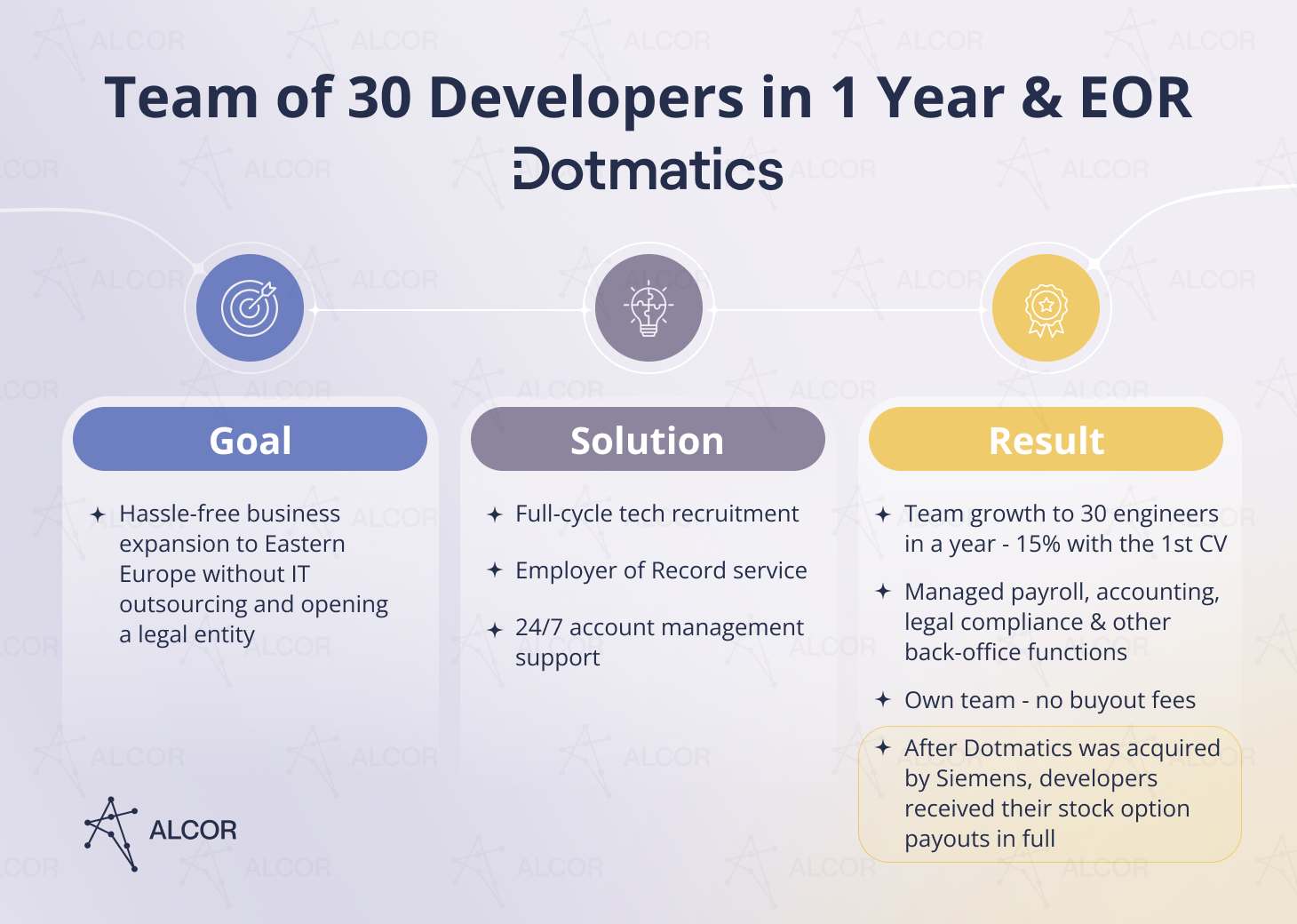
Dotmatics, a PE-backed company behind an AI-powered scientific R&D platform, faced a familiar challenge. Its product serves 2 million+ users across 10,000+ customers, including Pfizer, Moderna, and NASA. Engineering quality wasn’t negotiable, so outsourcing was off the table. Dotmatics needed engineers working directly under its leadership in a region where it had no legal entity and no local hiring expertise.
By partnering with Alcor, Dotmatics got:
- A 30-engineer team in 12 months: from zero presence in the region to a full team, including a Director of Engineering, Full Stack, React, QA Automation, DevOps, and Node.js engineers.
- First CVs in 3–5 days: 4 out of 5 candidates were approved, and a C++ vacancy was filled within days.
- Full control over the team: developers reported directly to Dotmatics’ leadership, with full IP rights secured from day one.
- A compliant setup without a local entity: payroll, accounting, compliance, onboarding, offboarding, and laptop procurement all in one place.
- One point of accountability: a dedicated Customer Operations Manager, one email away, with no tickets and no vendor layer.
- Exit readiness: when Siemens acquired Dotmatics for $5.1 billion in 2025, every developer’s stock options were paid out in full, with no delays.
You can build the same setup in Colombia. With IT recruitment in Colombia, you fill senior AI and product roles in 2–6 weeks, and 98.6% of hires pass probation. With Contractor of Record or Employer of Record services in Colombia, you get compliant contracts, benefits, and IP protection without opening a local entity. Payroll processing in Colombia runs in the background, too. Your engineers start delivering within 10 business days, and you get all the operations covered.
Why outsource when you can build a team that’s truly yours?
The same model is behind BigCommerce, Backstory (ex-People.ai), Sift, and more!
Now it’s your turn. Let’s build your team together.
References
- PwC, 2026 Global AI Jobs Barometer
- GlobalData
- Portafolio
- ProColombia
- StartupBlink
- Bogotá Chamber of Commerce
- CBRE, Scoring Tech Talent 2025
- Ruta N
- KPMG & BBVA Spark, Colombia Tech Report 2026
- Forbes Colombia
- El Tiempo
- MinTIC
- International Trade Administration
- CONPES 4144 (National Planning Department)
- Microsoft AI Economy Institute
- EY, Work Reimagined
- DPL News
- Alcor, 2026 Guide to Building AI & Product Engineering Teams in LATAM & Eastern Europe
- Minciencias
- Mexico’s Ministry of Economy
- Coursera Global Skills Report 2025
- Brasscom, 2025 Diversity Report
- Teletime
- EF English Proficiency Index
- TopCoder
- WIPO, Global Innovation Index 2025
- StartupBlink, Innovators Business Environment Index 2026
FAQ
Why choose Colombia over other Latin American IT outsourcing destinations like Mexico, Argentina, or Brazil?
Colombia combines Latin America’s #2 startup ecosystem, a GMT-5 time zone aligned with the US East Coast, and a fast-growing AI talent base. Colombia ranks ahead of Mexico and Argentina in StartupBlink’s 2026 index and leads Chile, Argentina, Mexico, and Brazil in generative AI adoption.
How does the talent pool in major hubs like Medellín, Bogotá, and Cali compare to North American developer standards?
Top Colombian engineers match North American standards in SaaS, fintech, and AI product delivery. Bogotá alone has 110,580 tech professionals, Medellín leads Latin America in startup density, and Cali posted the fastest startup growth among the region’s top cities in 2026.
How does the AI boom influence demand for the IT and software development outsourcing industry in 2027?
The AI boom shifts 2027 demand from outsourced coding capacity to dedicated senior AI, ML, and data engineering teams that companies own. US product companies increasingly build these teams in Colombia, where 24.5% of working-age adults use generative AI and a national AI policy funds 106 actions through 2030.
How much does it cost to hire a senior AI engineer in Colombia in 2027?
A senior AI engineer in Colombia earns $93,000–$123,000 in annual base salary, about 53% below US rates, according to Alcor’s 2026 research. The full employment cost adds about 30% in employer contributions, a one-month Prima de Servicios, and optional benefits of about $3,300 per year.
How would you rate this article?
Alcor is Your Trusted Scaling Partner
for expansion
support