


Key Takeaways
- Build-Operate-Transfer lets a provider build and run an engineering team abroad, then hand over the entity, engineers and IP rights, typically after two to three years in Central and Eastern Europe.
- Hybrid BOT arrangements are set to grow at a 9.10% CAGR through 2031, outpacing the global capability center market, with Mexico (10.98%) and Central and Eastern Europe (9.96%) leading.
- The BOT model for IT industry teams opens talent pools of 2.3M+ in Latin America and 2M+ in Eastern Europe, with senior base salaries 54.9–61.06% below US levels.
- The main risks sit inside the deal: split loyalty while the provider employs your engineers, a complex handover, and transfer fees that grow with headcount, so agree on fee terms before signing.
- After the transfer, an EU entity can hire across all 27 member states and claim incentives like Poland’s 5% IP Box, while mid-contract rule changes call for a change-in-law clause.
- Alcor’s software R&D center skips the wait: first candidates in 3–5 business days, senior hires in 2–6 weeks, IP assigned from day one and a free move to your own entity.
Build-Operate-Transfer in IT outsourcing is gaining ground as a route to engineering capacity abroad. According to Mordor Intelligence, hybrid BOT arrangements in the global capability center market are set to grow at a 9.10% CAGR through 2031 – faster than the market’s overall 7.97%. But growth alone won’t tell a CTO whether BOT fits their roadmap. What does the model deliver before the transfer, and what does the handover cost?
What is a Build-Operate-Transfer Model?
The Build-Operate-Transfer (BOT) model is a contractual agreement in which a provider sets up a business unit in another country, runs it for an agreed period, and then hands ownership to the client. The provider registers the local subsidiary, hires the engineers and manages daily operations. Once agreed targets or deadlines are met, it transfers the entity, the team, the contracts and the IP rights to the client. Until the transfer, the provider stays the legal employer, and the client gets full control only when ownership moves over.
The Build-Operate-Transfer concept comes from public infrastructure projects, where a private company builds and runs a road or power plant before handing it to the state. In tech, the cycle is much shorter. In Central and Eastern Europe, providers typically run a center to agreed service levels and transfer ownership after two to three years, according to Mordor Intelligence. The same report shows that company-owned centers generated 57.85% of the region’s capability center revenue in 2025. For a company without a local entity, the Build-Operate-Transfer model in the IT industry is a phased path to that kind of ownership.
How Does a BOT Model Work in IT Outsourcing?
Build-Operate-Transfer in IT outsourcing works in three stages, and control moves from the provider to the client at each one.
- In the Build stage, the provider registers a local subsidiary, hires the engineering team and sets up the office.
- In the Operate stage, the provider stays the legal employer and runs payroll, HR and compliance while the engineers ship on the client’s roadmap against agreed KPIs.
- In the Transfer stage, the entity, the engineers, the contracts and the IP rights pass to the client once headcount, performance or time triggers are met. The transfer route and any buyout fee are best fixed in the agreement before the first hire.
Each stage comes with its own decisions, and more product companies are taking this route. Build-Operate-Transfer in LATAM leads the curve: in Mexico, hybrid BOT structures are forecast to grow at a 10.98% CAGR through 2031, ahead of 10.24% for the country’s capability center market overall, according to Mordor Intelligence. Build-Operate-Transfer in Europe follows the same pattern. BOT is the fastest-growing engagement model in Central and Eastern Europe, at a 9.96% CAGR to 2031.
|
Stage |
What the provider does |
What you do |
What to lock in the agreement |
|
Build |
Registers the subsidiary, recruits engineers, leases and equips the office |
Approve role profiles, interview finalists, set the tech stack |
Who signs employment contracts and who owns the code from day one |
|
Operate |
Acts as legal employer, runs payroll, HR, compliance and local operations |
Set product priorities, track output against KPIs |
Service levels, KPIs and how salary reviews pass through to your invoice |
|
Transfer |
Hands over the entity, team, contracts, assets and IP, supports the transition |
Take over employment, management and infrastructure |
Transfer trigger, buyout fee, which engineers move, non-solicit terms |
1. Build
-
Team assembling. IT staffing via Build-Operate-Transfer starts with role profiles agreed with your CTO: stack, seniority, English level and the technical expertise your roadmap needs. The provider sources and screens candidates, and you make the final call.
-
Office setup. In parallel, the provider leases and equips the workspace that will become your R&D center after the transfer.
-
Legal and admin coverage. The provider handles employment contracts, payroll and compliance with the local jurisdiction. Some companies skip the entity at this point and hire through an Employer of Record, which employs engineers on their behalf until an entity makes sense.
2. Operate
In a BOT model in software development, Operate is the longest stage, and it’s where your costs take shape. The team ships on your roadmap while the provider runs everything around it:
-
Process setup. The provider sets up workflows, tooling access and reporting so the team can start shipping.
-
Service levels. The provider works to the SLAs in your agreement and keeps local operations running: equipment, benefits, office, local holidays.
-
Performance tracking. Both sides review KPIs such as velocity, quality and attrition at a fixed cadence and adjust the hiring plan.
3. Transfer
The final stage of the BOT model for the IT industry is where deals either close cleanly or drag on:
-
Transition planning. The provider drafts a step-by-step handover plan with owners and deadlines for every function, from payroll to code repositories.
-
Knowledge and asset transfer. The entity, employment contracts, equipment, licenses and IP move to you, with legal and financial checks along the way.
-
Post-transfer support. The provider stays on call for an agreed period to handle questions while your team takes over the back office.
The legal route matters as much as the timeline. In EU countries such as Poland, Romania and Bulgaria, a transfer of a business or part of one moves employees’ contracts to the new employer on their existing terms. The transfer itself can’t be grounds for dismissal, under the EU Transfer of Undertakings Directive. If you buy the provider’s local entity instead, the employer doesn’t change at all. That’s why the transfer mechanism belongs in the contract from day one, and the specifics depend on the country and the deal structure.
A BOT deal ends with your own R&D center, but it becomes yours only after the transfer.
Build-Operate-Transfer Examples in the IT Industry
Build-Operate-Transfer in IT outsourcing works best in three scenarios:
- A company needs engineers before its own foreign entity is ready.
- It’s moving work from a far-shore location to a nearshore one for time-zone overlap.
- It plans a long-term local presence and wants to take over a ready-made entity.
Real companies have followed each of these paths in Mexico and Poland. BOT is harder to justify for short projects or teams of a few engineers, where setup and transfer costs outweigh the value of owning an entity.
Example 1: Hiring before your entity is ready
This scenario fits companies that plan their own subsidiary abroad but can’t put hiring on hold until it’s registered. It often applies to larger enterprises, where a new entity needs legal, tax and board approvals before it can employ anyone.
Real-world example: a publicly traded US digital banking software company opened a team in Monterrey, Mexico, under a BOT setup before its own Mexican entity was fully operational. The provider handled recruiting, payroll and equipment logistics. Meanwhile, the hub grew to 57 roles across engineering, product, QA, design and architecture while the company prepared to take it over.
Example 2: Moving work closer to US time zones
This scenario fits companies that already outsource far-shore and want the work closer to home without rebuilding everything from scratch. The provider runs employment in the new market while the client’s managers learn how it works.
Real-world example: a US software company had relied on offshore teams in Asia, where time-zone gaps hurt project delivery. It moved to a BOT setup in Guadalajara, Mexico, with the local team reporting directly to its US organization. Over 18 months, the team grew from 6 to 40 people across engineering, mobile development, QA, product design and technical support. The company then moved all of them to its own payroll.
Example 3: Taking over a ready-made local entity
This scenario fits companies that plan to stay in a market for years. Here, the BOT cycle can end with the entity itself changing hands, rather than with people moving to a new employer.
Real-world example: a UK mobility-as-a-service company had a provider register its Polish entity, recruit the local team, help open the office and run the operation through its early growth. Ownership of the entity then passed to the client, giving it an in-house technology operation in Poland.
In each case, ownership was the end goal, reached by a different route. The pros and cons below show what that route buys and what it costs.
5 Benefits of the Build-Operate-Transfer Model for IT in 2027
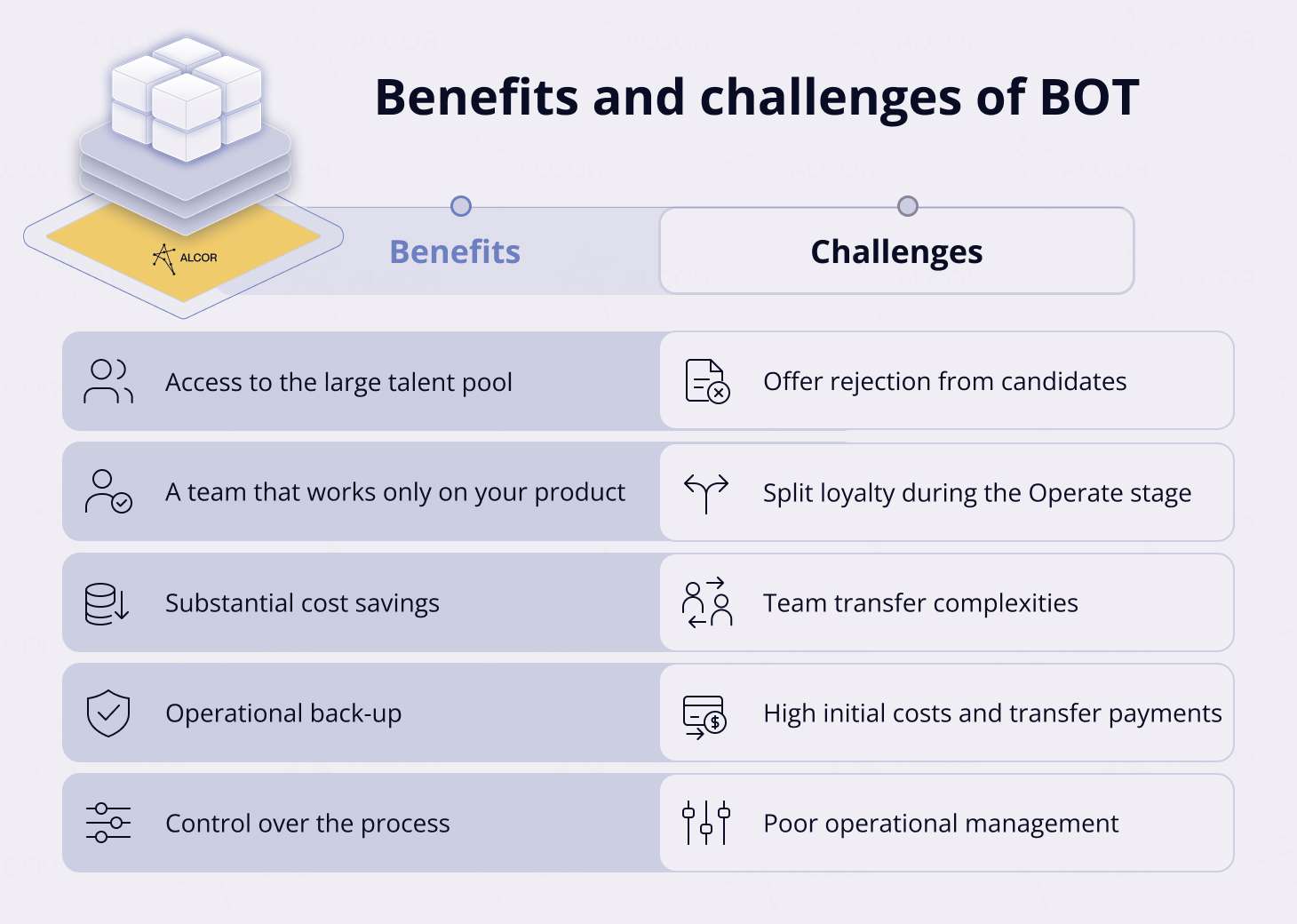
The BOT model for the IT industry gives tech companies five main advantages in 2027:
- Access to large talent pools in Latin America and Eastern Europe.
- A team that works only on the client’s product.
- Senior base salaries more than 50% below US levels.
- Local operations handled by the provider.
- Direct control over engineering processes.
The trade-off is timing. The client owns the team only after the transfer, and the provider’s fees and the buyout come on top of salaries.
1. Access to the large talent pool
Three senior roles open since Q1 is a familiar picture for US engineering leaders. The US Bureau of Labor Statistics projects about 106,100 openings for software developers, QA analysts and testers every year through 2035. Every one of them competes for the same local pool, which is the core of the US talent shortage. Build-Operate-Transfer in software development moves that search to regions with deeper talent pools:
|
Latin America |
Eastern Europe |
|
|
Tech talent pool |
2.3M+ |
2M+ |
|
Main tech stack |
Python, Java, JavaScript, PHP, C#, Ruby, SQL, Node.js |
JavaScript, Python, Java, C#, TypeScript, SQL, PHP, Kubernetes |
|
Tech hubs |
Mexico City, Monterrey, Guadalajara, Bogotá, Medellín, Buenos Aires, Córdoba, Santiago |
Warsaw, Kraków, Wrocław, Kyiv, Lviv, Bucharest, Cluj-Napoca, Sofia |
|
STEM/ICT graduates per year |
|
|
|
English proficiency |
|
|
|
Time zone vs US Eastern Time |
GMT−6 to GMT−3: 0–2 hours apart, near-full overlap with US working hours |
GMT+2 to GMT+3: 7–8 hours ahead, overlap in US mornings |
|
Business environment |
|
|
Sources: Eurostat, Digital State UA, IBEI 2026, EF EPI 2025
Mexico and Poland alone add more than 248,000 STEM and ICT graduates a year. For a dedicated development team in Eastern Europe or Latin America, the decision shifts from finding senior engineers to choosing the right destination for your stack and time zone.
2. A team that works only on your product
Outsourcing vendors often rotate engineers across clients and deliver code under their own processes. A BOT team works only on your product, inside your repositories, tools and rituals, under your brand from the first day. For Build-Operate-Transfer for tech companies, that matters for two reasons: product context stays with the same engineers, and the people you meet in sprint reviews are the people you inherit at the transfer. Until then, the provider remains the legal employer, so the team is yours in practice before it’s yours on paper.
3. Substantial cost savings
Salaries are the biggest line in any engineering budget, and the gap between markets is wide. According to Alcor’s 2026 global engineer compensation research, senior base salaries average 61.06% below US levels in Latin America and 54.9% below in Eastern Europe. The gap grows in AI roles: a senior ML Engineer earns an average base of $79,050 in Latin America and $222,000 in the US. Here is how senior base salaries compare for 15 in-demand roles in Build-Operate-Transfer in LATAM and Eastern European locations:
|
Senior Engineer Annual Base Salaries in 2026, USD |
|||
|
Role |
Latin America |
Eastern Europe |
US |
|
React Developer |
55,650 |
72,750 |
156,000 |
|
PHP Developer |
55,200 |
63,000 |
126,000 |
|
Node.js Developer |
57,300 |
75,300 |
156,000 |
|
Python Developer |
63,750 |
76,500 |
165,000 |
|
C/C++ Developer |
58,200 |
79,500 |
150,000 |
|
Mobile Developer (iOS/Android/Xamarin) |
64,650 |
75,000 |
174,000 |
|
Blockchain Developer |
72,525 |
76,800 |
171,000 |
|
DevOps Engineer |
68,700 |
80,400 |
168,000 |
|
AI Engineer |
104,250 |
118,500 |
222,000 |
|
ML Engineer |
79,050 |
86,100 |
222,000 |
|
LLM Engineer |
90,000 |
94,050 |
234,000 |
|
AI Data Engineer |
93,750 |
106,500 |
210,000 |
|
ML Data Scientist |
98,250 |
112,500 |
216,000 |
|
AI Platform Engineer |
112,500 |
127,500 |
228,000 |
|
AI Agent Developer |
119,250 |
134,250 |
237,000 |
|
According to Alcor’s 2026 global engineer compensation research |
|||
For a role-by-role view of one market, see the average senior developer salary in Mexico
4. Operational back-up
When you partner with an IT vendor in the offshoring country, they become your one-stop shop for all administrative tasks. It’s like having a reliable co-pilot – they handle everything from hiring software developers and managing payroll to negotiating office leases and offering tax consulting.
But that’s not all – legal matters are covered too. Lawyers well-versed in international IT law ensure your offshore branch complies with all regulations. They go the extra mile by preparing the necessary documents for a seamless R&D transfer. This comprehensive support means you can kick back a bit – stay focused on your product while your vendor takes care of the operational heavy lifting.
5. Control over the processes
Compared with project outsourcing, a Build Operate & Transfer solution keeps engineering decisions with you: the stack, coding standards, rituals and product priorities. If you agree on the operating structure with the provider upfront, the team grows inside your business strategy rather than next to it. Until the transfer, people decisions such as compensation and performance reviews still run through the provider’s contract. Full control, including those decisions, arrives with ownership, the last step of Build-Operate-Transfer in software engineering.
5 Challenges of Using the BOT Model for IT Outsourcing
The main disadvantages of the BOT model show up inside the deal itself:
- Offer rejections from candidates who don’t know your brand.
- Split loyalty while the provider is the employer.
- A complex handover.
- Transfer fees that grow with the team.
- Weak operations at providers without R&D center experience.
Most of them can be reduced through the contract and the setup: an employer branding plan for the Build stage, your own managers close to the team, a handover that starts months before the transfer date, and fee terms fixed from day one.
1. Offer rejections from candidates
In a new market, a strong product doesn’t guarantee a strong pipeline. Senior engineers often weigh several offers at once, and a company they’ve never heard of starts behind local employers with established reputations. Employer branding closes that gap with a clear EVP, visible hiring managers and a local presence that shows candidates who they’ll work with and why.
Sift, the US fraud-prevention unicorn, faced this when it opened its first R&D branch in Kyiv. It had no local entity, one in-house recruiter and 5–10 hires planned for the first quarter. Alcor put 10 researchers and 3 tech recruiters on the roles and backed outreach with a short video featuring Sift’s hiring manager, which raised the offer acceptance rate by 15%. The search grew into a 51-engineer R&D center across Ukraine and Poland, run by Sift’s own engineering leadership.
2. Split loyalty during the Operate stage
Until the transfer, BOT engineers work on your product, but they sign their contracts with the provider and get their reviews from it. Often they report to the provider’s managers too. That split matters more than it looks. According to Gallup’s State of the Global Workplace 2026, global employee engagement fell to 20% in 2025, the lowest level since 2020. Most of the decline came from managers, whose own engagement dropped from 27% to 22%. If the people closest to your engineers work for the provider, much of the team’s motivation depends on the provider too. For Build-Operate-Transfer for tech companies, the fix is structural: keep your own engineering managers in the team’s daily work, and agree in the contract who runs performance reviews and promotions.
3. Team transfer complexities
The transfer is where BOT deals are most likely to lose people and momentum. Writing in the Forbes Technology Council in September 2026, the CEO of a software development company made two points. Much of a team’s working knowledge lives in people, not in runbooks, and providers tend to move their strongest managers to new accounts as the transfer date nears. His advice is to embed your own managers in the operation three to six months before the handover. He also suggests holding back part of the provider’s payout until retention and productivity hold for six to twelve months afterwards. The legal side adds its own checks: employment law, data protection, IP licenses, NDAs and non-competes. Each depends on the transfer route described in the Transfer stage above.
4. High initial costs and transfer payments
The Build-Operate-Transfer in software engineering front-loads costs: entity setup, office lease, equipment and legal work all come before the first release. The less visible cost is the transfer itself. Providers might price BOT as a markup on each engineer’s compensation plus a transfer fee when the team moves to your entity. Others might sell you the local entity or its holding company for a pre-agreed price. Per-engineer fees scale with headcount, so a buyout that looked modest at 10 engineers can look very different at 50. Agree on the formula, the trigger and a cap before signing.
5. Poor operational management
Running an engineering team takes more than recruiting. During the Operate stage, payroll in local currency, benefits, equipment, visas, tax filings and labor law all sit with the provider. Gaps there reach engineers first: a late salary or a missing laptop costs goodwill the team carries into the transfer. Providers that mainly sell IT services may have strong engineers but little experience running offices and employment for another company. Ask for references from clients whose centers the provider has actually run and handed over.
3 Opportunities When Using the BOT Model
In SWOT terms, opportunities are outside trends that the BOT model helps a company capture. Three stand out for 2027:
- Building AI capability as AI skills spread across engineering hiring.
- Using a transferred EU entity as a base for hiring across the European Union.
- Claiming R&D tax incentives that only the owner of a local entity can use, such as Poland’s 5% IP Box rate.
The last two open up fully after the transfer, once the entity is yours.
|
Opportunities vs. Threats of the BOT Model |
||
|
Opportunity |
Threat |
What to put in the agreement |
|
Building AI capability alongside the product team |
A roadmap that moves faster than the contract |
Headcount flexibility, role swaps, early or partial transfer option |
|
An EU entity as a base for hiring across the European Union |
Changes at the provider before the entity is yours |
Change-of-control clause with an early transfer right, copies of entity and IP documents |
|
R&D tax incentives after the transfer |
Labor and tax rules that change mid-contract |
Change-in-law clause, provider registration checks, local tax review before the handover |
1. Building AI capability alongside the product team
AI is no longer a niche requirement in engineering hiring. According to the Stanford AI Index 2026, based on Lightcast job-posting data, AI skills now appear in 2.5% of all US job postings. Agentic AI was also added as a new skill cluster after fast growth in 2025. For a CTO, that means every AI role on the roadmap competes with all the other companies making the same shift. With the BOT model in software development, AI and ML engineers can sit in the same center as the product team rather than in a separate vendor project. Models, data pipelines and product code then stay in one place, and they move to the company together at the transfer. That’s how a team adds a new capability instead of buying it in pieces.
2. A base for hiring across the European Union
Once a BOT center in Poland, Romania or Bulgaria becomes your entity, it’s also an EU employer. Under the EU’s free movement of workers, citizens of any member state can take a job in another EU country without a work permit, per the European Commission. One center then becomes a hiring base for the whole bloc. A Polish entity can bring in a senior engineer relocating from Spain or Lithuania without a visa process, and that widens the pool for roles the local market can’t fill. Ukraine sits outside this framework, so the advantage applies to centers in EU jurisdictions only.
3. Tax incentives that open up after the transfer
Several CEE countries reward companies that run R&D locally, but the benefit goes to the company that owns the entity and the IP rights. Poland, for example, has two such reliefs:
-
R&D tax relief: a company can deduct 200% of the qualifying costs of employees working on R&D from its tax base, according to PwC’s tax summaries.
-
IP Box: income from qualifying IP rights, including copyrighted software, is taxed at 5% instead of the standard 19% corporate rate, per Poland’s Ministry of Finance.
The two reliefs can be combined. During the Operate stage, the provider’s entity is the taxpayer. After the transfer, your own entity can plan its R&D and IP around these incentives. Eligibility depends on how the work and IP are documented, so it’s worth bringing in a local tax advisor before the handover.
3 Threats of Build-Operate-Transfer
Threats are the outside forces that can turn a sound BOT deal against the client over a multi-year contract. In the BOT model for the IT industry, three matter most:
- Labor and tax rules that change in the destination country mid-contract.
- A roadmap that moves faster than the headcount plan written into the agreement.
- Changes at the provider itself, from an acquisition to a market exit.
Each one is manageable if the contract assigns the risk before it happens.
1. Rules that change mid-contract
A BOT deal is priced on the labor and tax rules in force when it’s signed, and those rules move.
Latin America: Mexico rewrote its subcontracting rules in 2021, which directly affects how a provider can structure the Operate stage there. Personnel subcontracting was banned, and specialized services now require registration in a Ministry of Labor registry known as REPSE. Client companies can also share liability for a provider’s non-compliance, as Lockton summarizes.
Europe: Build-Operate-Transfer in Europe carries the same exposure. Romania removed the income tax exemption for software developers’ salaries from January 2025, according to PwC Romania. Qualifying engineers’ net pay dropped unless employers raised gross salaries.
Agree upfront who absorbs a change in law, and check the provider’s local registrations before the first hire.
2. A roadmap that moves faster than the contract
BOT agreements fix headcount plans, role profiles and fees for two to three years, while engineering needs shift much faster. According to the Personio Index, the share of European software engineering job postings mentioning generative AI skills rose from 3.2% in Q1 2024 to 24.5% by Q3 2026. A team designed in 2025 for web and backend work may need ML, data and AI platform roles by 2027. If a Build-Operate-Transfer in software development contract can’t flex, the client keeps paying for yesterday’s plan until the transfer.
Funding changes have the same effect. A down round, an acquisition or a new PE owner can change the business model behind the center mid-contract. For tech executives using IT staffing via Build-Operate-Transfer, the safeguard is the same in both cases: headcount flexibility, role swaps and an early or partial transfer option.
3. Changes at the provider
During the Operate stage, the provider owns the entity, employs the engineers and holds the contracts your team depends on. If the provider is acquired, restructures or leaves a market, your engineers’ employer can change hands without your say. The provider’s own stability becomes part of your risk.
When comparing BOT or global capability center service providers, check how long each has run centers in your destination and who owns its local entities. In the contract, add a change-of-control clause that gives you the right to an early transfer if the provider is sold. Also keep copies of entity documents, employment contracts and IP assignments on your side throughout the Operate stage. For Build-Operate-Transfer for tech companies, those steps are what separate owning the outcome from depending on someone else’s balance sheet.
Variations of the BOT Model for the IT Industry
The BOT model for the IT industry has four common variations. They differ in who owns the setup during operation and whether a transfer happens at all:
- BOO: the provider keeps ownership permanently.
- BOOT: the provider owns the setup until a planned handover.
- BLT: the client leases the setup and runs it itself, with an optional transfer.
- BOTT: the provider adds a modernization stage before the handover.
Build-own-operate (BOO)
The BOO model is used across industries, including IT. This model is a form of public-private partnership in which the private sector finances, builds, owns, and operates an infrastructure facility. What sets the BOO model apart is that the entity maintains ownership of the project not only during construction but also throughout the operational phase. This fundamental distinction separates it from the Build-Operate-Transfer (BOT) model. In IT, a BOO setup is a center that the provider builds and keeps running for the client indefinitely, with no path to ownership.
Build-own-operate-transfer (BOOT)
The BOOT model is popular in public-private partnerships and is also applied in tech when building and managing IT infrastructure. It finds frequent application in scenarios where private sector involvement is sought to fund and develop public infrastructure. In BOOT, the service provider retains ownership during the operational phase, which can lead to legal and technical complexities during the final transfer. In IT, many engagements sold as BOT actually follow this logic: the provider owns the local entity until the handover, as described in the Transfer stage above.
Build-lease-transfer (BLT)
The BLT model is a project delivery and financing model akin to the Build-Operate-Transfer concept. In the BLT model, the primary stages entail constructing and leasing a project to the client for a designated period. The transfer stage may or may not take place, contingent on the terms of the agreement. Another difference from the BOT model lies in operational responsibilities, typically shifted to the client during the leasing stage. In IT, that can mean a provider-built office and team that the client leases and manages directly, with an option to buy.
Build-Operate-Transform-Transfer (BOTT)
The BOTT model is a variation of the traditional BOT, which presupposes an additional stage of transformation. Before transferring ownership, the BOTT service provider modernizes or optimizes the system to meet evolving needs or tech standards. While offering advantages in terms of improved outcomes, the BOTT model typically demands additional time and financial resources due to the extra stage. In IT, the transform stage can cover process automation, cloud migration or AI adoption inside the center before it changes hands.
BOT model vs. GCC vs. ODC
The GCC vs BOT model choice comes down to when the client takes ownership, and an Offshore Development Center (ODC) adds a third option:
- Global Capability Center (GCC): owned and run by the client from day one through its own entity. It takes the longest to set up.
- BOT center: built and run by a provider, then transferred, usually with a buyout.
- ODC: a dedicated team that a provider employs and runs for one client only, while the client directs the work. No transfer is built into the model.
Alcor’s software R&D center follows the ODC logic, with the team and IP yours from day one and an optional free transfer.
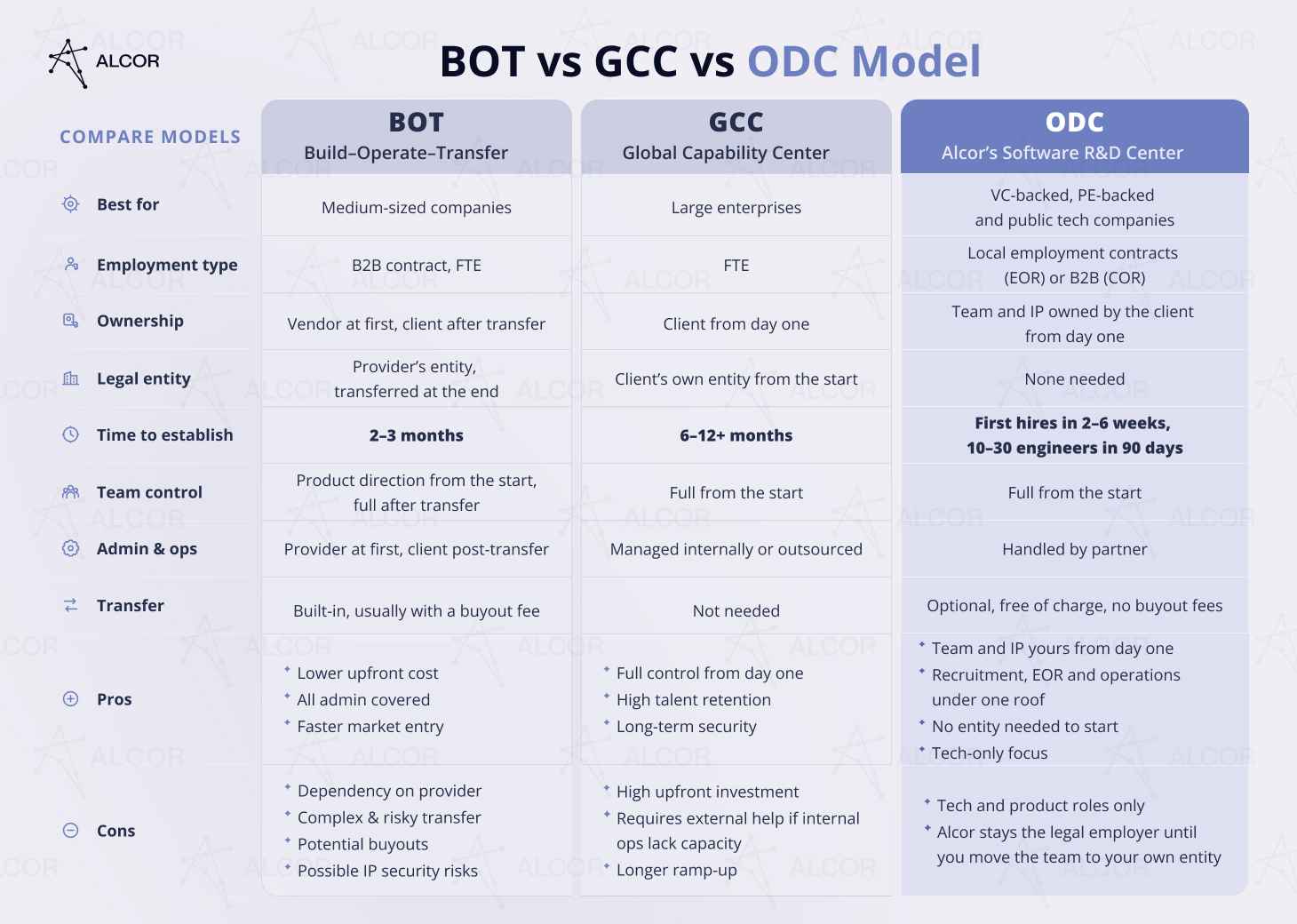
The Build-Operate-Transfer model and the Global Capability Center as a service (GCC) both result in a client-owned team abroad, but their approaches differ. GCCs are owned and operated by the client from day one, while BOT starts with provider control and ends with a handover. IT staffing via Build-Operate-Transfer is faster and less resource-intensive than a GCC, which suits tech companies entering a new market. GCCs, on the other hand, fit large enterprises with long-term expansion strategies and in-house operational capacity.
An Offshore Development Center is a dedicated team that works only for one client, while a provider employs the engineers and runs the office, payroll and compliance. The client directs the product and engineering work from day one, and there’s no handover deadline to plan around. The trade-off is that the team stays on the provider’s books for as long as the arrangement lasts.
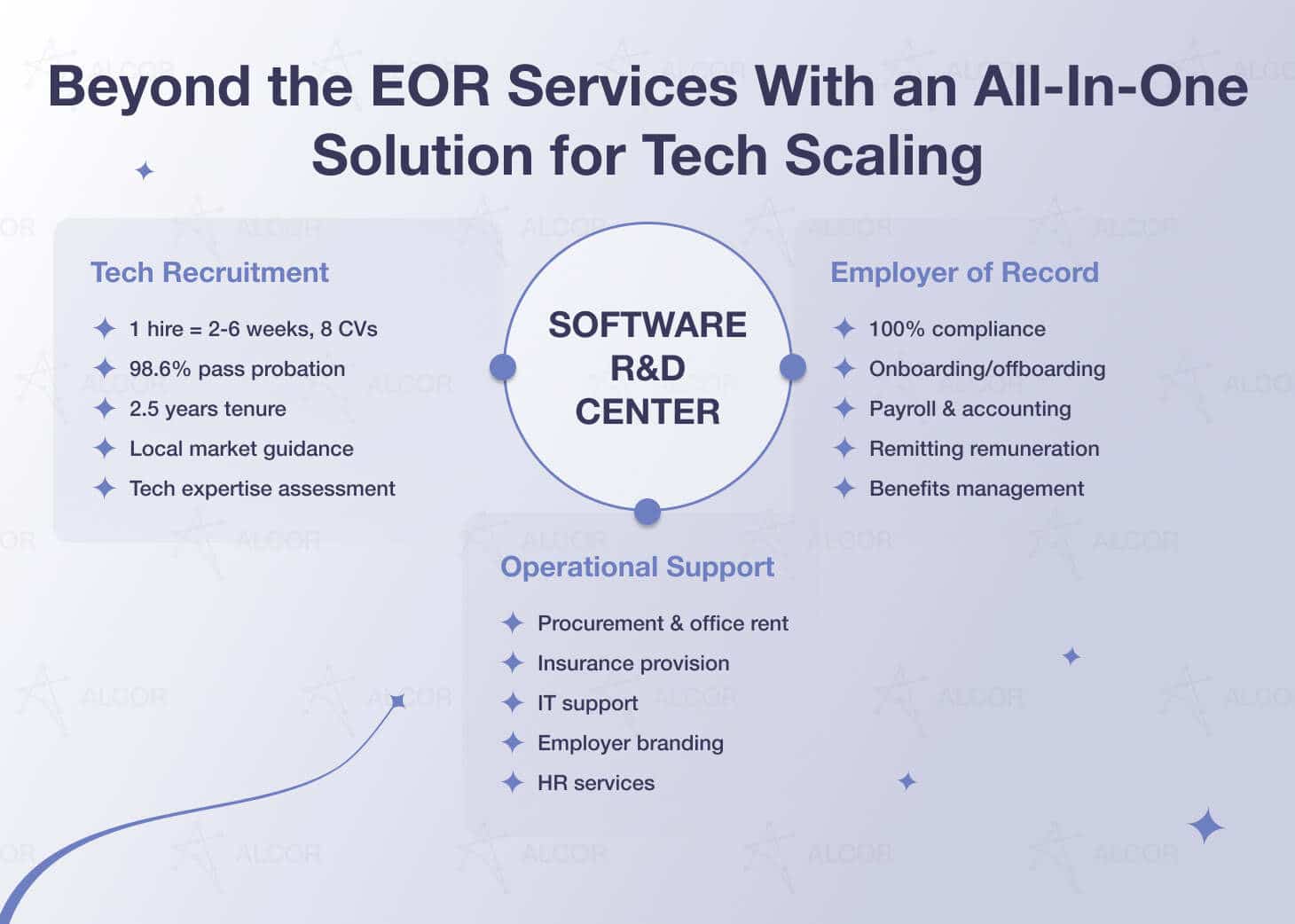
A software R&D center with Alcor works on the ODC principle but closes that gap. Your CTO manages the engineers, and the IP is assigned to you from day one. Alcor handles enterprise IT recruitment, EOR and local operations under one roof. If you later open your own entity, the team moves to it free of charge, with no buyout fees.
Why Settle for BOT only? Launch Your Own Software R&D Center!
Alcor’s software R&D center gives tech companies their own engineering team from day one, the same result BOT delivers only at the end of the contract. Alcor combines tech-only recruitment, Employer of Record and Contractor of Record services, and local operations under one roof. Engineers are operational within 90 days (10–30 of them), IP is assigned from the start, and the team moves to the client’s own entity free of charge whenever it’s ready. Unicorn-grade clients show how it works:
- PX moved off an outsourcing provider to a 28-person team in six countries.
- Teladoc Health hired 25 engineers in 8 months without a new entity.
- EGYM runs 51 R&D specialists across five countries.
- Backstory (formerly People.ai) has built a 50-engineer AI R&D center with Alcor since 2017.
BOT asks you to wait two to three years for the team you’re already paying for. Alcor removes the wait. As a tech-only partner, Alcor runs IT recruitment, Employer of Record and local operations under one software R&D center model. Your CTO manages engineers who are yours from the first day, with 10–30 of them operational within 90 days and IP assigned from the start. In BOT terms, it’s closer to a build-to-operate model with an open exit: if you later open your own entity, the team moves to it free of charge, with no buyout fees.
The model works the same way in Latin America, in Mexico and Colombia. It also covers software development in Poland and Ukraine.
Here’s what it looks like for companies that chose ownership from day one:
-
Your team, not a provider’s roster. PX had 13 engineers in Ukraine working through an outsourcing provider, with no HR, finance or legal infrastructure of its own anywhere. Alcor moved the specialists onto their own contracts in their home countries and kept hiring senior .NET, C++, DevOps and QA roles. The team grew into a 28-person R&D unit across six countries. When engineers relocated, their contracts moved with them, at no cost or process change to PX.
-
No new entity in the corporate structure. Teladoc Health, the NYSE-listed virtual care company, needed engineers in Ukraine, but the providers it looked at sold compliance without recruitment. Alcor ran both halves: it sourced the engineers and contracted them through its Contractor of Record setup. 25 engineers joined in 8 months, working in a regulated data environment under Teladoc’s own engineering leadership across four internal teams. None of it required a new entity on Teladoc’s side.
-
One setup that scales across borders. EGYM, the fitness tech unicorn, had an engineering team in Ukraine but no entity, HR or payroll to engage it directly. Alcor took over the employment layer, and since 2019 the R&D organization has grown to 51 people across Ukraine, Poland, Slovakia, Portugal and Romania. Every contract assigns IP to EGYM from the moment of creation. Senior C++ searches closed in about 2.5 weeks each, with every offer accepted.
-
A partner from the first hire to the AI core. Backstory (formerly People.ai) has worked with Alcor since 2017. Alcor found, leased and equipped its Eastern European R&D office in four weeks, then hired 25 engineers in the first year and 25 more as the product grew. Several of them now sit on Backstory’s core AI team, the engineers who carried the platform through its rise past a $1 billion valuation.
Skip the wait for a transfer. Build your own software R&D center in Latin America or Eastern Europe with Alcor, with 10–30 engineers operational in 90 days.
FAQ
What’s the difference between Build-Operate-Transfer and Managed Services?
Managed services cover specific functions, such as infrastructure, support or a defined project. The provider runs the work to agreed service levels and keeps the team. Build-Operate-Transfer builds a dedicated engineering team, and often a local entity, that works only on your product and moves to your company at the end of the contract. Managed services suit companies that want an outcome delivered. BOT suits tech companies that want to own the team long-term, provided the transfer terms and fees are agreed upfront.
How to measure the efficiency of your BOT performance?
BOT performance is best measured stage by stage:
– Build: time-to-hire and offer acceptance rate.
– Operate: delivery speed, SLA adherence and attrition.
– Transfer: how fully knowledge, processes and access move to your managers.
The clearest signal comes after the handover. Retention and productivity should hold for 6–12 months once the provider steps back. Cost against plan and alignment with your roadmap round out the picture.
How should a tech business choose a Build-Operate-Transfer location strategy?
A BOT location strategy starts with priorities: talent availability for your stack, time-zone overlap, cost and the legal environment.
– Latin America gives US teams near-full working-day overlap.
– Eastern Europe offers deep senior talent and, in EU countries, an entity that can hire across the European Union.
According to Alcor’s 2026 global engineer compensation research, senior base salaries average 61.06% below US levels in Latin America and 54.9% below in Eastern Europe. Labor and tax rules change, so the right partner should check country-specific regulations and salary benchmarks before the first hire.
What should you look for in a BOT model partner?
A strong BOT partner has run R&D centers through all three stages, not just recruited for them, so ask for references from clients whose centers it built, operated and handed over. Its IT staffing depth matters next: how fast it closes senior roles and how it tests technical expertise, English and culture fit. Operations are just as important. Payroll, benefits, equipment and local registrations in your destination should be in place, because gaps there reach engineers first. Finally, the partner needs legal competence. Entity setup, employment contracts, the transfer route and a change-of-control clause should all be defined in the agreement before signing.
How would you rate this article?
Alcor is Your Trusted Scaling Partner
for expansion
support