


Key Takeaways
- Ukrainian software developers remain a go-to choice for building an engineering team in Europe, offering resilience proven through more than four years of war, and senior base salaries 51–63% lower than in the US, per Alcor’s 2026 compensation research.
- Ukraine’s tech ecosystem offers a pool of 305,000 tech professionals and spans 2,243 active tech companies, per IT Ukraine Association’s “Code of the Economy” research, and adds 40,000 new tech graduates a year. Java, JavaScript, C#, and Python lead the most common tech stacks.
- IT sector generated a $7.85 billion market in 2025, with IT exports of $6.6 billion and a 3.2% share of GDP, per the same research.
- AI/ML and defense tech are growing fastest. AI/ML engineer vacancies rose 115% in 2025, per DOU, and the defense tech market reached $6.8 billion, per the Kyiv School of Economics Institute.
- Senior engineers earn $66,000–$111,000 a year in Ukraine versus $150,000–$234,000 in the US, per Alcor’s 2026 compensation research.
- 59% of Ukrainian tech specialists rate their English as Upper-Intermediate or Advanced, per Business Inform (2025), and 48% work at product companies, per DOU.
- 76% of European Business Association member companies plan to keep operating in Ukraine regardless of when the war ends, and 92% of AmCham member companies remain fully operational.
Software Development Industry in Ukraine 2026
The Ukrainian software development industry has evolved from a low-cost offshoring hub into one of Europe’s fastest-growing tech ecosystems, per Dealroom’s 2025 index. Despite russia’s war, the sector generated a $7.85 billion market in 2025, with IT exports of $6.6 billion (up 3% year over year) and a 3.2% share of GDP. European clients now account for over half of that export revenue, with the US still the single largest market. The European Business Association reports that 76% of member companies plan to keep operating in Ukraine regardless of when the war ends.
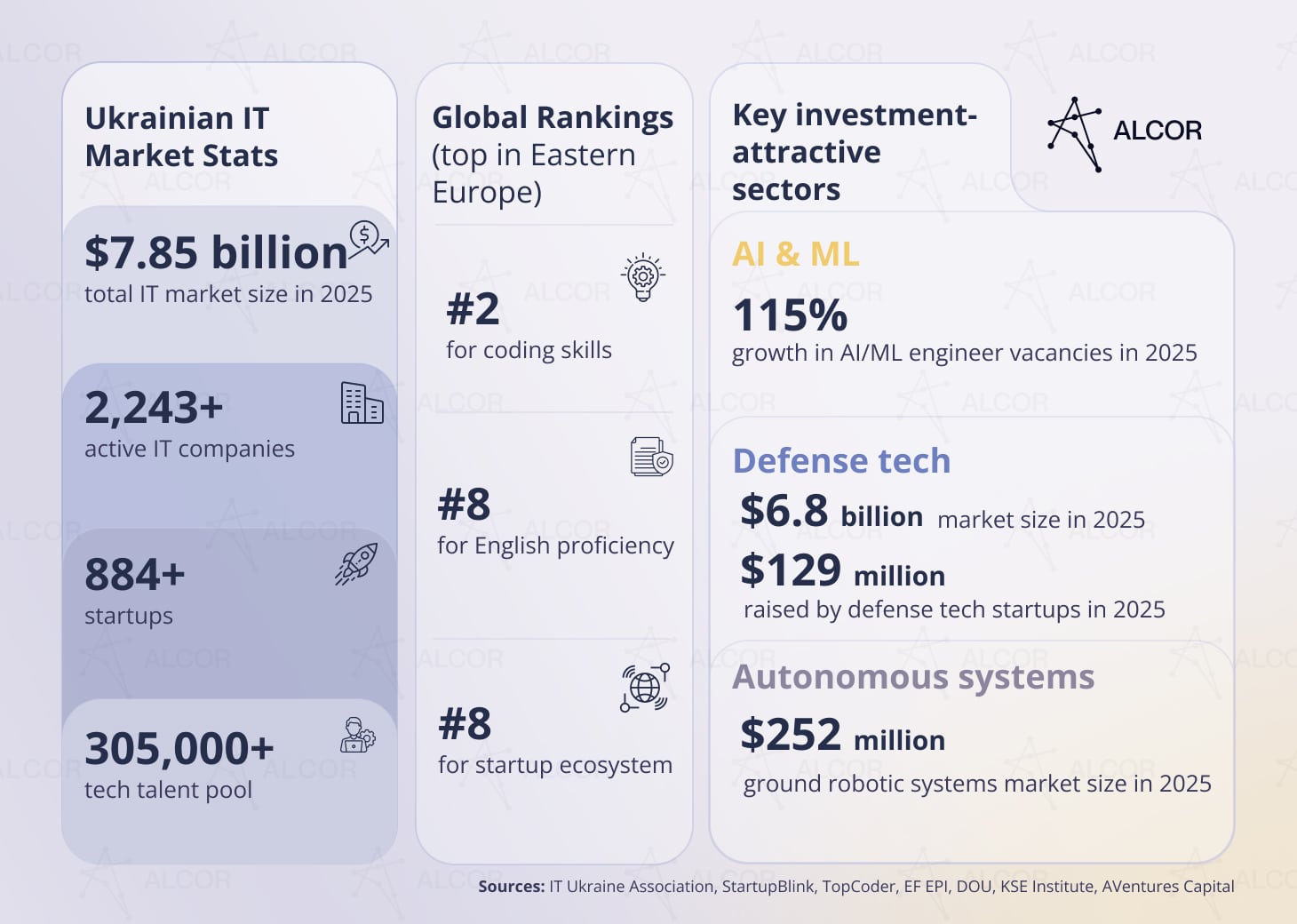
Before the beginning of the russian full-scale war, the Ukrainian IT sector had been a go-to offshoring destination for both tech giants and startups. This solidified Ukraine’s position as a key regional IT hub and, according to Dealroom’s Global Tech Ecosystem Index 2025, one of Europe’s fastest-growing tech ecosystems.
According to IT Ukraine Association’s 2025 “Code of the Economy” research, developed with Ukraine’s Ministry of Digital Transformation, software development in Ukraine generated a $7.85 billion total market in 2025. IT exports reached $6.6 billion, up 3% year over year. The IT sector now accounts for 3.2% of the country’s GDP and paid 50.5 billion UAH in taxes.
Every 1 UAH generated in IT creates another 1.09 UAH across adjacent industries. One IT professional supports 2.29 jobs elsewhere in the economy. Together, they underpin more than 800,000 jobs nationwide. Ukraine also has 2,243 active companies.
European clients account for the majority of Ukraine’s IT exports. Over 51% – around $3.39 billion – went to Europe in 2025, according to IT Ukraine Association’s “Code of the Economy” research. Per Lviv IT Cluster’s 2025 export report, the US remained the single largest individual market at $2.39 billion, while Latvia, Finland, and Hungary posted the fastest export growth of any destination.
A European Business Association survey of 131 member-company executives, conducted in February 2026, found that 76% plan to keep operating in Ukraine regardless of when the war ends.
Trends of Ukraine’s Software Development in 2027
Four trends will shape the Ukrainian software development industry heading into 2027:
- AI/ML specialization: AI/ML engineer vacancies grew 115% in 2025; AI-focused startups raised $302 million – three times more than non-AI companies, per AVentures Capital.
- Automation: Digitalization is cutting equipment downtime by 30–50% and raising output by 10–20% in Ukraine’s core industries, according to IT Ukraine Association’s “Code of the Economy” research.
- Defense tech: The fastest-growing sector, reaching a $6.8 billion market in 2025.
- Autonomous systems: Ground robotic systems grew sixfold to $252 million in 2025; NATO’s UNITE – Brave NATO program, launched in March 2026, now funds joint autonomous-systems projects.
AI/ML-driven specialization
AI/ML is the fastest-growing specialization in Ukrainian tech hiring. Open AI/ML roles on DOU grew 115% in the first half of 2025, including a record 132 AI/ML vacancies in June alone, per DOU’s IT job market review. The talent pool is growing with it. Ukraine now has 6,100 AI specialists, up 17% in two years, according to the Ukrainian AI Talent study by AI HOUSE and the Ministry of Digital Transformation. One in three of them previously worked as a software developer, 41% work at product companies, and 17% have defense tech experience.
AI-focused startups raised $302 million in 2025, nearly three times the $104 million raised by startups without a significant AI component, according to AVentures Capital’s DealBook of Ukraine 2025. Ukraine’s AI sector is also built for foreign markets: 70% of its AI companies are export-oriented, per IT Ukraine Association’s Ukraine AI Industry Map.
Adoption reaches well beyond tech companies. In a Top Lead survey of more than 200 Ukrainian businesses, 93% already use AI, and 62% report a positive effect on productivity and financial results, per the Ministry of Digital Transformation. Ukraine climbed 14 places to 40th out of 195 countries in Oxford Insights’ Government AI Readiness Index 2025.
For the software development industry of Ukraine, a growing AI talent pool, rising investment, and widespread business adoption make AI/ML the clearest area of opportunity heading into 2027.
Automation
In Ukraine’s core industries, digitalization is reducing equipment downtime by 30–50% and raising production volumes by 10–20%, according to IT Ukraine Association’s “Code of the Economy” research, developed with support from Ukraine’s Ministry of Digital Transformation.
Defense tech and autonomous systems
Ukraine’s defense technology market reached $6.8 billion in 2025, per a Kyiv School of Economics Institute study. Ground robotic systems grew sixfold year over year to $252 million, and electronic warfare systems grew 3.1 times to $220 million. Defense tech was 2025’s fastest-growing startup sector, raising $129 million – a 19-fold increase over three years, per AVentures Capital. Swarmer, a Ukrainian startup building an AI platform for autonomous drone-swarm control, raised $15 million in 2025, the largest single defense tech round of the year.
Defense tech itself is also moving into new segments. According to the Kyiv School of Economics Institute, the next growth areas are interceptor drones, domestically produced reconnaissance drones that replace Chinese suppliers, and “middle strike” systems between tactical FPV drones and long-range strike. KSE Institute estimates the defense sector’s 10-year recovery potential at $690 billion.
NATO and Ukraine’s joint UNITE – Brave NATO program launched its first competition in March 2026, funding joint Ukrainian–NATO projects in counter-drone systems, electronic warfare, signals intelligence, and ground robotic platforms. Funding is set to grow from €10 million to €50 million if the pilot succeeds.
Resilience
- Per Kyiv Post, Kyivstar listed on Nasdaq in 2025 and then acquired Uklon in the country’s largest M&A deal of the year.
- Fintech-IT Group (per Kyiv Post) and Preply both crossed $1 billion valuations in 2025.
- Haiqu, a Ukrainian quantum computing startup, was named a 2025 Technology Pioneer by the World Economic Forum.
- Per Startup Genome’s Global Startup Ecosystem Report 2026, UFORCE became Ukraine’s first defense tech unicorn.
Is Ukraine a Good Choice to Expand to?
Yes. Ukraine offers a mature tech ecosystem well-suited for building an engineering team: 305,000 tech specialists, 40,000 new tech graduates yearly, and 9 QS-ranked universities feeding hubs like Kyiv, Lviv, and Kharkiv. Despite the war, resilience is strong – Diia.City’s resident tech companies grew from 253 in 2022 to over 4,300 by 2026, and 92% of AmCham member companies remain fully operational after more than four years of war. The startup ecosystem counts 884 active startups. Companies can hire via FTE, B2B, or Diia.City gig contracts.
Ukraine is an Eastern European country with 305,000 tech specialists and an additional 40,000 ICT/STEM graduates each year, according to Digital State. In the midst of the russian war, the Ukrainian tech sector is growing thanks to high-tech education and top universities, 9 of which ranked in the QS World University Rankings 2027. The list includes Taras Shevchenko National University of Kyiv, V. N. Karazin Kharkiv National University, the National Technical University of Ukraine “Igor Sikorsky Kyiv Polytechnic Institute”, and Lviv Polytechnic National University. This strong educational foundation feeds directly into the country’s software development landscape, which is characterized by thriving tech hotspots spread across its major cities.
Diia.City – Ukraine’s tax and legal framework for tech companies – tells the clearest growth story. It launched on February 9, 2022, two weeks before russia’s full-scale invasion, with a small founding group of residents. By 2026, it had grown to more than 4,300 resident companies, including several large global tech corporations, per Startup Genome – a seventeenfold increase from its first 253 residents five months after launch. More than four years into the war, that number is still climbing, not shrinking.
Ukrainian software development hubs
- Kyiv remains Ukraine’s largest tech hub. Per peer-reviewed research published in Business Inform, Kyiv has the most tech company offices of any city, at 46. The same research found Kyiv leads the country in product-company concentration: the share of its tech specialists working at product companies rose from 35% in 2015 to 55% in 2024. On StartupBlink’s live ecosystem ranking, Kyiv ranks #74 globally and #1 in Ukraine, with 608 active startups.
- Lviv has grown into the country’s primary western hub. Per the same Business Inform research, Lviv’s share of national tech specialists rose from 14% in 2021 to a wartime peak of 21% in 2022, settling at 18% by 2024, and the city has 23 tech company offices. The same source found Lviv has stayed a services and outsourcing center: 47% of its tech specialists worked at service companies in 2024 (16% specifically in outsourcing), while only 31% worked at product companies – the lowest product-company share of any major hub. On StartupBlink, Lviv ranks #378 globally and #2 in Ukraine.
- Kharkiv was hit hardest by the war’s effect on software engineering talent concentration. Per the Business Inform research, its share of national tech specialists collapsed from 14% in 2021 to just 4% by 2025, and its tech company office count fell from 25 to 10 over three years as firms relocated west. The same source found its business-model mix has since balanced out to 41% product and 38% service companies. Per StartupBlink, Kharkiv ranks #663 globally and #3 in Ukraine.
- Dnipro and Odesa round out the top five. Per the Business Inform research, Dnipro’s product-company share grew from 32% in 2015 to 41% in 2024, nearly even with its 38% service-company share. Odesa’s product-company share rose from 32% to 47% over the same period, tracking closer to Kyiv’s model. Dnipro ranks #682 and Odesa #718 globally, #4 and #5 in Ukraine, respectively, on StartupBlink’s 2026 index.
Thriving startup ecosystem
Ukraine’s startup ecosystem counts 884 active startups, ranking #8 in Eastern Europe and #43 globally in StartupBlink’s 2026 ecosystem ranking. Notably, The Recursive reports that 90% of startups see high future growth potential, while 46% believe the ecosystem is still operating at an average level despite the ongoing war.
To succeed in Ukraine’s growing startup ecosystem, you need a partner who can assist with market entry and employer branding. Sift, a VC-backed AI fraud-prevention platform trusted by brands like Airbnb and DoorDash, needed to scale its Ukrainian software development team fast. Without a local entity or the recruiting bandwidth to compete for senior AI and backend talent in Kyiv’s crowded market.
Partnering with Alcor, Sift built a 51-engineer R&D center in 12 months, hired 30 engineers in year one alone, and saw a 15% lift in offer acceptance after an employer-branding campaign built around its own hiring manager – all without ever setting up a legal entity in the region.
Life in Ukraine
After more than 4 years of ongoing war, Ukrainians have adapted to new realities. After enduring daily missile strikes, massive blackouts, communication outages, and constant uncertainty, Ukrainian tech specialists now rank #16 globally in the National Cyber Security Index. This progress helps uphold Ukraine’s reputation as one of Europe’s leading tech service providers.
Many Ukrainian tech specialists and companies have invested in backup infrastructure – from fiber-optic internet, UPS systems, and portable power stations to generators. Most specialists now work from home with minimal disruption, maintaining stable connectivity even during long outages.
A typical favorable location in the country for Ukrainian programmers is now defined by key factors: being at a considerable distance from the frontline. This mainly applies to cities in western and central regions, such as Lviv, Uzhhorod, Chernivtsi, Vinnytsia, and the well-protected capital city, Kyiv. Ukrainian software engineers are gravitating toward these safer cities to ensure smooth task execution and a productive workflow without interruptions.
That continuity shows up in the numbers: 92% of AmCham member companies remain fully operational after more than four years of war, and nearly 70% of respondents have operated in Ukraine for over 20 years, per the chamber’s June 2026 survey with Citi Ukraine.
Legal aspects
When entering the Ukrainian market, it’s important to keep in mind the specifics of local legislation to avoid fines and legal risks. Under Ukrainian labor law:
|
Standard workweek |
40 hours (as of 2026) |
|
Overtime |
4 hours for 2 consecutive days; 120 hours/year (not applicable during martial law) |
|
Overtime pay |
200% of the regular rate in regular hours and public holidays |
|
Probation |
1 month for workers; 3 months for other roles; 6 months with trade union consent |
Full-time employees are entitled to a statutory benefits package: 24 days of paid vacation, 12 paid public holidays, and partially or fully employer-compensated sick leave. Employees are also entitled to 126 days of maternity leave, 14 days of paternity leave, and severance of 1 to 6 months’ average salary on termination, depending on the grounds. Diia.City gig contracts carry fewer statutory guarantees – most benefits there are set directly in the contract rather than mandated by law.
Ukraine offers three ways to engage a developer:
|
FTE contracts |
Under an employer of record, give developers in Ukraine the strongest labor-law protections and give companies the lowest misclassification risk and turnover, without the cost and timeline of setting up a legal entity in Ukraine. |
|
B2B contracts |
Engage developers as registered private entrepreneurs, offering flexibility and lower administrative overhead since the employer carries no social security or payroll tax obligation. This model has shrunk sharply, though: the number of IT private entrepreneurs fell 21% – a record drop – to 205,939 as of February 2026, down from 263,093 a year earlier, as many moved to gig contracts instead, per DOU’s analysis. |
|
Diia.City gig contracts |
Sit between full employment and freelance work, under the dedicated legal and tax framework Ukraine created for IT and digital businesses. About 13% of Ukrainian tech specialists now work under this model. Diia.City residents who hold “critical enterprise” status can apply for employee reservations from mobilization. Though the mechanism has gone through repeated rule changes in 2026, including a temporary pause over the summer. So, current eligibility and terms are worth confirming at the time of hiring. |
Companies ensure successful tech outsourcing or offshoring by using legal and compliance services in Ukraine. Alcor ensures your tech business is fully compliant with local and home-country laws, handling everything from intellectual property protection to business visa support for your Ukrainian developers.
Taxation system
Ukrainian software developers who work under the B2B model benefit from tax incentives introduced by the Ukrainian government. They are subject to a simplified taxation system, namely group 3, and should pay only:
- 5% income tax once a month,
- 22% social security tax on a minimum monthly salary in Ukraine, once every three months,
- 1% military tax.
If you hire developers as full-time employees (FTE) or enter the Ukrainian market via Diia.City and gig contracts, the tax breakdown looks like this:
|
|
Employment agreement (FTE) |
Diia.City Gig Contract |
|
Social Security Contributions (Employer) |
22%, capped at UAH 172,940 (~$3,955) monthly base; max monthly contribution UAH 38,046.80 (~$870)
Effective employer SSC rate: ~17.4% on top of a $5,000 salary |
SSC charged at the statutory minimum salary only – not gross salary – at the same 22% rate.
Effective employer SSC rate: ~0.8% at $5,000/month |
To be efficient in tax planning, payroll, tax return preparation, financial management, document maintenance, bookkeeping, and other operational functions, companies use payroll and accounting services in Ukraine. By relying on a trusted EOR/COR provider, such as Alcor, to handle these and other administrative functions, companies save tens of thousands of dollars and free their teams from additional tasks.
Ukrainian Software Developer Portrait
The typical Ukrainian software developer is about 31 years old, part of a tech workforce that’s 69% male and 31% female. Developers made up 37% of Ukraine’s tech specialists in 2026, down from 44% a year earlier, as the field shifts toward analysts, HR, and other non-technical roles. The industry has grown more senior: just 11% are juniors or interns, roughly half the 2022 share. Product companies now employ 48% of Ukrainian tech specialists, the largest and most stable segment, while outsourcing has shrunk. English proficiency is strong, with 59% at Upper-Intermediate or Advanced level. Common tech stacks include Java, JavaScript, C#, and Python.
The median Ukrainian tech specialist is 31 years old, according to DOU’s “Portrait of the Ukrainian IT Specialist 2026”, based on a summer 2026 survey of 14,631 professionals in Ukraine and abroad. Women now make up 31% of the field, up from 29% a year earlier and 23% in 2021. Kyiv remains home to the largest share of specialists (46%), followed by Lviv (18%) and Dnipro (6%).
Developers specifically have become a smaller slice of the workforce: their share fell from 44% to 37% over the past year, as analysts, HR and recruiting, support, project management, and marketing roles grew instead. Technical specialists still make up 84% of the field overall.
The talent pool keeps getting more senior. Junior specialists and interns now account for just 11% (down from 12% a year earlier, and roughly half the 2022 level), while the Middle-level share fell to 30% from 32% as Senior and Lead shares grew to fill the gap. Senior specialists alone now make up 32% of the sample, and 57% of all tech specialists have more than five years of experience, up from a third in 2022.
Product companies now employ the largest and most stable share of Ukrainian tech specialists, at 48% – unchanged over the past year – while the share working at outsourcing companies fell 6 percentage points. Remote work remains the norm: 66% of specialists work fully remotely, though the office-based share edged up from 11% to 13%.
Education and language skills round out the profile: 96% of Ukrainian software developers have completed or are pursuing a STEM degree, and English proficiency keeps improving – 59% now rate themselves Upper-Intermediate or Advanced, according to peer-reviewed research published in Business Inform. On the EF English Proficiency Index, Ukraine ranks 8th in Eastern Europe with a score of 526 (B2). Common tech stacks include Java, JavaScript, C#, TypeScript, PHP, Kotlin, and Python, alongside tools like React, Angular, HTML, and CSS.
Developers are also among the specialists most cautious about AI’s effect on their own roles: 15% expect demand for their specialization to decline as generative AI tools mature, compared with just 7% of tech specialists overall who expect AI to make them more in demand, per the DOU research.

Ukrainian Developers’ Salaries
Ukrainian developer salaries make building a team more than twice as cost-efficient as in the US.
- Senior roles span $66,000–$111,000 annually in Ukraine versus $150,000–$234,000 in the US;
- Lead roles span $81,000–$156,000 versus $183,000–$270,000.
Ukraine’s one-time recruitment fee runs 15–25% of annual salary (vs 25–35% in the US), and basic benefits average $1,900 per developer yearly (vs $15,400 in the US).
The main reason why business leaders choose tech outsourcing to Ukraine is the salaries of local programmers. Average compensation is more than twice as cost-efficient as in the US.
Here’s how base salaries compare for Ukrainian and US senior software engineers across in-demand roles, based on Alcor’s 2026 compensation research:
|
Senior Annual Base Salary, USD |
||
|
Position |
Ukraine |
US |
|
Angular Developer |
$66,000 |
$156,000 |
|
React Developer |
$66,000 |
$156,000 |
|
Python Developer |
$70,800 |
$165,000 |
|
C/C++ Developer |
$69,600 |
$150,000 |
|
Mobile Developer (iOS/Android/Xamarin) |
$66,000 |
$174,000 |
|
Blockchain Developer |
$76,800 |
$171,000 |
|
DevOps Engineer |
$72,000 |
$168,000 |
|
ML Engineer |
$84,000 |
$222,000 |
|
LLM Engineer |
$86,400 |
$234,000 |
|
MLOps Engineer |
$90,000 |
$189,000 |
|
Data Platform Engineer |
$80,400 |
$189,000 |
|
AI Engineer |
$105,000 |
$222,000 |
|
AI Data Engineer |
$93,000 |
$210,000 |
|
ML Data Scientist |
$99,000 |
$216,000 |
|
AI Platform Engineer |
$111,000 |
$228,000 |
Want to hire a lead specialist? The table below shows the base annual salaries of lead software developers, based on our 2026 job market research.
|
Lead Annual Base Salary, USD |
||
|
Position |
Ukraine |
US |
|
Angular Developer |
$81,000 |
$186,000 |
|
React Developer |
$82,800 |
$186,000 |
|
Python Developer |
$87,000 |
$207,000 |
|
C/C++ Developer |
$82,800 |
$183,000 |
|
Mobile Developer (iOS/Android/Xamarin) |
$82,200 |
$213,000 |
|
Blockchain Developer |
$90,000 |
$201,000 |
|
DevOps Engineer |
$88,200 |
$201,000 |
|
ML Engineer |
$102,000 |
$252,000 |
|
LLM Engineer |
$102,000 |
$258,000 |
|
MLOps Engineer |
$105,600 |
$222,000 |
|
Data Platform Engineer |
$90,000 |
$222,000 |
|
AI Engineer |
$144,000 |
$252,000 |
|
AI Data Engineer |
$129,000 |
$246,000 |
|
ML Data Scientist |
$135,000 |
$252,000 |
|
AI Platform Engineer |
$156,000 |
$270,000 |
However, don’t overlook key factors such as recruitment fees and benefits packages, when planning your hiring budget.
- Recruitment fee
This is a one-time fee charged as a percentage of the tech specialist’s annual compensation, payable to your provider upon hiring.
|
Role |
Ukraine |
USA |
|
Middle |
15% |
25% |
|
Senior |
20% |
30% |
|
Lead |
25% |
35% |
- Basic benefits package
In the US, a basic benefits package costs about $15,400 per year per developer. Meanwhile, in Ukraine, a basic benefits package costs about $1,900 per year per tech professional.
All these benefits are what make Ukraine stand out among other Eastern European countries today, despite the challenges it faces.
Many businesses start their search with software outsourcing to Ukraine. The appeal is clear: a vendor already has engineers available, so that work can begin within weeks. The catch is ownership. Offshore developers from Ukraine hired this way sign contracts with the vendor, take direction from its managers, and can move to another client once your project winds down.
But what can help you choose an option that’s far more effective and advantageous than traditional outsourcing?
Your Own Software R&D Center: a Turnkey Business Solution
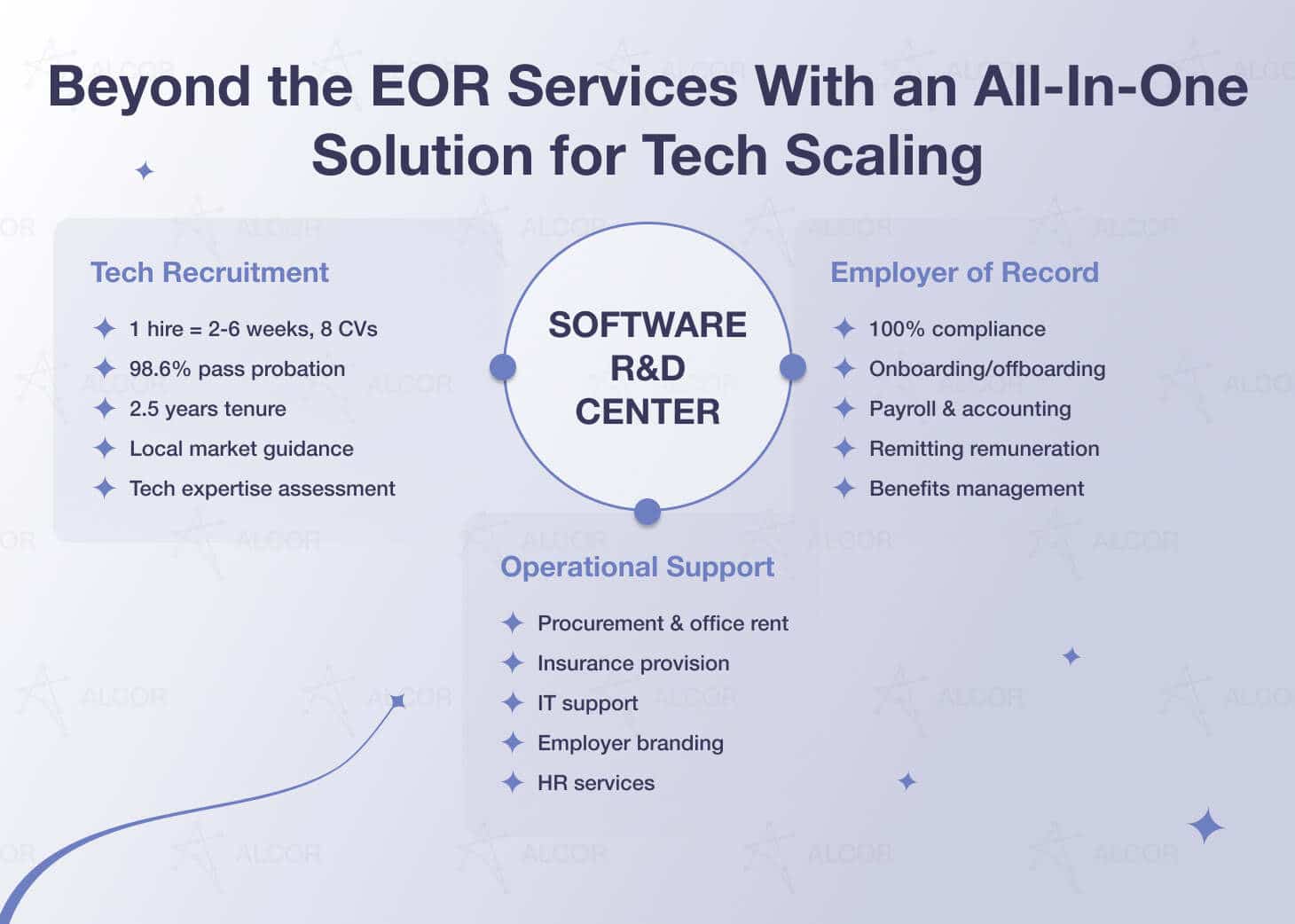
Alcor offers a turnkey way to build your own software R&D center in Ukraine, combining EOR, tech recruitment, and full operational support under one roof. We handle all aspects of employment – FTE and B2B contracts, onboarding/offboarding, payroll, taxes, and benefits – so you stay fully compliant while focusing on product and growth. You also get the top 10% of local talent, and we set up everything for you – from offices and co-working spaces to hardware and on-the-ground IT support.
Alcor builds your software R&D center as your own internal software development team in Ukraine. Companies can build a team of up to 30 engineers in as little as 90 days, with full control, full IP ownership, and no vendor layer between you and the people writing your code.
The model works because top-notch tech recruitment, comprehensive EOR for tech, and full operational support run as one system, not a chain of vendors. Alcor’s 325,000-candidate database and 40+ in-house technical recruiters source senior engineers optimized for today’s AI-driven development cycle, while Alcor’s own legal entities in Eastern Europe and Latin America handle compliant employment, payroll, and IP protection from day one. If you’re still comparing recruitment agencies before you hire Ukrainian developers, this in-house model replaces that step entirely.
Backstory (ex-People.ai), an AI data platform for go-to-market teams backed by Y Combinator and Andreessen Horowitz, got exactly that after juggling multiple vendors with no one owning the outcome. They found a single partner running recruitment, EOR, office setup, and compliance together.
Partnering with Alcor, Backstory scaled its Eastern Europe engineering team from 25 engineers in year one to 50 today, moved into a fully equipped R&D office within a month, and kept its legal exposure at zero across two jurisdictions. All while growing from startup to $1.1 billion unicorn. Several of those engineers are now core senior and staff AI engineers on the platform used by Zoom, Cisco, and Nvidia.
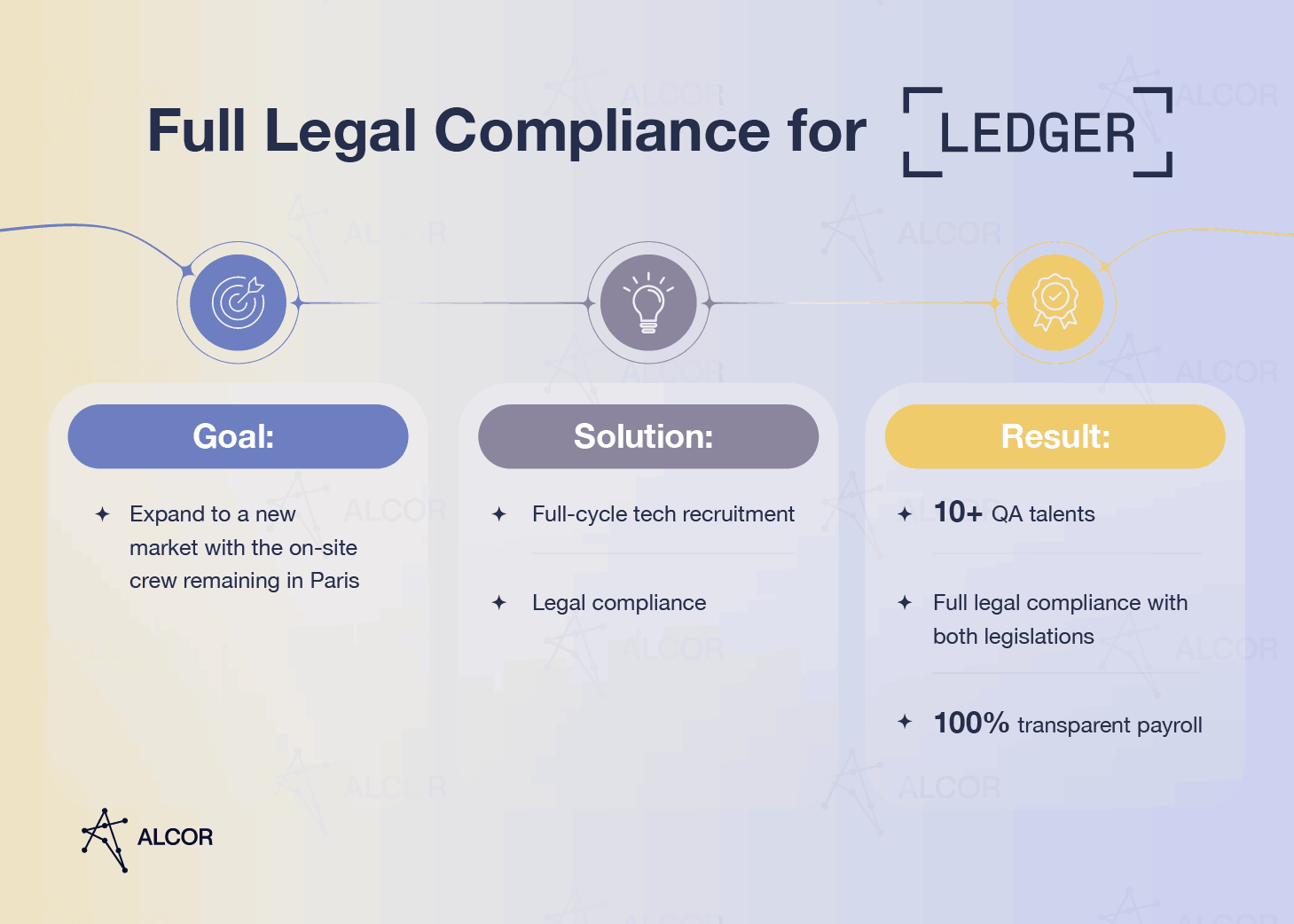
Ledger, the Paris-based hardware wallet unicorn that secures roughly 20% of the world’s crypto assets, needed senior QA and engineering talent vetted well beyond a standard CV screen – without opening a legal entity in Kyiv.
Partnering with Alcor, Ledger built a 35+ engineer team, including 10 QA developers, with an average hire time of 4.5 weeks and average tenure of 2.5+ years. A single-day interview format in Kyiv turned five candidates into one signed QA Manager offer before the Paris team’s flight home – and Ledger more than doubled its team size within a year on the strength of that first hire.
Backstory, Ledger, and UFORCE are different companies solving different problems, but the model behind all three is the same: one partner, one accountable team, no vendor sprawl. That’s offshore development in Ukraine done the Alcor way. Your engineers are based in Ukraine but belong to your company: they work on your roadmap, report to your engineering leads, and keep the product knowledge they build inside your team.
Partner with Alcor to hire developers in Ukraine through this same structure from day one.
FAQ
Why do foreign IT companies hire developers in Ukraine?
Foreign tech companies hire developers in Ukraine for its deep talent pool – 305,000 tech specialists plus 40,000 new graduates yearly – paired with strong delivery maturity. Moreover, hiring a senior engineer costs $66K–$111K annually in Ukraine versus $150K–$234K in the US, per Alcor’s 2026 compensation research.
What are the most prominent hard and soft skills of Ukrainian programmers?
Ukrainian programmers’ strongest traits are technical depth and resilience. Most are in their early thirties, over half hold Middle or Senior titles, and 96% have a STEM degree, per DOU and Business Inform research. Common tech stacks include Java, JavaScript, C#, and Python, backed by strong English and teamwork skills.
How to hire Ukrainian software engineers most effectively?
The best way to succeed in hiring of Ukrainian developers is to cooperate with a professional provider that can not only source and interview the most suitable candidates, but also provide proper employer branding services for your company in Ukraine, like Alcor.
Are there other ways to cooperate with Ukrainian IT specialists than outsourcing?
Apart from outsourcing tech, you can make use of offshoring tech services to countries like Ukraine. Software R&D center accelerator Alcor can provide you with all the needed support to establish your R&D office in Ukraine – from tech recruitment to legal & accounting.
How would you rate this article?
Alcor is Your Trusted Scaling Partner
for expansion
support