


We build and operate top-tier tech teams in LATAM and Eastern Europe.
Up to 40% savings. 100 people a year. No entity. No buy-out fees.
Atlas Employer of Record reviews from G2, Capterra, and Gartner position it as an established name in the EOR industry – recognized for its direct-entity model across 160+ countries, solid compliance infrastructure, and full employee lifecycle coverage. At the same time, Atlas HXM clients criticize a steep learning curve for new users, occasional platform performance issues, and internal coordination gaps that may affect payroll accuracy and timing.
What Atlas HXM is, where it performs well, where it falls short, and how it compares to alternatives – that’s what this article covers. Whether you’re evaluating it as a primary EOR partner or benchmarking it against other options, here’s an objective look at what the platform actually delivers.
Key Takeaways
- Atlas HXM is a direct EOR provider in 160+ countries through its own legal entities – stronger compliance control than partner-based models, but at a premium starting price of $599/employee/month.
- G2 and Capterra reviews are largely positive on account management and compliance expertise, but flag a steep learning curve, platform performance issues, and coordination gaps that have caused payroll errors.
- Atlas fits companies across all industries that need broad global employment coverage at scale – best when compliance depth and geographic reach are the top priorities.
- Rippling integrates EOR with HR, IT, and AI automation for major global markets; Paylocity focuses on deep US payroll and employee engagement for companies with established domestic teams.
- For tech companies scaling in Eastern Europe or LATAM, Alcor combines EOR, IT recruitment, and full ops support in one engagement – teams of 10-30 engineers built in 90 days, onboarded within 10 business days, with no setup fees, and a free insource option when you’re ready to take the team in-house.
Key Things to Know About Atlas HXM Solutions
Atlas HXM is a direct Employer of Record provider founded in 2015, headquartered in Chicago, with 500+ employees across 16 regional offices and service coverage in 160+ countries. Its core services include direct EOR, global payroll, talent onboarding, immigration support, and an employee learning platform. In 2022, the company rebranded from Elements Global Services to Atlas HXM, launching a SaaS-based Human Experience Management platform backed by a $200 million investment, expanding its positioning beyond EOR to encompass the full employee lifecycle management.
Atlas HXM is an Employer of Record provider that describes itself as a company that “combines enterprise-grade technology, in-country expertise, and direct legal infrastructure to help organizations scale their workforce globally with confidence.”
| Year founded | 2015 (as Elements Global Services by Rick Hammell) |
| HQ | Chicago, Illinois, USA |
| Company headcount | 500+ employees across 16 regional offices |
Key services Atlas HXM offers:
- Employer of Record (EOR). Atlas positions itself as a 100% direct EOR, meaning it owns and operates its legal entities across 160+ countries rather than routing through third-party partners.
- Global Payroll. Atlas describes this service as the ability to “pay employees quickly and compliantly in more than 160 countries,” with accurate salaries, payslips, and statutory contributions delivered on time and in local currencies.
- Global Immigration & Visa Support. Atlas offers immigration and mobility services to support international employee relocation, including visa sponsorship.
- Atlas HXM Learning. The platform includes access to over 9,000 online courses, professional certificates, and degree programs from universities and companies worldwide, designed to help retain and develop international talent post-hire.
The shift to Atlas Human Experience Management
On June 1, 2022, Elements Global Services announced its rebranding to Atlas HXM – a move that coincided with the launch of its SaaS-based Human Experience Management (HXM) platform, designed to streamline operations for globally distributed workforces. This rebrand came alongside a strategic equity investment of up to $200 million from Sixth Street Growth, which funded continued global expansion and platform development.
On their website, they position the platform as going beyond traditional EOR – a solution for companies that want to “hire, support, and scale talent anywhere in the world, creating consistent, engaging experiences for employees while making global expansion simpler and more seamless for businesses.” The platform, they state, is designed to deliver “end-to-end EOR and Human Experience Management (HXM) solutions through an empowered user experience.”
Breaking Down Atlas As an Employer of Record Company
Atlas HXM owns its legal entities across 160+ countries rather than relying on third-party partners. This model eliminates co-employment risk, subsidiary setup, and permanent establishment exposure for client companies. Atlas serves startups, SMEs, and enterprise organizations. Compliance is handled in-house, with ISO 27001, ISO/IEC 27017, and ISO/IEC 27018 data protection standards built into the onboarding process. Pricing starts at $599 per employee per month for teams of up to five, with volume-based discounts available for larger teams. G2 reviewers validate Atlas’s local regulatory expertise, though some flag internal coordination gaps that have occasionally affected payroll accuracy.
On their EOR page, Atlas HMX states their end-to-end solution gives clients “complete transparency, faster onboarding, and stronger compliance control without added third-party costs or delays,” and promises “speed to market – onboard employees in days, not weeks, thanks to in-house local experts.”
Who Atlas HXM is built for
Atlas states that “our business model helps startups and SMEs compete on the international playing field, turning commercial innovations into viable global enterprises.” Based on its public positioning, Atlas serves a wide range of organizations – from fast-growing startups that want to enter new markets quickly, to mid-market and enterprise companies that need a reliable managing employer across multiple jurisdictions, without building local entities in each. Their website also specifically calls out technology, financial services, life sciences, energy, private equity, and non-profit sectors.
Atlas’s compliance-first approach
Compliance is central to how Atlas presents its value. The platform covers local employment contracts, tax registration, statutory benefits, and labor law adherence in each country – handled by what they describe as in-house legal and HR teams, not resellers. On the data protection side, Atlas states that its onboarding infrastructure is built to ISO 27001, ISO/IEC 27017, and ISO/IEC 27018 standards.
Clients on G2 largely reflect this in their experience:
|
That said, compliance execution isn’t always consistent across every market. One Trustpilot reviewer described a prolonged dispute in the Philippines, where Atlas allegedly failed to apply local wage payment frequency requirements under the Labor Code: “Despite repeated requests, they only made changes after we explicitly cited the Labor Code, particularly Articles 101 and 103. Prior to that, they kept insisting that no changes were needed, which is both misleading and unacceptable.”
Atlas’ EOR pricing structure
Atlas publishes its starting rate publicly: $599 per employee per month for teams of one to five employees. For larger teams, they offer volume-based discounts negotiated directly – their website encourages companies onboarding more than five employees to get in touch for custom pricing. They position this as “simple, predictable flat-rate pricing with no hidden fees.”
Compared to the broader EOR market – where rates typically range from $199 to $1,500+ per employee per month (PEMP) – Atlas sits toward the premium end of the spectrum. Some G2 reviewers have flagged this directly:
|
Atlas Employer Of Record: Reviews Highlights
Atlas HXM’s user reviews across G2 and Trustpilot reveal a consistent pattern of strengths and limitations. On the positive side, clients frequently highlight dedicated account management with fast response times, an intuitive platform interface after the initial setup, and centralized workforce visibility with real-time payroll and HR data. On the critical side, the most common concerns are a steep learning curve for new users, intermittent platform performance issues under certain conditions, and internal coordination gaps among Atlas’s country-level teams, which, in documented cases, have led to incorrect pay, invoice errors, and delayed payroll.
|
Platform Ratings |
|||
|
G2 |
Capterra |
Trustpilot |
Gartner |
| 4.5/5 (37 reviews) | 5/5 (5 reviews) | 2.9/5 (2 reviews) |
4.7/5 (5 reviews) |
Top 3 “Yes” factors
- Dedicated account management
One pattern that stands out across Atlas EOR reviews is how frequently clients mention their account managers by name – or at minimum, in terms that go well beyond standard satisfaction language. This praise reflects a service model in which clients appear to have consistent, named points of contact who respond with urgency.
G2 reviewers described their experience this way:
|
What these testimonials collectively point to is a support model that operates on human accountability, not just ticket queues.
- An interface that’s intuitive once you’re in it
The second factor that consistently surfaces in reviews of Atlas Employer of Record is the quality and usability of the platform’s interface – particularly for day-to-day tasks. Users describe it as clean, logically structured, and accessible once the initial orientation period passes. G2 reviews point out:
|
This is a meaningful point for distributed engineering teams or global HR leads who need employee self-services to work without hand-holding.
- A centralized platform with real workforce visibility
The third “yes” factor speaks directly to what Atlas HXM describes as its move toward full Human Experience Management – and it’s one that users on G2 actually validate in practice. The platform serves as a centralized hub for the full employee lifecycle, with data visibility that supports real-time decision-making. G2 reviews note:
|
For companies that don’t have their own subsidiary, Global Employment Organization (GEO) infrastructure, or in-country HR teams, having that kind of centralized, real-time visibility is a practical thing.
Top 3 “Red Flags”
- A learning curve that can slow early adoption
The most consistent criticism in Atlas Employer of Record company reviews is about how long it takes new users to become comfortable with the platform, which becomes useful only after you learn to navigate through it. Multiple reviewers flag that the interface, while functional, isn’t immediately self-explanatory for someone coming in cold. G2 reviews note:
|
This is worth factoring in if your onboarding timeline is tight or if you’re rolling out the platform to employees across multiple countries simultaneously. The experience appears to improve with use, but the initial friction is real enough to show up in enough reviews to be called a pattern, not an outlier.
- Platform performance issues under certain conditions
A second red flag that emerges from reviews of the Atlas Employer of Record company is intermittent performance instability – slow load times, occasional crashes, and features that aren’t easy to locate, particularly for newer users.
|
The context in the last G2 review matters: performance issues tied to virtualized environments are not unusual for any SaaS platform, but they’re relevant if your teams work in similar infrastructure setups.
Taken together, these don’t suggest platform instability as a rule, but they do indicate that performance consistency under load or in complex configurations isn’t always guaranteed.
- Internal coordination gaps leading to payroll errors
The most serious pattern in customer references – and the one that warrants the most careful appraisal – is the breakdown of internal communication between Atlas teams, with real downstream consequences for clients and employees. G2 reviews observe this:
|
When coordination lapses, the impact tends to show up in payroll. One reviewer documented this plainly: “Communication among Atlas teams has caused issues for us with incorrect pay, portal issues, incorrect invoices, and employee frustration.” It was followed by more direct clarification on such issues from another G2 reviewer: “I recently had a missed pay day, and I’m still following up to find out why. I was due to be paid on Friday, but didn’t receive pay until Monday. It can be difficult to contact urgent problems like this.”
The most pointed account comes from a Trustpilot reviewer, whose retrospection on their overall experience reads: “Avoid at all costs – the only thing this company seems intent on doing is holding onto your wages for as long as possible. Pay day is ‘on or around’ the end of the month. The stress this causes is overwhelming.”
It’s worth keeping this in context: the volume of Trustpilot reviews for Atlas is still very limited, making statistical weight low. But the pattern showing up across both G2 and Trustpilot – delayed or incorrect pay tied to coordination issues between Atlas’s country-level teams – is consistent enough to take seriously.
For any company where accurate, on-time payroll across jurisdictions is mission-critical (and it usually is, particularly where VAT treatment and local tax filing deadlines are in play), this is the area where Atlas’s scale appears to work against it.
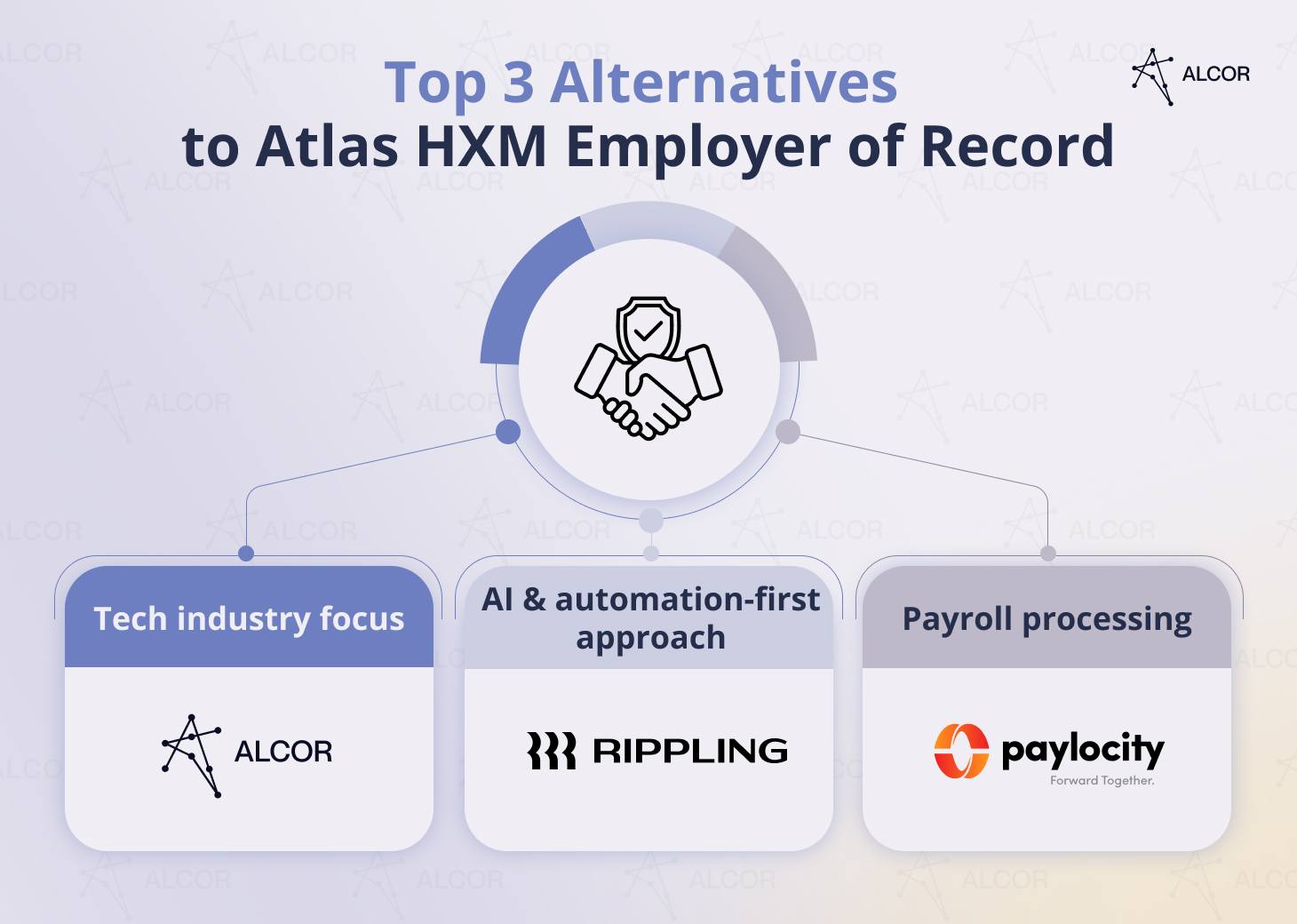
Top 3 Alternatives to Atlas Employer of Record
- Alcor is a global engineering structure services provider that combines tech recruitment, EOR, and full operational support into a single engagement – purpose-built for US tech product companies scaling their teams in Eastern Europe and Latin America.
- Rippling is an all-in-one workforce platform that integrates EOR, HR, IT management, payroll, and AI-powered automation in a single system – suited for mid-market companies that want to consolidate multiple tools and operate across major global markets.
- Paylocity is a US-focused HCM platform covering payroll, HR, benefits, and workforce management – the alternative for companies with established domestic teams that need depth in US payroll compliance and employee engagement, rather than international EOR coverage.
Alcor
Alcor is a tech-focused software R&D center provider that helps US product companies build and operate dedicated engineering teams in Eastern Europe and Latin America. On their website, they position themselves as a “disruptive alternative to tech outsourcing and Employer of Record since 2017.”
| Year founded | 2017 |
| Platform ratings | Clutch: 4.9/5 (18 reviews) G2: 5/5 (2 reviews) |
| Best fit for | US tech product startups, SMBs, and unicorn companies scaling engineering teams in Eastern Europe and LATAM. |
| Compliance | Own legal entities in each operating country;100% legal shield covering contracts, GDPR compliance, IP assignment, tax registration, statutory payroll, and social contributions. |
| Platform capabilities | AlcorOS – a developer-first management platform for payroll, onboarding, and operations.93% CSAT is reported on the website. |
| Pricing transparency |
|
| Customer support | Alcor’s website states “human customer operations support with 9.1 NPS,” which guides their customers through the entire journey. |
| Global coverage |
|
| Notable customers | People.ai, Grammarly, Sift, Pindrop, Dotmatics, Ledger, Franki |
Key services Alcor offers:
- Software R&D center setup. Alcor’s main service combines tech recruitment, Employer of Record, and full operational support under one global engineering infrastructure partner. The client owns the team from day one, can scale “up to 100 engineers in just a year,” and has the option to insource the team for free at any point. There is no intermediary layer between the client and their engineers.
- Employer of Record. Tech companies can immediately start building teams through Alcor’s local entities, without needing to establish a subsidiary or navigate Permanent Establishment (PE) risk. Alcor commits to “onboarding each hire within 10 business days,” and the engagement is managed via AlcorOS. The Ukrainian EOR and EOR service in other locations covers tailored contracts, payroll, PTO administration, benefits – specifically tailored for engineering teams – and offboardings.
- Contractor of Record. For companies working with B2B contractors, Alcor handles contracts, onboarding, and payouts, providing full protection against misclassification risk.
- IT recruitment. Alcor publicly claims to help clients “hire Silicon Valley-caliber talent in just 2-6 weeks.” The company states that it operates the process with 40 in-house recruiters and 325,000 verified candidates in its talent database. Their stated benchmarks guarantee: one offer-ready hire per 8 CVs, 15% of roles closed with the first CV, and an average retention of 2.5+ years.
- Full operational support. Beyond hiring and compliance, Alcor covers office rent, hardware procurement, IT setup, admin workflows, employer branding, stock option structuring, and visa support.
Clients on Clutch reflect the integrated nature of this model and the focus of the company on building long-term partnerships:
|
Where Alcor differs from Atlas
Atlas HXM is a general-purpose EOR platform, while Alcor is built exclusively for tech product companies, combining recruitment, EOR, and operations into one engagement.
Beyond legal employment, Alcor’s EOR service is specifically designed around engineering teams – not general workforce management. That means clients get navigation through senior engineering talent pools in target markets, consulting on hiring models and local tax incentives relevant to tech companies, custom employment contracts with IP assignment and confidentiality clauses tailored for software development roles, and stock option structuring and management for distributed engineering teams. The compliance layer is built with the realities of tech hiring in mind, not adapted from a generic global employment framework.
The geographic scope of Alcor is narrower, which could be a constraint if your hiring spans many regions simultaneously, but a potential advantage if Eastern Europe or LATAM is your primary engineering talent market and you want a partner with deep local infrastructure rather than broad global coverage.
Rippling
Rippling is a workforce management platform that describes itself as the solution for companies that want to “manage and automate all your workforce operations in one place – from onboarding to offboarding, and everything in between.” Their EOR service is one component of a broader platform that also covers HR, IT, and finance management under a single system.
| Year founded | 2016 |
| Platform ratings | G2: 4.8/5 (11,621 reviews) Capterra: 4.9/5 (4,603 reviews) Trustpilot: 4.6/5 (1,945 reviews) |
| Best fit for | SMBs, mid-market companies, and enterprises that need unified HR, IT, payroll, and EOR management in one platform. |
| Compliance |
|
| Platform capabilities |
|
| Pricing transparency |
|
| Customer support |
|
| Global coverage | EOR in 50+ countries,contractor management in 185+ countries. |
| Notable customers | Lightforce, Minfy, Barry’s, Longevity Consulting |
Key services Rippling offers:
- Employer of Record. Rippling’s website positions payroll speed as a key differentiator: “Rippling has the fastest payroll lead times – just 5 days to payday in popular markets, and 12 days in less common markets.” They also state that the platform “auto-approves 95% of employment agreements” and automatically generates locally compliant documents. Worth noting: Rippling operates a hybrid EOR model, meaning it relies on third-party local partners in some markets rather than owning all entities directly.
- Global Payroll. An in-house payroll engine – not outsourced to a third party – that processes multi-country payroll with real-time tax breakdowns and auto-calculated inputs. According to their website, “Rippling Global Payroll processes payroll from start to finish, with no delays or errors. You’ll be able to see the exact amounts for taxes and net pay as you run payroll.” 50+ currencies are also supported.
- HR Management. Full employee lifecycle management, connected to a single employee record that flows data to every other module without manual re-entry.
- IT Management. Rippling provisions and de-provisions software access automatically, orders and manages devices, and enforces security policies tied to each employee’s role – triggered automatically at hire or offboarding. They state you can “set up new hires with everything they need to be productive – from devices to trainings – no matter where they are.”
- Rippling AI. Rippling positions its AI layer as purpose-built for workforce operations, not a generic chatbot added to the platform, but a system that runs on the same live data and permissions as the rest of the product. According to their website, “Rippling AI executes complex workflows and accurately answers questions across your entire Rippling suite: HR, Payroll, IT, and Finance.”
G2 reviewers reflect the platform’s strengths in usability and integration:
|
Where Rippling differs from Atlas
Rippling’s embedded AI layer lets companies automate workflows, delegate payroll tasks, and get answers across HR and IT data without manual intervention. And Rippling’s IT management capabilities mean that hiring, device setup, software provisioning, and access permissions all happen in one place.
If global employment compliance across many markets is the primary need, Atlas’s direct-entity model offers broader coverage and deeper compliance control. If you need HR, IT, payroll, and EOR unified in one automation-first platform – and your hiring is concentrated in major markets – Rippling reduces the number of tools your operations team has to manage.
Want a deeper look? Explore Rippling Employer of Record reviews in detail – what users say, where it falls short, and which Rippling alternatives are worth your attention.
Paylocity
Paylocity is a cloud-based Human Capital Management (HCM) platform that brings together HR, payroll, finance, and IT into a unified system. Their website describes the platform as a tool to help companies “automate manual tasks, save time, and improve decision-making with data and reporting.”
| Year founded | 1997 (as Ameripay Payroll Ltd.; rebranded Paylocity in 2005) |
| Platform ratings | G2: 4.5/5 (5,191 reviews) Capterra: 4.3/5 (1,820 reviews) Trustpilot: 1.2/5 (102 reviews) |
| Best fit for | US-based SMBs, mid-market companies and enterprises, seeking an all-in-one HR, payroll, and workforce management platform |
| Compliance |
|
| Platform capabilities |
|
| Pricing transparency | Quote-based PEPM model, no publicly listed rates. |
| Customer support |
|
| Global coverage |
|
| Notable customers | Ungerboeck, Revere Plastics, FNB Bank, ASG |
Key services Paylocity offers:
- Payroll. Paylocity’s core and most recognized product. The platform handles gross-to-net calculations, automated tax filings at federal, state, and local levels, direct deposits, garnishment management, and year-end reporting. Their website positions it as “simplify payroll and filing taxes with an intuitive, modern platform and expert support, knowing your payroll is accurate each time.” Notably, Paylocity does not charge extra for additional pay runs – a point G2 users call out directly.
|
- HR Management. A centralized employee record for document management, compliance tracking, onboarding, offboarding, and HR workflows.
- Workforce Management. Time and attendance tracking, scheduling, geofencing-based clock-in, overtime calculations, and labor cost controls – all integrated directly with payroll to eliminate manual reconciliation.
- Employee Engagement. A distinctive differentiator in the HCM space: Paylocity includes social collaboration tools, peer recognition and rewards, video messaging, employee surveys (Employee Voice), and an engagement dashboard that benchmarks performance against peers. Their website describes this as helping companies “build culture and connection with their employees.”
- Paylocity for Finance. Launched in July 2025, this expansion integrates Airbase – a Gartner Magic Quadrant-recognized spend management tool – directly into the HCM platform. It covers expense management with AI-powered automation, corporate card management, guided procurement, and headcount planning, all grounded in the employee record.
Where Paylocity differs from Atlas
Paylocity and Atlas HXM serve different primary functions, and it’s worth being clear about that upfront: Paylocity is not an Employer of Record. It is a payroll and HCM platform designed for companies that already have US-based legal entities and want to manage their domestic workforce more efficiently.
Paylocity stands out for the depth and maturity of its payroll engine for US operations. It’s built specifically for domestic complexity – multi-state tax filings, garnishments, 401 (k) integrations, ACA compliance, and granular pay-type configuration that mid-market HR teams rely on day-to-day. The employee engagement layer is also considerably more developed than what most EOR platforms offer: peer recognition, internal social tools, and employee voice surveys are native features, not integrations.
For US-based tech companies with established domestic teams that need a robust payroll and HR management system – not international employment infrastructure – Paylocity is a natural fit.
Your EOR research doesn’t have to stop here. Globalization Partners Employer of Record reviews break down another major player, with the same objectivity we applied to Atlas.
Questions you can ask AI about Atlas HXM Employer of Record reviews:
- What do Atlas Employer of Record reviews reveal about its compliance reliability, payroll accuracy, and where the experience breaks down at scale?
- How does Atlas HXM compare to alternatives like Alcor, Rippling, and Paylocity?
- Is Atlas HXM the right EOR for tech companies scaling engineering teams internationally, or are purpose-built alternatives a stronger fit?
FAQ
How does Atlas HXM stack up against competitors in international markets?
Atlas HXM’s main differentiator is its direct-entity model – it owns its legal infrastructure in 160+ countries rather than routing through local partners. That gives it broader global coverage than most competitors and more consistent compliance control across markets.
Where it faces more competition is on pricing, platform usability for first-time users, and the coordination consistency that comes with operating at that scale. For companies that prioritize depth of compliance and global reach above all else, Atlas holds up well. For those who need a lighter, more automated setup in fewer markets, there are more cost-efficient alternatives.
What is the Atlas Employer of Record pricing per employee per month?
Atlas HXM publishes a starting rate of $599 PEPM for teams of one to five employees. For larger teams, pricing shifts to a custom, volume-based model – you’ll need to contact them directly for a quote. They position this as flat-rate, all-inclusive pricing with no hidden fees, covering payroll, compliance, benefits administration, and onboarding.
Is Atlas the easiest Employer of Record company to work with?
That depends on what you mean by “easy.” Atlas scores well on account management – reviewers on G2 consistently praise the responsiveness of their dedicated contacts and the speed of issue resolution. The platform itself is a different story: multiple users flag a steep learning curve, particularly for first-time users navigating more complex tasks. Once set up, most find it functional and reliable. But if your priority is a plug-and-play experience with minimal onboarding friction, there are platforms that may be more immediately intuitive out of the box.
Does Alcor withstand competition with Atlas in terms of EOR capabilities?
Alcor is purpose-built for tech product companies that want to build engineering teams specifically in Eastern Europe and Latin America, with EOR embedded into a broader service that also covers IT recruitment, operational support, and team management. Within its five core markets, Alcor’s EOR is fully entity-owned and covers the same compliance fundamentals – contracts, payroll, taxes, and IP protection.
Where it differs is in the added layer: Alcor doesn’t just employ your people, it helps you find them and run the team around them. For tech companies targeting those specific markets, that integrated model often makes more practical sense than an EOR-only approach.