

AI Architect Recruiting
AI architect staffing for scaling companies. Focus on your product.
We will headhunt leadership you can trust.
- Custom sourcing based on your exact candidate portrait
- 98% CV acceptance rate
- Reach to multiple global talent markets
- TC benchmarking, from base salary and equity to bonuses and compute perks
- 100% compliance, payroll, and operational support



 Mexico
 Colombia
 Argentina
 Chile
 Poland
 Ukraine
 Romania
 Bulgaria
Recruiting AI Architects Fast and Efficient

























Top-rated AI Architect Staffing Agency

325,000+ Candidates
in Alcor’s global tech talent network
Market-First Hiring
talent availability and compensation data before you commit to a location
40+ Tech Recruiters
sourcing AI, ML, data and other scarce engineering profiles
2-6 Weeks
average time to close a AI architect position
No Local Entity
recruitment, compliant employment, payroll, and legal support under one roof
98.6%
of our hires pass probation periodAI Talent Pipeline
Our Team of AI Architect Recruiters









Transparent Recruitment Process

AI Role Calibration
- Mapping the role’s production scope.
- Separating research, modeling, data, MLOps, and infrastructure needs.
- Benchmarking salaries and talent availability.
Scarce Talent Mapping
- Mapping niche talent pools across target regions.
- Targeting passive specialists with relevant production experience.
- Aligning the EVP with candidate expectations.

AI Expertise Validation
- Assessing shipped models, production systems, research, and open-source work.
- Evaluating English, collaboration, and ownership.
- Filtering out profiles without proven engineering expertise.

Interview and Offer Management
- Shortlisting candidates aligned with the technical profile.
- Coordinating interviews, feedback, offers, and counteroffers.
- Aligning salary, equity, and role expectations.

Employment and Team Scaling
- Managing onboarding, payroll, employment, and compliance.
- Providing a free replacement within the three-month warranty period.
- Scaling from individual specialists to 10+ AI hires per month.
Result
Global talent strategy for hard-to-fill AI roles
Contact Us

















Key Things to Know About Recruiting AI Architects
AI Architect Talent Market Overview
The AI architect talent market in 2026–2027 is shaped by growing enterprise adoption of generative AI, demand for production-ready applications, and competition for professionals with advanced system design experience.
An AI architect defines how models, applications, data, and infrastructure work together. Unlike AI engineers focused primarily on implementation, architects establish technical standards, assess architectural risks, and guide engineering teams through complex deployments.
Companies increasingly need professionals experienced in both traditional enterprise architecture and modern AI technologies, including LLMs, retrieval-augmented generation (RAG), model orchestration, and cloud-native infrastructure.
Global supply and enterprise demand
The World Economic Forum’s Future of Jobs Report 2025 identifies AI and machine learning specialists among the fastest-growing technology occupations through 2030. The research also indicates that 86% of surveyed employers expect AI and information-processing technologies to transform their businesses by the end of the decade.
Enterprise demand increasingly favors architects with practical experience deploying AI-enabled systems into existing infrastructure. Companies need specialists capable of addressing data access, model reliability, scalability, security, and deployment costs.
The supply of qualified candidates is harder to measure. AI architect is not a consistently defined occupational category, and similar responsibilities appear under several titles:
- Enterprise AI architect
- Generative AI solutions architect
- Machine learning architect
- LLM architect
- AI infrastructure architect
- Cloud AI architect
- Principal AI engineer
Job titles frequently overlap, but technical responsibilities differ. For example, an LLM architect typically concentrates on GenAI applications, model orchestration, and retrieval systems. An enterprise AI architect must also account for platform governance, legacy infrastructure, and organization-wide technology standards.
As a result, effective AI architect recruiting requires assessing previous projects rather than relying exclusively on job titles.
Where should enterprises look for AI architects?
The United States remains an important hiring market for senior AI professionals. Yet companies expanding their engineering capacity increasingly evaluate international locations to access specialized skills and diversify their hiring pipeline.
Eastern Europe offers established software engineering, cloud, data engineering, and enterprise development communities. Poland, Romania, Ukraine, and Bulgaria provide potential sourcing markets for architects with relevant technical backgrounds.
LATAM offers another option, particularly for US companies prioritizing overlapping working hours. Mexico, Colombia, Argentina, and Chile have engineering communities supporting cloud development, data platforms, and AI implementation.
The best market depends on the required specialization, compensation expectations, communication needs, and experience with enterprise technology environments.
For strategic positions, location alone should never determine the shortlist. Candidates need proven ownership of complex technical decisions.
AI Architect Salary Benchmarks in 2026–2027
AI architect compensation depends on technical specialization, business responsibility, industry, location, and the scope of systems the professional will manage.
The average annual base salary for an AI Solution Architect in the United States was $125,986 as of October 1, 2026. The reported middle salary range was
120,511–130,181.
These figures represent one defined job category rather than the entire market. Senior enterprise architects responsible for large-scale GenAI infrastructure, technical strategy, or engineering leadership may command higher compensation.
For international hiring, closely related AI engineering specialties provide useful additional reference points.
| AI specialization | United States | Eastern Europe | LATAM |
| LLM Engineer | $234,000 | $94,000 | $90,000 |
| AI Product Engineer | $228,000 | $93,000 | $83,000 |
| ML Ops Engineer | $189,000 | $94,000 | $86,000 |
Source: Alcor’s 2026 AI engineering salary benchmarks. Figures represent annual base compensation for related specialties, not direct AI architect salary estimates.
These benchmarks help establish regional compensation differences when recruiting professionals with adjacent technical skills. An architect-level offer should reflect broader responsibilities, including system design authority, engineering leadership, and production accountability.
What affects the total cost of hiring an AI architect?
Base salary represents only part of the hiring budget. Employers should also evaluate:
- Employment taxes and statutory contributions
- Recruitment agency fees
- Benefits and retention packages
- Cloud certifications and professional development
- Equipment and software access
- Payroll, legal, and HR administration
- Long-term infrastructure ownership and operational continuity
For a direct staffing engagement, the cost structure typically includes a placement fee and the employee’s compensation. Contractor arrangements introduce recurring service or hourly charges. International employment through an EOR adds local employment administration fees.Enterprises should compare the full annual cost of employment rather than salary figures alone.
Hiring Criteria for an AI Architect Role
- AI systems design and architecture
An architect should design systems supporting the intended workloads, user traffic, data requirements, and availability targets.Relevant expertise includes distributed systems, APIs, event-driven architecture, microservices, asynchronous processing, and scalable inference infrastructure.
For GenAI projects, candidates should understand LLM selection, RAG architecture, vector databases, agent orchestration, and model evaluation.
A practical interview scenario might involve designing a customer support assistant using internal company documentation. The candidate should explain how the system retrieves relevant information, manages access permissions, reduces unsupported responses, and monitors response quality.
- Data platform engineering
AI systems depend on reliable data access and processing.
Architects should understand ETL/ELT pipelines, batch and streaming processing, data warehouses, lakehouses, data quality, and metadata management.
Enterprise experience with platforms such as Databricks, Snowflake, Apache Spark, or cloud-native data services is valuable when relevant to the company’s infrastructure.
For RAG-based applications, candidates also need experience designing retrieval pipelines, chunking strategies, embeddings, indexing, and evaluation datasets.
- MLOps and production deployment
MLOps ensures models move through development, testing, deployment, and monitoring using repeatable engineering processes.
Senior architects should demonstrate familiarity with:
- Model versioning and artifact management
- CI/CD pipelines for AI applications
- Model evaluation and monitoring
- Automated deployment and rollback
- Infrastructure as code
- Observability and incident management
- Model drift and quality degradation
Cloud experience with AWS, Microsoft Azure, or Google Cloud is important for organizations operating AI workloads at scale.Knowledge of Kubernetes, Docker, Terraform, and model-serving infrastructure strengthens a candidate’s operational expertise.
- Security, governance, and compliance
AI architecture introduces risks involving sensitive information, model outputs, third-party services, and infrastructure access.
Candidates should understand encryption, identity and access management, data isolation, audit logging, secure API design, and vendor risk assessment.
For GenAI systems, additional considerations include prompt injection, sensitive data exposure, insecure tool access, and evaluation of generated outputs.
- Technical leadership and strategic guidance
AI architects frequently work with CTOs, platform engineers, data specialists, security teams, and product leaders.They must explain complex design decisions, establish development standards, review architectural proposals, and evaluate trade-offs between performance and cost.
A senior candidate should also identify situations where a conventional software solution is more appropriate than an AI-enabled approach.
First 6 Months With an AI Architect on Board
Month 1: Assess existing systems
The architect reviews infrastructure, development workflows, data sources, security requirements, and current AI initiatives.
Expected deliverables include an architecture assessment, risk register, prioritized use cases, and recommendations for technology selection.
Month 2: Establish the architecture roadmap
The specialist defines target architecture, technology standards, implementation phases, and infrastructure requirements.
The roadmap should identify dependencies involving data engineering, platform development, security, and model operations.
Months 3–4: Validate technical decisions
The engineering team implements a representative use case or production-oriented pilot under the architect’s guidance.Evaluation focuses on output quality, latency, reliability, integration with enterprise systems, and operating costs.
Months 5–6: Establish production readiness
The architect helps the team standardize deployment processes, observability, access controls, technical documentation, and operational procedures.
By the end of the period, leadership should have a clear assessment of architectural feasibility, system performance, financial requirements, and the engineering resources needed for further expansion.
For mature AI programs, the expected outcome may instead involve modernizing existing infrastructure or improving production reliability.Success should be measured against the responsibilities established before hiring.
Common AI Architect Staffing Models
Contingent hire
Contingent staffing provides access to an AI architect for a defined project, implementation phase, or temporary capacity requirement.
The professional typically works under a contract or staffing arrangement with an agreed duration, deliverables, and commercial terms.
This model suits companies requiring a project expert to assess AI architecture, design an LLM platform, lead a migration, or prepare technical documentation before a permanent team takes ownership.
Advantages include flexible engagement duration, access to specialized skills, and the ability to address an immediate technical requirement.
Limitations involve knowledge transfer, contract renewals, and reduced continuity when the engagement ends.
Direct hire
Direct staffing focuses on permanent recruitment into the company’s engineering organization.
A specialized AI architect recruitment agency identifies candidates, conducts preliminary assessments, coordinates interviews, and supports offer negotiations.The company hires the selected specialist through its existing employment structure.
Direct hire is suitable when architecture decisions will affect multiple products, departments, or long-term engineering investments.
Permanent architects establish technical standards, mentor development teams, and maintain architectural knowledge as systems grow.
The main considerations include recruitment costs, compensation competitiveness, interview capacity, and retention.
A direct-hire strategy is especially appropriate when the employer has a local legal entity and established HR infrastructure.
Embedded teams
Embedded staffing places an architect within an existing engineering organization or alongside a dedicated group of developers, data engineers, and MLOps specialists.
The architect participates in planning, system reviews, implementation decisions, and ongoing technical coordination.
Unlike a short-term advisory engagement, embedded architects work closely with the team’s regular engineering processes.
This model suits enterprises developing several interconnected AI applications or expanding an existing AI platform.
Responsibilities should be clearly allocated between the architect, engineering manager, and product owner.
Alcor’s Expertise in AI Architect Recruiting
Alcor helps technology companies recruit senior AI specialists and establish dedicated engineering teams across Eastern Europe and LATAM.
As an AI architect staffing agency, Alcor combines candidate sourcing, recruitment coordination, and local employment operations within a single service model.
Our recruitment capabilities support companies seeking specialists in AI architecture, LLM engineering, cloud infrastructure, machine learning, data engineering, and MLOps.
Recruitment aligned with engineering growth
A senior architect often represents the beginning of a broader engineering expansion.
Once the technical direction is established, companies may need LLM engineers, data engineers, platform specialists, MLOps professionals, and additional software developers.
Alcor supports recruitment programs designed to scale from initial senior appointments into larger dedicated teams.
Our recruitment capacity supports hiring plans targeting 10–30 engineers within 90 days and up to 100 or more within a year, subject to project requirements and agreed recruitment plans.
Local employment and operational support
- Alcor provides EOR/COR and operational services across Mexico, Colombia, Argentina, Chile, Poland, Romania, Ukraine, and Bulgaria.
- Clients receive support with locally tailored employment or contractor agreements, payroll coordination, benefits administration, onboarding, equipment, and local HR matters.
- Employment documentation includes IP assignment and confidentiality provisions designed around local legal requirements.
- A dedicated Customer Operations Manager coordinates ongoing employee-related needs and provides responses within one business day.
This structure lets engineering leaders manage their specialists directly while Alcor handles the agreed local employment and operational responsibilities.
Ready to Build Your AI Engineering Team?
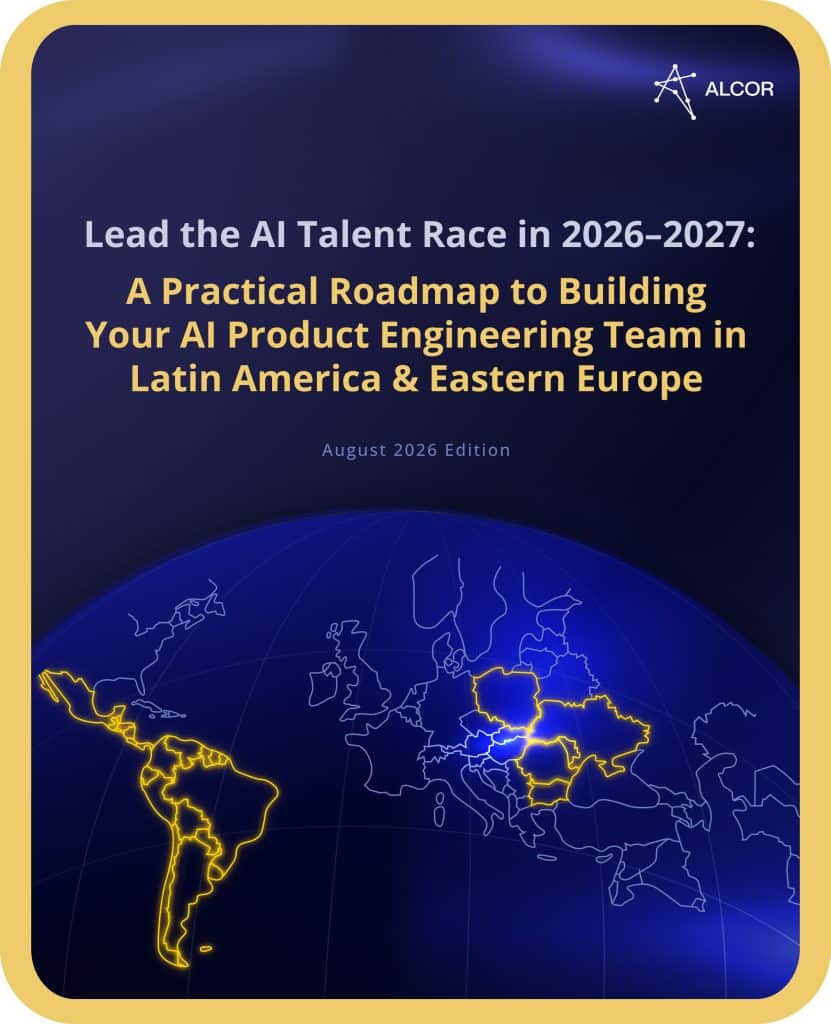
While your competitors are stuck fighting over the same domestic AI talent for months, this guide shows you where to build your AI engineering team twice as fast and save up to 66% on base salaries alone.
FAQ
What are the key operations AI architects are in charge of?
AI architects oversee technical design decisions across AI systems, including model selection, data infrastructure, application architecture, deployment standards, scalability, and security.Their responsibilities also include evaluating cloud infrastructure, LLM orchestration, RAG pipelines, model-monitoring strategies, and infrastructure costs.In enterprise environments, architects coordinate with security, data engineering, platform, and product teams to align technical design with business needs.
When should you consider recruiting an AI architect?
Organizations should consider recruiting an AI architect when AI projects require complex system design, production deployment, multiple data integrations, or coordination across several engineering teams.Common triggers include moving a GenAI application beyond a pilot, building a shared AI platform, modernizing machine learning infrastructure, or implementing governance standards.
What is the best AI architect staffing model for 2027?
There are options. Direct hire is generally suitable for permanent architectural ownership. Contingent staffing works for temporary or narrowly defined technical projects.Embedded staffing supports organizations requiring collaboration between architects and engineering teams.International recruitment combined with an EOR is appropriate for companies seeking permanent specialists abroad without immediately establishing a legal entity.
How do nearshore and offshore AI architects compare to US-based hires?
US-based specialists may offer advantages when the role requires frequent on-site collaboration or close coordination with US headquarters.Nearshore markets such as Mexico and Colombia support working-hour overlap with North American engineering teams.Eastern European markets offer experienced software and infrastructure professionals, with varying degrees of time-zone overlap depending on the client’s location.
How does Alcor screen and vet candidates for senior AI architect positions?
For senior AI architecture roles, candidates examine practical experience with systems design, cloud infrastructure, LLM applications, MLOps, data engineering, and production deployment.Recruiters coordinate candidate qualification and present relevant profiles. The client conducts technical interviews and determines whether candidates meet the required architectural standards.
How does Alcor support tech enterprises with their AI hiring strategy?
Our recruiters help companies fill individual senior vacancies and expand teams with complementary technical specialists. For enterprises building dedicated AI engineering functions, Alcor also provides EOR/COR services, payroll, locally tailored agreements, onboarding coordination, and ongoing HR support.Clients maintain direct management of their specialists and control over technical delivery.