
















We build and operate top-tier tech teams in LATAM and Eastern Europe.
Up to 40% savings. 100 people a year. No entity. No buy-out fees.
Key Takeaways
- Colombian PEO takes payroll, benefits, and compliance off your plate, but the model assumes you already have a legal entity and operates as co-employment.
- PEO’s main benefits in Colombia: built-in compliance, lower legal exposure, cost savings, reduced admin, and competitive benefits packages to attract senior talent.
- An EOR removes the entity requirement completely and carries all compliance risk itself, unlike a PEO.
- Alcor makes that practical: no entity, no compliance risk, no vendor maze. You get a high-performing 30-engineer team ready in 3 months, backed by a dedicated Customer Ops Manager.
What Are the Benefits of Using a PEO in Colombia?
Let’s say that you have a Colombian legal entity open. The talent is there, the timing is right, and your legal status is clear. Yet setting up HR and compliance systems from scratch can slow you down. Let’s see the advantages of cooperation with PEO under the co-employment model:
1. Full compliance and reduced legal risk
Colombian labor law is detailed and strongly enforced. Complying with it on your own means long nights with legal consultants and high stakes if you get anything wrong. A PEO becomes your compliance partner, handling employment contracts and SLAs, mandatory benefits, social security contributions, privacy considerations, and day-to-day regulatory updates.
2. Cost savings
A PEO expansion service in Colombia can cut your expenses by leveraging group purchasing power to obtain discounted insurance and workers’ compensation plans. Even in Colombian premium markets like Bogotá, it keeps total employment costs well-balanced.
At the same time, its familiarity with Colombian labor law and payroll processes minimizes the risk of costly compliance issues and unexpected fines. Also, these PEO efficiencies typically translate into a 27% cost-based ROI, according to NAPEO.
3. More time for product and strategic priorities
Delegating HR and administrative responsibilities to a Professional Employer Organization company in Colombia allows your company to prioritize its core activities. Freed from routine tasks like processing payroll or managing tax filings for your engineering team, you can concentrate on product development, strengthening operations, growing revenue, and scaling more efficiently.
4. Access to enterprise-level benefits
For many companies, outsourcing HR is the only realistic way to offer enterprise-grade benefits without negotiating each line item individually. A PEO services vendor in Colombia structures benefits not as “nice extras,” but as a deciding factor for senior and lead tech professionals who typically compare multiple offers side by side and choose the one with the strongest overall package.
Through a PEO model, companies can provide:
- private health insurance plans at better rates
- life and disability insurance
- retirement and savings programs
5. Smooth onboarding
When operating in the Colombian market, onboarding new team members can quickly become a logistical challenge. A PEO partner in Colombia streamlines this step by taking over all required documentation, registrations, and compliance checks under local labor law.
Which Responsibilities Does a PEO Provider in Colombia Assume?
A strong Professional Employer Organization (PEO) in Colombia doesn’t replace your leadership. In fact, it operates through a co-employment model: your company partners with the PEO vendor in Colombia to share specific obligations. You remain the legal employer and retain full control over day-to-day management and technical direction, while the PEO builds the infrastructure that keeps your team compliant, supported, and operationally stable.
Here’s what a PEO provider in Colombia typically takes off your plate:
- Full payroll processing and tax administration. Manages local payroll cycles, calculates and withholds taxes, and ensures all payments are made accurately, in the right currency, and on time.
- Compliance management and legal guidance. Keeps your operations aligned with Colombian labor law, monitors regulatory changes, and mitigates risks related to contracts, terminations, benefits, and privacy regulations.
- Employment contract preparation and review. Drafts legally compliant employment agreements in Spanish, ensuring they follow Colombian labor standards.
- Labor law compliance. Ensures employee schedules meet legal limits, applies proper overtime premiums, and handles mandatory 13th-month salary payments. A PEO firm in Colombia also tracks employees’ annual public holidays and vacation entitlements, and manages sick leave, maternity leave, and paternity leave.
- HR support and employee relations. Serves as a local HR partner, assisting with training, performance management, employee engagement, and everyday HR inquiries.
- Benefits administration and enrollment. Provides access to compliant and competitive benefit plans and manages employee enrollment in health insurance, pension funds, risk insurance, and welfare programs.
Hiring in Colombia via a Professional Employer Organization
| Inflation Rate (CPI, %)
6.14% |
COP/USD
volatility (%) 11.02% |
Corporate income tax (CIT)
35% |
| English proficiency
Upper B1 |
Graduate Employment Rate (%) (aged 25-34)
77.4% |
Nominal Wage Growth (YoY, %)
10.8% |
Over the past few years, Colombia has quietly rebuilt its economy. After slowing to around 0.7% growth in 2023 (BBVA Research), driven largely by weaker domestic demand, the economy regained a positive trend, reaching 1.6% in 2024 (World Bank Group). Growth continued to accelerate in the first half of 2025 to 2.4%, putting Colombia on a steady path toward its long-term growth potential of 2.9% by 2027, according to the same source.
The uptick has been supported by several factors. Unemployment has dropped to 8% and even lower in key tech hubs like Medellín and Cali, per Trading Economics. With a workforce surpassing 23.8 million (BBVA Research) and inflation projected to stabilize around 4% in 2026 (Trading Economics), Colombia offers something valuable in the region: macro stability paired with a growing labor market.
Then there is the factor American tech product companies notice immediately: labor costs. Senior software engineers earn about $5,620 per month – almost half the US benchmark of $14,220.
But for many companies, wanting to hire in Colombia and being able to hire in Colombia are two different things. A PEO removes the friction of operating in the Colombian labor market by sharing employment responsibilities with your company.
There’s one important caveat: using Professional Employer Organization services in Colombia requires your company to have a local legal entity. If you don’t have one – or don’t want to spend up to 3 months establishing it – an EOR is a more flexible alternative.
Employment in Colombia with PEO Company Support
Labor legislation in Colombia
The foundation of Colombia’s labor system is the Código Sustantivo del Trabajo (CST) – a local core labor code created in 1950 and continually updated to reflect international standards and the country’s economic landscape.
A major shift arrived in 2025. The Labor Reform (Law 2466 of 2025) introduced new rules that directly affect employers:
- Higher premiums for Sunday work, rising from 80% in 2025 to 100% by 2027.
- Redefined workday schedules, with daytime running from 6:00 a.m. to 7:00 p.m., and nighttime from 7:00 p.m. to 6:00 a.m.
- Hiring incentives: Companies with up to 50 employees (or whose annual sales growth aligns with the CPI) can receive subsidies covering up to 25% of the minimum monthly wage for six months when hiring women, youth, or workers aged 50 and over.
In Colombia, the legal maximum workweek is now 42 hours. Overtime is capped at 12 hours per week and must be authorized through the Ministry of Labor’s SUIT portal. Overtime pay is like that: 125% of the regular rate during regular hours and 180% on a holiday or Sunday.
Types of employment contracts
- Indefinite-term contracts serve as the default model. They have no end date and remain in effect until either party terminates the relationship in accordance with labor law.
- Fixed-term contracts must be in writing and may run for up to four years, including renewals. After that point, they automatically convert into indefinite-term agreements.
- Service (independent contractor) agreements apply when workers operate autonomously, invoice for services, and handle their own taxes and benefits. While flexible, they carry misclassification risks if the relationship resembles traditional employment.
To protect intellectual property, NDAs are essential. They are enforceable when bilingual (Spanish–English), specific in scope, and time-bound. Trade secrets receive additional protection under Decision 486 of 2000 and Law 256 of 1996.
Probation & onboarding
In Colombia, probation serves as a trial period to confirm the employer–employee fit and must be documented in the contract. It lasts up to two months.
After signing, onboarding begins. Though not legally required, it’s standard practice, especially in the tech sector. Effective onboarding includes contract delivery, Social Security registration, early training, and clear first-day coordination to help new hires integrate quickly and confidently.
Termination & severance package
Colombian law permits termination with or without cause. A dismissal with cause must be explained in writing and allows the employee to respond; when justified, no severance is paid.
Terminations without cause require severance payments based on salary and tenure:
- 20 days’ salary for the first year of service, and
- 15 additional days for each subsequent year.
Regardless of contract type, employees are entitled to payment for unused vacation, 30 days of salary per year worked (Cesantía), any pending compensation for days worked but not yet paid, and a prorated 13th-month bonus.
Pregnant employees, union members, or those with medical restrictions are considered protected employees. Terminating them requires prior authorization from the Ministry of Labor.
Payroll management
Payroll in Colombia follows a monthly cycle, with most employers paying on the last business day of the month. Some sectors use a bi-weekly schedule, issuing payments on the 15th and at month-end. Regardless of the cadence, payroll is highly regulated and requires accurate calculations, compliant documentation, and timely social security contributions. Employers must also issue payslips and submit payroll reports electronically to the national tax authority (DIAN).
A defining feature of Colombian payroll is the 13th-month salary (Prima), paid in two installments: June and December. Beyond wages, payroll includes:
Social security contributions (federal)
- Pension fund contribution: 12%;
- Health insurance contribution: 8.5% (Only applicable when salary exceeds 10 min. monthly wages);
- Labor risks system: 0.522%.
Payroll taxes
- Institute for Family Welfare contribution: 3%;
- National Apprenticeship Service (SENA) contribution: 2%;
- Family Compensation Fund: 4%.
Taxation in Colombia
Local companies pay tax on worldwide income, while foreign entities are taxed only on income sourced within Colombia. The fiscal year runs from January 1 to December 31.
Key points for employers:
- Corporate Income Tax (CIT): 35% standard rate (PWC).
- Municipal industry and trade tax: 0.2%–1% on gross revenue from industrial, commercial, or service activities (fully deductible for CIT purposes), per PWC.
- Value-added tax (VAT): 19%, according to PWC.
Work permits and visas
Colombia’s work permits and visa system is regulated by the Ministry of Foreign Affairs and generally requires employer sponsorship for foreign workers’ relocation. Most professionals fall under the Migrant (M) category, valid for up to two years, while Visitor (V) visas cover short business stays and Resident (R) visas support long-term settlement.
Several work-focused variations exist, including standard employment visas, temporary technical visas, intra-company transfer options, and digital nomad permits.
Statutory and Non-statutory Benefits in Colombia
Colombia requires a thoughtful approach to statutory benefits and offers a growing ecosystem of non-statutory perks that help attract top talent.
Statutory benefits:
- Social security coverage;
- Severance pay (Cesantía);
- 13th-month salary (Prima);
- Minimum wage (COP 1,750,905 (~$526) per month, according to WageIndicator;
- Vacation, sick leave, public holidays, and parental leave coverage;
- Health, pension, work-injury & occupational-risk insurance.
Non-statutory benefits:
- Supplemental private health plans;
- Extra pension schemes;
- Meal and transport allowances;
- Performance bonuses;
- Education aid;
- Life insurance.
Benefits in the tech sector:
- Remote-work stipends;
- Stock options;
- Learning budgets;
- Flexible schedules;
- Wellness programs.
Annual Leave in Colombia: Types and Duration
Public holidays
According to World Population Review, Colombia observes 18 national public holidays each year. They include a mix of civil and religious celebrations:
- New Year’s Day
- Epiphany
- Saint Joseph’s Day
- Maundy Thursday
- Good Friday
- Labor Day
- Ascension Day
- Corpus Christi
- Sacred Heart
- Feast of Saint Peter and Saint Paul
- Independence Day
- Battle of Boyacá Day
- Assumption of Mary
- Columbus Day
- All Saints’ Day
- Independence of Cartagena
- Feast of the Immaculate Conception
- Christmas Day
Annual leave (Vacation)
After one year of service, Colombian employees earn 15 paid working days of annual leave. At least 6 of those days must be taken each year, but employees may accumulate up to 4 years of unused days.
Sick leave
Employer pays 100% of the salary for the first two days of sick leave. From the third day, the Social Security Institute covers 66.67% of the salary for up to 90 days; 50% from the 91st to the 180th day, paid by social security.
Maternity and paternity leave
Female employees who contribute to the Social Security system receive 126 calendar days of fully paid leave, which must start at least 7 days before the expected due date. It’s funded by the Social Security system.
Male employees are entitled to 14 paid calendar days of paternity leave.
Bereavement leave
Employees are entitled to 5 days of paid leave following the death of a spouse, partner, parent, child, or close family member.
Professional Employment Organization vs Employer of Record
Let’s imagine: you’re a US CTO who’s decided to build a team in Colombia. You want senior engineers, fast ramp-up, and zero surprises with local law. Very quickly, two acronyms show up on your radar: PEO and EOR. Both promise to “take care of HR and compliance,” but they address different problems and entail very different trade-offs.
So, what’s the difference?
Professional Employment Organization
A Professional Employer Organization is essentially HR infrastructure-as-a-service. You still own the employment relationship and need to have your local legal entity; the PEO company in Colombia runs the back office.
Pros:
- Access to competitive, enterprise-level benefits. A Professional Employer Organization in Colombia enables you to offer benefit packages that meet professionals’ expectations without negotiating each plan individually or managing enrollment yourself.
- Faster operations without building an HR admin from scratch. Instead of setting up internal payroll, HR, and compliance processes, you plug into an existing infrastructure.
- Efficient scaling within one market. When growth is focused on Colombia, a PEO provides country-specific infrastructure that supports controlled, predictable headcount expansion.
Cons:
- Entity is mandatory. No entity, no PEO. You must invest time and money into incorporation before you can even start.
- Shared liability. In a co-employment model, you still carry a significant slice of compliance and employment risk.
- Limited global reach. A PEO framework won’t magically let you hire in markets where you’re not registered. For multi-country expansion, it quickly becomes a disadvantage.
Employer of Record
An Employer of Record, by contrast, becomes the legal employer of your team. You lead the roadmap, manage performance, and own the IP; the EOR runs everything that touches local law.
Pros:
- No entity required. You can hire in Colombia (and other countries) through the EOR’s local entity instead of opening your own entity. This will save you up to 3 months.
- Full compliance shield. The EOR assumes legal responsibility for contracts, payroll, taxes, benefits, and statutory reporting. So there’s no legal risk for you.
- Speed to market. You can often hire and onboard in weeks, not months, because the infrastructure is already in place.
Cons:
- Standardized frameworks. Benefits and HR policies are usually more standardized, and heavy country-level customization is limited.
- Exit friction when transitioning to your own entity. Moving employees from an EOR to your own legal entity can require re-contracting and careful administrative coordination, and many providers also charge fees. However, some providers, such as Alcor, offer entity transitions with no buyout fees and a simple handover process.
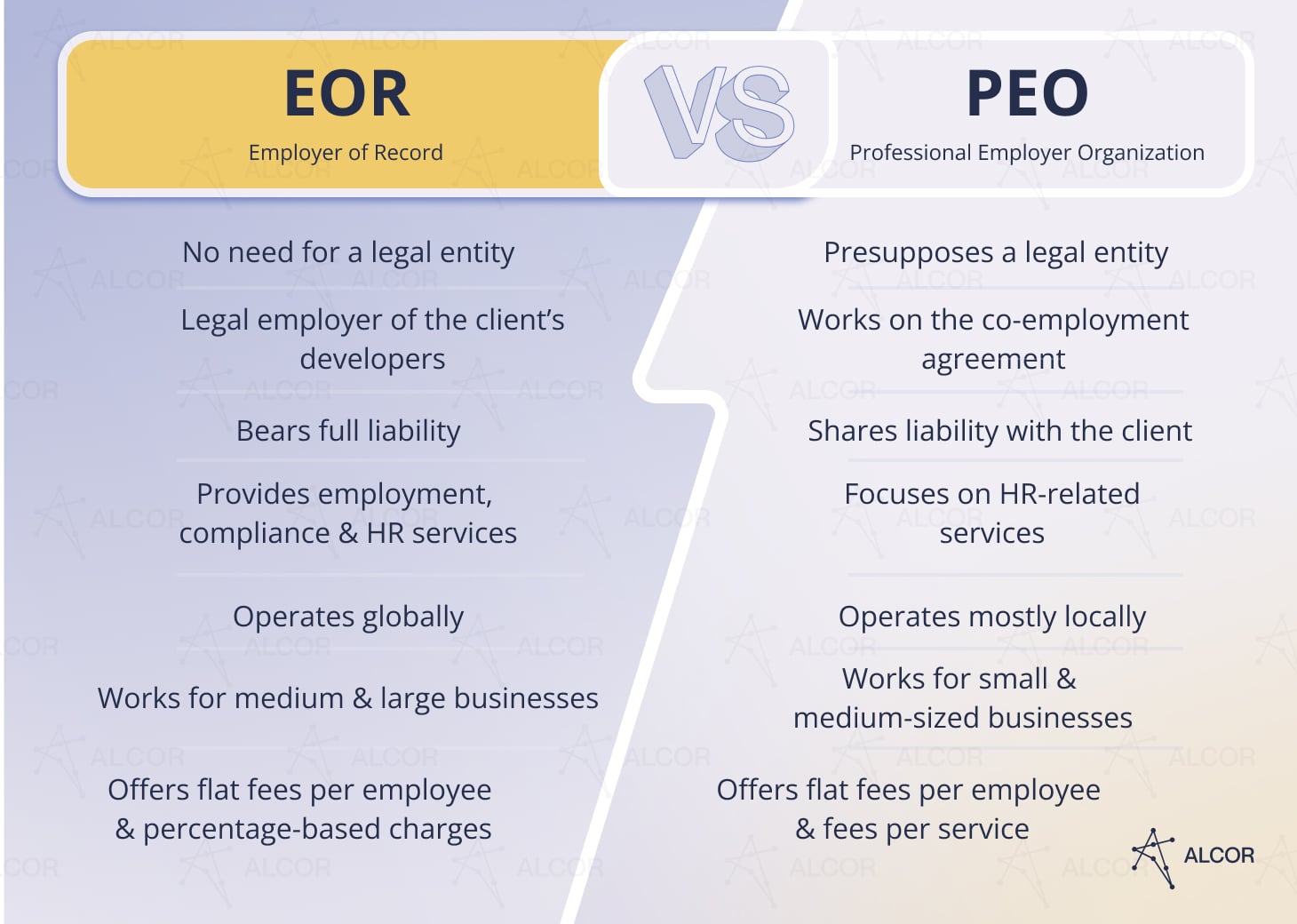
This is why Alcor’s EOR solution has become the preferred model for tech product companies and VC-backed startups entering LATAM and Eastern Europe.
For example, when Franki, the US experience app, needed senior iOS and Android developers, they couldn’t wait for entity registration to complete.
Within the first phase of the partnership with Alcor, Franki got market-based salary benchmarks and a curated shortlist of 20 senior engineers with expertise in RxSwift. Then, we helped them successfully onboard 7 senior engineers, with an average time-to-hire of 4 weeks. Every hire passed probation, all employment remained fully compliant with Mexican labor regulations, and compensation packages, including bonuses, benefits, and paid time off, were handled end-to-end.
Working with their high-performing tech team, Franki doubled its revenue and sustained 30% month-over-month growth throughout 2024.
Alcor takes the EOR model and tunes it specifically for tech product companies and VC-backed startups. Then layers on full software R&D center capabilities & optimizes for today’s AI-driven development cycle, so you’re not managing multiple vendors.
Instead of just “making people legal on paper,” Alcor helps you build and run a real Valley-caliber engineering team in Colombia and other LATAM and Eastern European countries. What’s inside our tech R&D solution?
- End-to-end tech recruitment: Build teams of 30 engineers in 3 months and up to 100 within a year without coordinating multiple recruiters or compromising on talent quality.
- EOR tailored for tech that removes risk, not your control. We eliminate audit exposure, contractor misclassification, and compliance gaps. Get properly structured employment contracts, SLAs, NDAs, IP rights protection & more without adding bureaucratic friction.
- Operational support that actually supports: From hardware to local logistics – our dedicated Customer Ops managers understand your needs and handle everything.
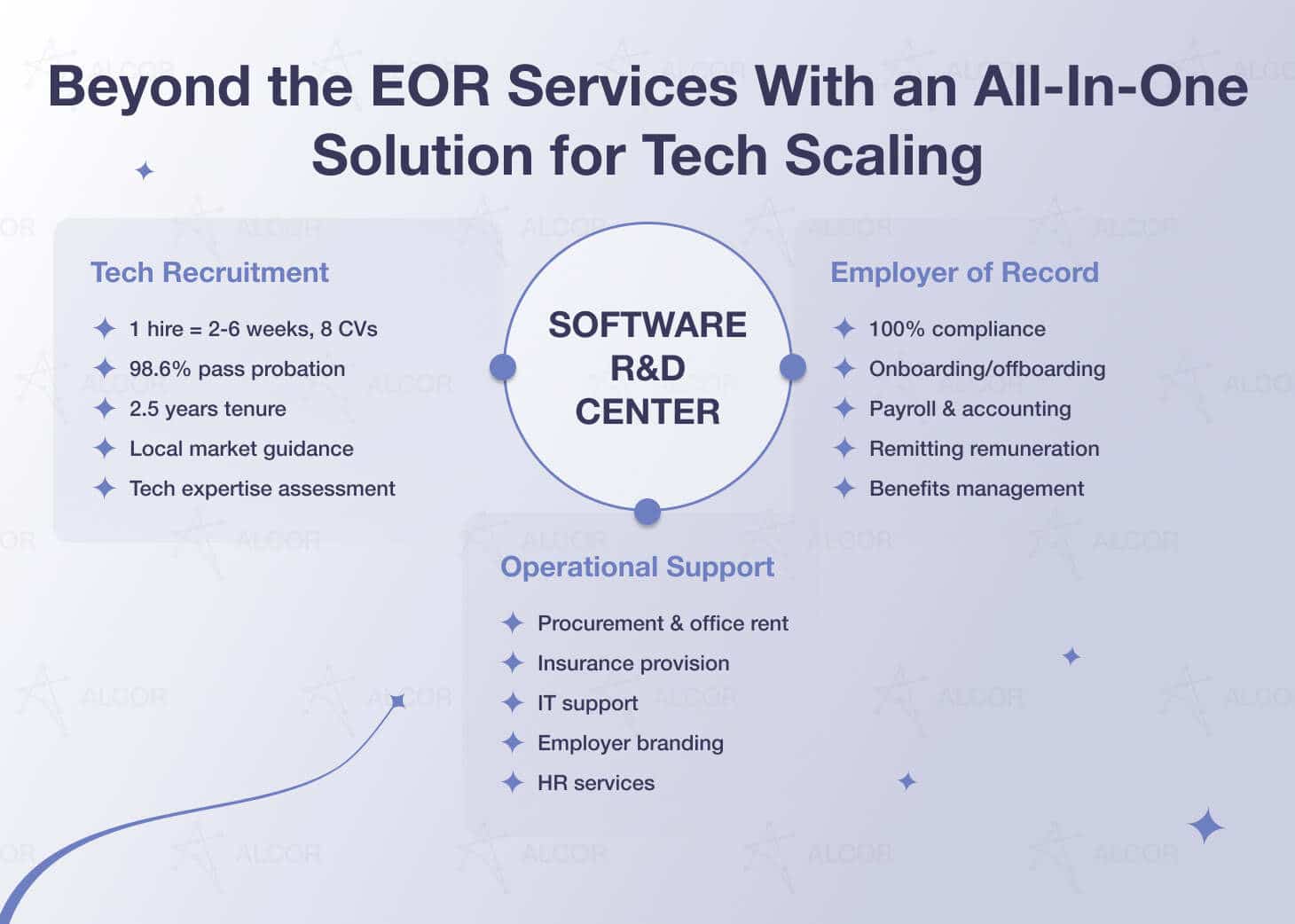
Unicorns like Sift and People.ai have already chosen Alcor to scale their dedicated engineering teams.
If you’re ready to explore what that could look like for your business, let’s talk.